Faculty of Epidemiology and Population Health, London School of Hygiene & Tropical Medicine, London, UK.
Malawi Epidemiology and Intervention Research Unit, Karonga, Malawi.
AIDS. 2020 May 1;34(6):931-941. doi: 10.1097/QAD.0000000000002513.
To assess the validity of self-reported HIV status, and investigate factors that influence accurate reporting of HIV-positive status, in a population tested and informed of their HIV test result.
Prospective cohort study.
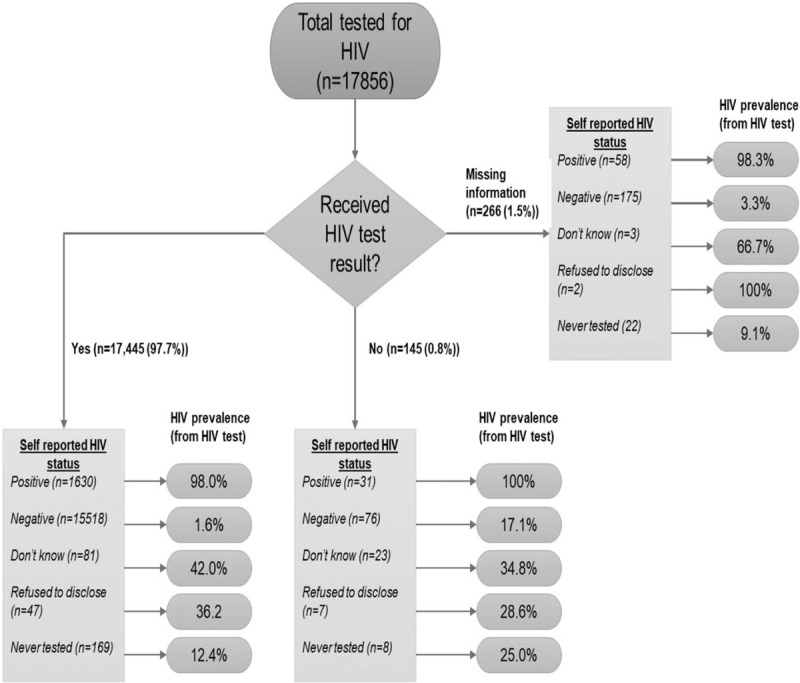
We compared self-reported HIV status with biomarker-confirmed HIV test status among participants of Karonga Health and Demographic Surveillance Site in rural northern Malawi. We linked information on HIV test results to subsequent self-reported HIV status, and calculated sensitivity, specificity, positive predictive value and negative predictive value for self-reported HIV status (considered as a diagnostic test). We used Poisson regression with robust variance estimators to examine predictors of accurate self-reporting of HIV-positive status.
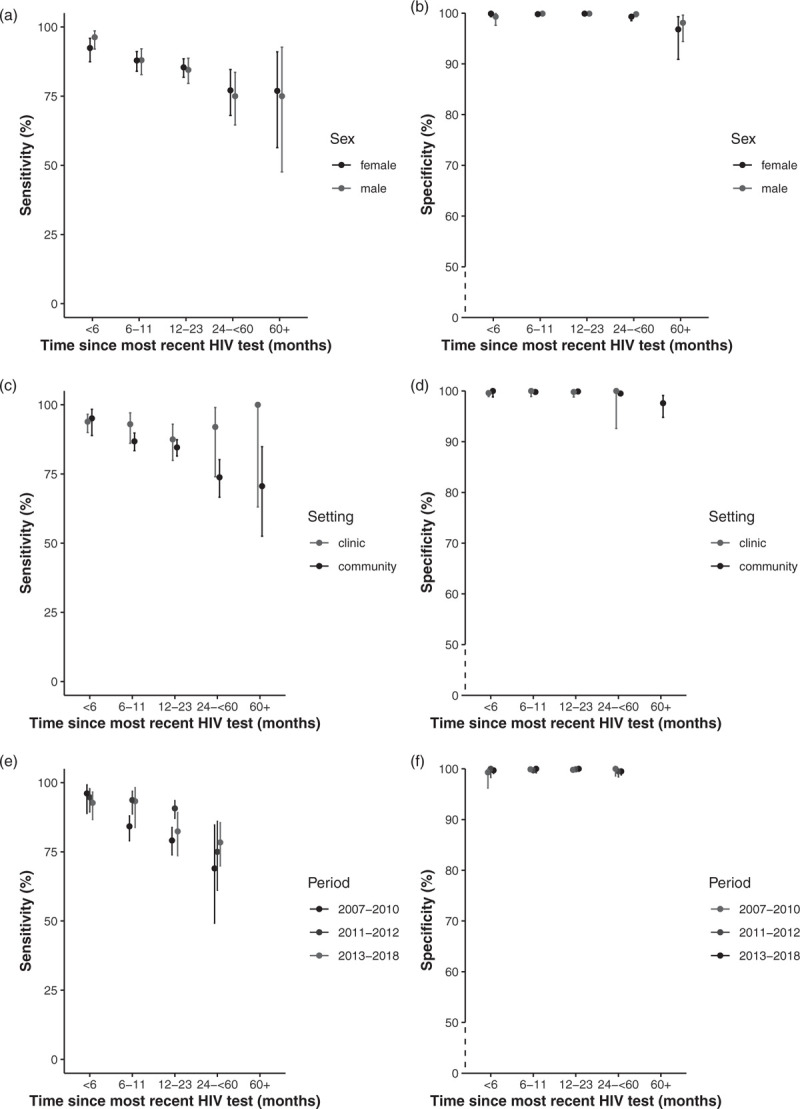
Among 17 445 adults who tested for HIV, were recorded as having received their HIV test results, and had a subsequent self-reported HIV status between 2007 and 2018: positive predictive value of self-reported HIV status was 98.0% (95% confidence interval: 97.3-98.7); negative predictive value was 98.3 (98.1-98.5); sensitivity was 86.1% (84.5-87.7); and specificity was 99.8% (99.7-99.9). Among true HIV-positive people, those who were younger, interviewed in community settings, and had tested for HIV longer ago were more likely to misreport their HIV-positive status.
In this setting, self-report provides good estimates of test-detected HIV prevalence, suggesting that it can be used when HIV test results are not available. Despite frequent HIV testing, younger people and those interviewed in community settings were less likely to accurately report their HIV-positive status. More research on barriers to self-reporting of HIV status is needed in these subgroups.
评估自我报告的 HIV 状态的有效性,并调查影响 HIV 阳性状态准确报告的因素,在接受 HIV 检测并被告知其 HIV 检测结果的人群中。
前瞻性队列研究。
我们比较了马拉维北部农村卡拉翁卫生和人口监测点参与者的自我报告的 HIV 状态与生物标志物确认的 HIV 检测状态。我们将 HIV 检测结果信息与随后的自我报告的 HIV 状态联系起来,并计算了自我报告的 HIV 状态的敏感性、特异性、阳性预测值和阴性预测值(视为诊断测试)。我们使用泊松回归和稳健方差估计量来研究准确报告 HIV 阳性状态的预测因素。
在 2007 年至 2018 年间,17445 名成年人接受了 HIV 检测,记录为已收到 HIV 检测结果,并且随后报告了 HIV 状态:自我报告的 HIV 状态的阳性预测值为 98.0%(95%置信区间:97.3-98.7);阴性预测值为 98.3%(98.1-98.5);敏感性为 86.1%(84.5-87.7);特异性为 99.8%(99.7-99.9)。在真正的 HIV 阳性人群中,年龄较小、在社区环境中接受访谈且 HIV 检测时间较长的人更有可能错误报告其 HIV 阳性状态。
在这种情况下,自我报告提供了 HIV 检测的良好估计,表明在无法获得 HIV 检测结果时可以使用。尽管经常进行 HIV 检测,但年轻人和在社区环境中接受访谈的人更不可能准确报告其 HIV 阳性状态。在这些亚组中,需要更多研究自我报告 HIV 状态的障碍。