Angelini RR&D (Regulatory, Research & Development)-Angelini S.p.A., S. Palomba-Pomezia (Rome), Italy.
Department of Life and Environmental Sciences, Polytechnic University of Marche, Ancona, Italy.
PLoS One. 2020 Feb 19;15(2):e0228509. doi: 10.1371/journal.pone.0228509. eCollection 2020.
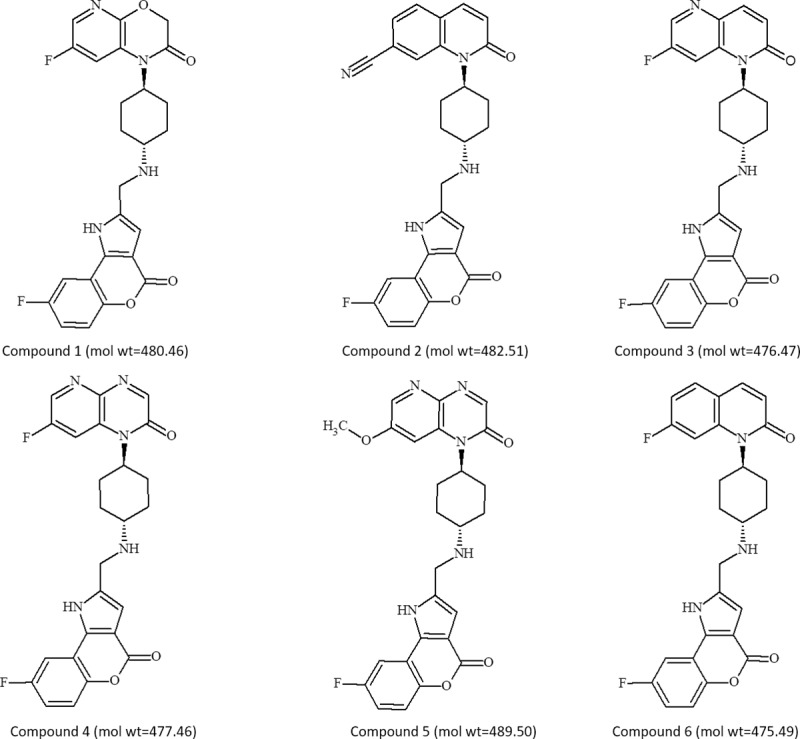
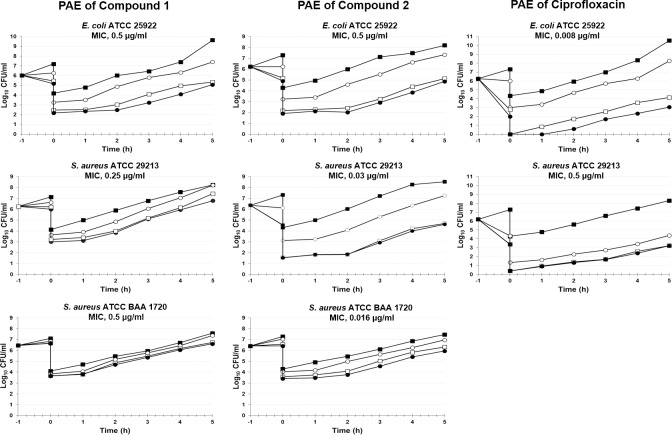
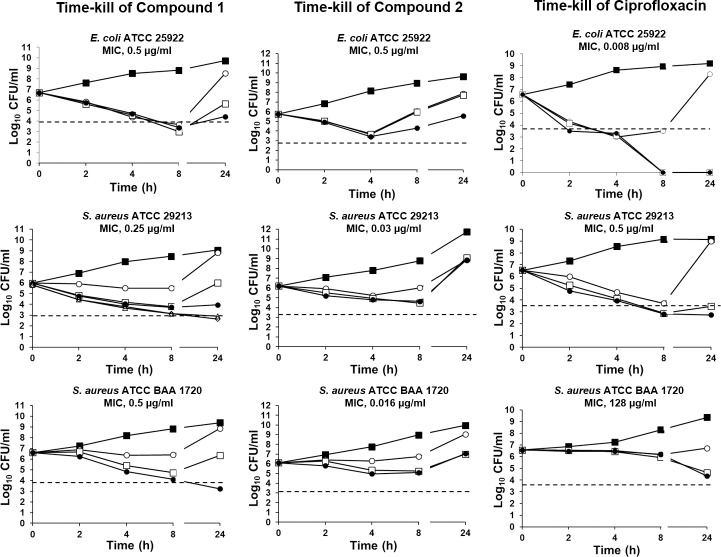
In this study, a drug discovery programme that sought to identify novel dual bacterial topoisomerase II inhibitors (NBTIs) led to the selection of six optimized compounds. In enzymatic assays, the molecules showed equivalent dual-targeting activity against the DNA gyrase and topoisomerase IV enzymes of Staphylococcus aureus and Escherichia coli. Consistently, the compounds demonstrated potent activity in susceptibility tests against various Gram-positive and Gram-negative reference species, including ciprofloxacin-resistant strains. The activity of the compounds against clinical multidrug-resistant isolates of S. aureus, Clostridium difficile, Acinetobacter baumannii, Neisseria gonorrhoeae, E. coli and vancomycin-resistant Enterococcus spp. was also confirmed. Two compounds (1 and 2) were tested in time-kill and post-antibiotic effect (PAE) assays. Compound 1 was bactericidal against all tested reference strains and showed higher activity than ciprofloxacin, and compound 2 showed a prolonged PAE, even against the ciprofloxacin-resistant S. aureus BAA-1720 strain. Spontaneous development of resistance to both compounds was selected for in S. aureus at frequencies comparable to those obtained for quinolones and other NBTIs. S. aureus BAA-1720 mutants resistant to compounds 1 and 2 had single point mutations in gyrA or gyrB outside of the quinolone resistance-determining region (QRDR), confirming the distinct site of action of these NBTIs compared to that of quinolones. Overall, the very good antibacterial activity of the compounds and their optimizable in vitro safety and physicochemical profile may have relevant implications for the development of new broad-spectrum antibiotics.
在这项研究中,一个旨在寻找新型双细菌拓扑异构酶 II 抑制剂 (NBTI) 的药物发现计划导致了六种优化化合物的选择。在酶促测定中,这些分子对金黄色葡萄球菌和大肠杆菌的 DNA 拓扑异构酶和拓扑异构酶 IV 酶显示出等效的双重靶向活性。一致地,这些化合物在针对各种革兰氏阳性和革兰氏阴性参考物种的敏感性测试中表现出强大的活性,包括对环丙沙星耐药株的活性。还证实了这些化合物对临床多药耐药性金黄色葡萄球菌、艰难梭菌、鲍曼不动杆菌、淋病奈瑟菌、大肠杆菌和万古霉素耐药肠球菌分离株的活性。两种化合物(1 和 2)在时间杀伤和抗生素后效应 (PAE) 测定中进行了测试。化合物 1 对所有测试的参考菌株均具有杀菌活性,其活性高于环丙沙星,化合物 2 显示出较长的 PAE,甚至对环丙沙星耐药的金黄色葡萄球菌 BAA-1720 菌株也是如此。在金黄色葡萄球菌中,两种化合物的自发耐药性选择频率与喹诺酮类药物和其他 NBTI 获得的频率相当。对化合物 1 和 2 耐药的金黄色葡萄球菌 BAA-1720 突变体在喹诺酮耐药决定区 (QRDR) 之外的 gyrA 或 gyrB 中有单点突变,证实了这些 NBTI 与喹诺酮类药物的作用部位不同。总的来说,这些化合物具有非常好的抗菌活性,其体外安全性和理化特性可优化,这可能对开发新的广谱抗生素具有重要意义。