Graduate School of Environmental and Human Science, Meijo University, 150 Yagotoyama, Tempaku, Nagoya 468-8503, Japan.
Faculty of Pharmacy, Meijo University, 150 Yagotoyama, Tempaku. Nagoya 468-8503, Japan.
Molecules. 2020 Feb 14;25(4):832. doi: 10.3390/molecules25040832.
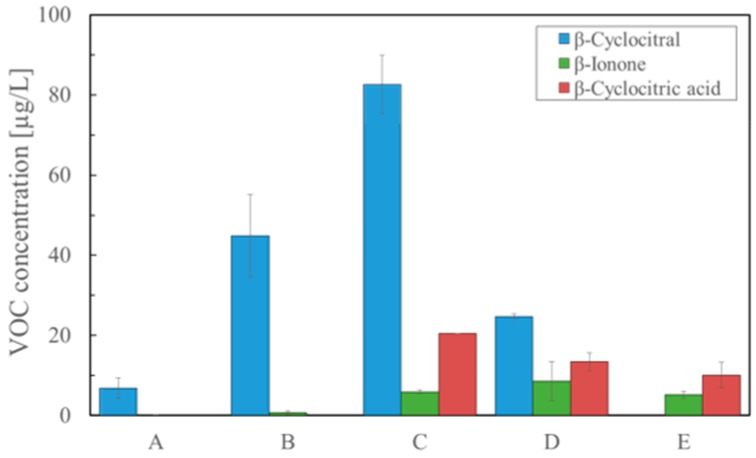
β-Cyclocitral, specifically produced by , is one of the volatile organic compounds (VOCs) derived from cyanobacteria and has a lytic activity. It is postulated that β-cyclocitral is a key compound for regulating the occurrence of cyanobacteria and related microorganisms in an aquatic environment. β-Cyclocitral is sensitively detected when a high density of the cells is achieved from late summer to autumn. Moreover, it is expected to be involved in changes in the species composition of cyanobacteria in a lake. Although several analysis methods for β-cyclocitral have already been reported, β-cyclocitral could be detected using only solid phase micro-extraction (SPME), whereas it could not be found at all using the solvent extraction method in a previous study. In this study, we investigated why β-cyclocitral was detected using only SPME GC/MS. Particularly, three operations in SPME, i.e., extraction temperature, sample stirring rate, and the effect of salt, were examined for the production of β-cyclocitral. Among these, heating (60 °C) was critical for the β-cyclocitral formation. Furthermore, acidification with a 1-h storage was more effective than heating when comparing the obtained amounts. The present results indicated that β-cyclocitral did not exist as the intact form in cells, because it was formed by heating or acidification of the resulting intermediates during the analysis by SPME. The obtained results would be helpful to understand the formation and role of β-cyclocitral in an aquatic environment.
β-环柠檬醛是由 产生的挥发性有机化合物(VOCs)之一,具有裂解活性。据推测,β-环柠檬醛是调节水生态系统中蓝藻及相关微生物发生的关键化合物。当细胞密度在夏末至秋季达到高值时,β-环柠檬醛能被灵敏地检测到。此外,它有望参与湖泊中蓝藻物种组成的变化。虽然已经报道了几种β-环柠檬醛的分析方法,但在之前的研究中,仅使用固相微萃取(SPME)可以检测到β-环柠檬醛,而使用溶剂萃取法则完全无法检测到。在这项研究中,我们研究了为什么仅使用 SPME-GC/MS 就可以检测到β-环柠檬醛。特别是,研究了 SPME 中的三个操作,即萃取温度、样品搅拌速率和盐的影响,以研究β-环柠檬醛的产生。其中,加热(60°C)对于β-环柠檬醛的形成至关重要。此外,与加热相比,酸化并在 1 小时内储存更有效。结果表明,β-环柠檬醛不存在于细胞中完整的形式,因为它是在 SPME 分析过程中通过加热或酸化中间产物形成的。这些结果有助于理解β-环柠檬醛在水生态系统中的形成和作用。