Weidner-Glunde Magdalena, Kruminis-Kaszkiel Ewa, Savanagouder Mamata
Department of Reproductive Immunology and Pathology, Institute of Animal Reproduction and Food Research of Polish Academy of Sciences, Tuwima Str. 10, 10-748 Olsztyn, Poland.
Pathogens. 2020 Feb 15;9(2):125. doi: 10.3390/pathogens9020125.
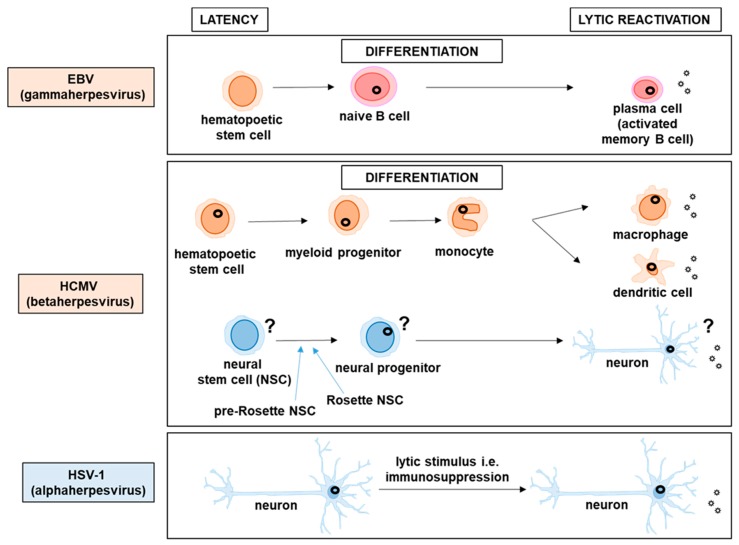
Latency establishment is the hallmark feature of herpesviruses, a group of viruses, of which nine are known to infect humans. They have co-evolved alongside their hosts, and mastered manipulation of cellular pathways and tweaking various processes to their advantage. As a result, they are very well adapted to persistence. The members of the three subfamilies belonging to the family Herpesviridae differ with regard to cell tropism, target cells for the latent reservoir, and characteristics of the infection. The mechanisms governing the latent state also seem quite different. Our knowledge about latency is most complete for the gammaherpesviruses due to previously missing adequate latency models for the alpha and beta-herpesviruses. Nevertheless, with advances in cell biology and the availability of appropriate cell-culture and animal models, the common features of the latency in the different subfamilies began to emerge. Three criteria have been set forth to define latency and differentiate it from persistent or abortive infection: 1) persistence of the viral genome, 2) limited viral gene expression with no viral particle production, and 3) the ability to reactivate to a lytic cycle. This review discusses these criteria for each of the subfamilies and highlights the common strategies adopted by herpesviruses to establish latency.
潜伏期的建立是疱疹病毒的标志性特征,疱疹病毒是一类病毒,已知其中有九种可感染人类。它们与宿主共同进化,掌握了对细胞通路的操控并调整各种过程以使其自身受益。因此,它们非常适应持续性感染。疱疹病毒科三个亚科的成员在细胞嗜性、潜伏库的靶细胞以及感染特征方面存在差异。控制潜伏状态的机制似乎也大不相同。由于先前缺乏适用于α和β疱疹病毒的潜伏期模型,我们对γ疱疹病毒潜伏期的了解最为全面。然而,随着细胞生物学的进展以及合适的细胞培养和动物模型的出现,不同亚科潜伏期的共同特征开始显现。已经提出了三个标准来定义潜伏期并将其与持续性或顿挫性感染区分开来:1)病毒基因组的持续性,2)有限的病毒基因表达且无病毒颗粒产生,3)重新激活进入裂解周期的能力。本综述讨论了每个亚科的这些标准,并强调了疱疹病毒建立潜伏期所采用的共同策略。