Department of Ecology, Evolution and Behavior, Alexander Silberman Institute of Life Sciences, Faculty of Science, The Hebrew University of Jerusalem, Jerusalem 9190401, Israel.
Viruses. 2020 Feb 15;12(2):218. doi: 10.3390/v12020218.
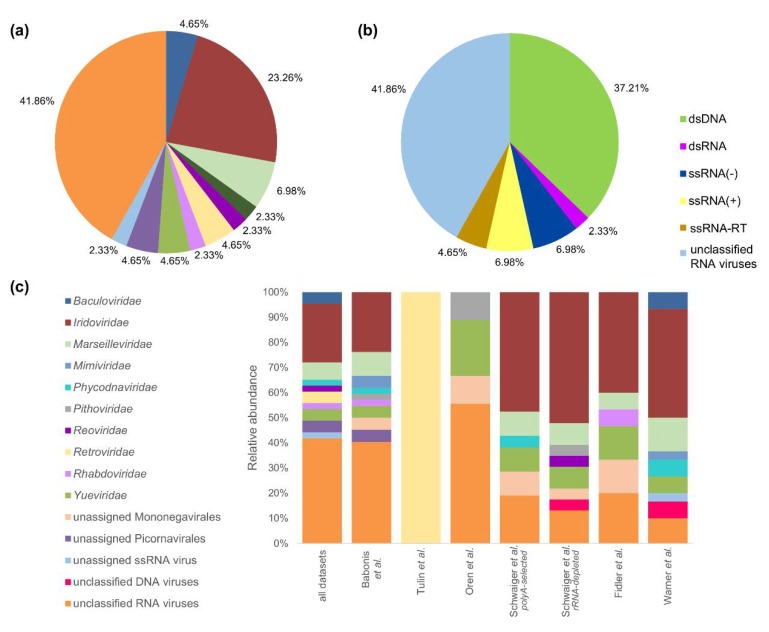
The role of viruses in forming a stable holobiont has been the subject of extensive research in recent years. However, many emerging model organisms still lack any data on the composition of the associated viral communities. Here, we re-analyzed seven publicly available transcriptome datasets of the starlet sea anemone , the most commonly used anthozoan lab model, and searched for viral sequences. We applied a straightforward, yet powerful approach of de novo assembly followed by homology-based virus identification and a multi-step, thorough taxonomic validation. The comparison of different lab populations of revealed the existence of the core virome composed of 21 viral sequences, present in all adult datasets. Unexpectedly, we observed an almost complete lack of viruses in the samples from the early developmental stages, which together with the identification of the viruses shared with the major source of the food in the lab, the brine shrimp , shed new light on the course of viral species acquisition in . Our study provides an initial, yet comprehensive insight into virome and sets the first foundation for the functional studies of viruses and antiviral systems in this lab model cnidarian.
近年来,病毒在形成稳定的全生物群中的作用一直是广泛研究的主题。然而,许多新兴的模式生物仍然缺乏有关相关病毒群落组成的任何数据。在这里,我们重新分析了七种已公开的明星海葵转录组数据集,明星海葵是最常用的珊瑚虫实验室模型,并搜索病毒序列。我们应用了一种简单而强大的方法,即从头组装,然后基于同源性进行病毒识别,以及多步骤、彻底的分类学验证。对不同实验室种群的比较表明,存在由 21 条病毒序列组成的核心病毒组,存在于所有成年数据集。出乎意料的是,我们在早期发育阶段的样本中几乎观察不到病毒的存在,这与在实验室主要食物来源丰年虾中鉴定出的病毒一起,为明星海葵中病毒种获得的过程提供了新的认识。我们的研究首次全面深入地了解了明星海葵的病毒组,并为该实验室模式刺胞动物的病毒和抗病毒系统的功能研究奠定了基础。