Department of Gastroenterology and Hepatology, Nagasaki University Graduate School of Biomedical Sciences, 1-7-1 Sakamoto, Nagasaki, 852-8501, Japan.
Department of Pediatrics, Shimane University Faculty of Medicine, 89-1 Enya, Izumo, Shimane, 693-8501, Japan.
BMC Gastroenterol. 2020 Feb 19;20(1):41. doi: 10.1186/s12876-020-01190-6.
The level and profiles of blood free carnitine and acylcarnitines, obtained by acylcarnitine analysis using tandem mass spectrometry, reflect various metabolic conditions. We aimed to examine the level of free carnitine and acylcarnitines in liver cirrhosis patients by acylcarnitine analysis and determine the clinical and subjective factors associated with blood carnitine fraction levels in liver cirrhosis.
We compared blood carnitine fractions in 54 liver cirrhotic patients to other laboratory test results and questionnaire answers.
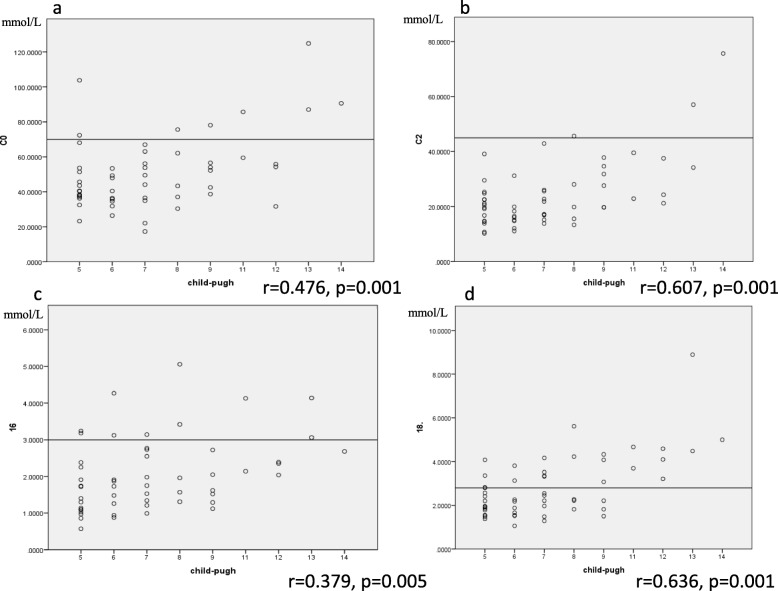
In almost all patients, the blood levels of free carnitine (C0) and acetylcarnitine (C2) were within the normal reference range. However, in some patients, the levels of long-chain acylcarnitines, such as C16 and C18:1-acylcarnitine, were higher than the normal reference range. Liver function, assessed by Child-Pugh score, was significantly correlated with the blood level of each carnitine fraction measured (C0, C2, C3, C4, C6, C10, C12, C12:1, C14:1, C16, C18:1, and C18:2-acylcarnitine). Cirrhotic symptom score was significantly correlated with C0, C2, C3, C16, and C18-1-acylcarnitine blood levels. Among the 36-item short-form health survey (SF-36) items, the physical component summary was significantly associated with C0, C2, and C18-1-acylcarnitine blood levels.
Carnitine fraction levels were positively correlated with liver cirrhosis stage, particularly, long-chain acylcarnitines. Moreover, carnitine fraction levels were associated with various subjective physical symptoms in liver cirrhosis patients.
通过串联质谱法进行酰基肉碱分析获得的血游离肉碱和酰基肉碱水平反映了各种代谢情况。我们旨在通过酰基肉碱分析检查肝硬化患者的游离肉碱和酰基肉碱水平,并确定与肝硬化患者血肉碱分数水平相关的临床和主观因素。
我们将 54 例肝硬化患者的血肉碱分数与其他实验室检查结果和问卷调查答案进行了比较。
几乎所有患者的游离肉碱(C0)和乙酰肉碱(C2)血水平均在正常参考范围内。然而,在一些患者中,长链酰基肉碱(如 C16 和 C18:1-酰基肉碱)的水平高于正常参考范围。肝功能(通过 Child-Pugh 评分评估)与所测每种肉碱分数(C0、C2、C3、C4、C6、C10、C12、C12:1、C14:1、C16、C18:1 和 C18:2-酰基肉碱)的血水平显著相关。肝硬化症状评分与 C0、C2、C3、C16 和 C18:1-酰基肉碱的血水平显著相关。在 36 项简明健康调查问卷(SF-36)项目中,生理成分综合评分与 C0、C2 和 C18:1-酰基肉碱的血水平显著相关。
肉碱分数与肝硬化分期呈正相关,尤其是长链酰基肉碱。此外,肉碱分数与肝硬化患者的各种主观躯体症状相关。