Department of Medicine, University of Hong Kong, Hong Kong, China and.
Department of Pharmacology and Pharmacy, University of Hong Kong, Hong Kong, China.
Clin J Am Soc Nephrol. 2020 Mar 6;15(3):359-366. doi: 10.2215/CJN.11710919. Epub 2020 Feb 19.
Protein carbamylation is a consequence of uremia and carbamylated lipoproteins contribute to atherogenesis in CKD. Proteins can also be carbamylated by a urea-independent mechanism, and whether carbamylated lipoproteins contribute to the progression of CKD has not been investigated.
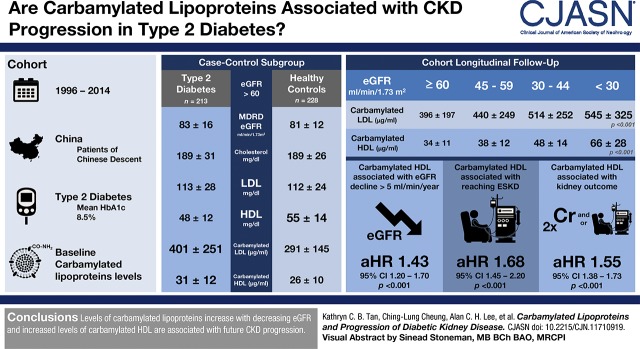
DESIGN, SETTING, PARTICIPANTS, & MEASUREMENTS: A case-control study was performed to determine whether there were changes in plasma levels of carbamylated lipoproteins in individuals with type 2 diabetes with eGFR >60 ml/min per 1.73 m compared with a group of age- and sex-matched healthy controls. A cohort of 1320 patients with type 2 diabetes with baseline eGFR ≥30 ml/min per 1.73 m was longitudinally followed up to evaluate the association between carbamylated lipoproteins and progression of CKD. The primary kidney outcome was defined as doubling of serum creatinine and/or initiation of KRT during follow-up. Plasma carbamylated LDLs and HDLs was measured by ELISA.
In individuals with diabetes with eGFR >60 ml/min per 1.73 m, both plasma carbamylated LDL and HDL levels were higher compared with healthy controls (<0.001). After a mean follow-up of 9 years of the diabetic cohort, individuals in the top quartile of carbamylated LDL (hazard ratio, 2.21; 95% confidence interval, 1.42 to 3.46; <0.001) and carbamylated HDL (hazard ratio, 4.53; 95% confidence interval, 2.87 to 7.13; <0.001) had higher risk of deterioration of kidney function compared with those in the lowest quartile. On multivariable Cox regression analysis, plasma carbamylated LDL was no longer associated with kidney outcome after adjusting for baseline eGFR and potential confounding factors. However, the association between plasma carbamylated HDL and kidney outcome remained significant and was independent of HDL cholesterol.
Plasma carbamylated HDL but not carbamylated LDL was independently associated with progression of CKD in patients with type 2 diabetes.
蛋白质氨甲酰化是尿毒症的后果,氨甲酰化脂蛋白有助于 CKD 中的动脉粥样硬化形成。蛋白质也可以通过非尿素依赖的机制发生氨甲酰化,而氨甲酰化脂蛋白是否有助于 CKD 的进展尚未得到研究。
设计、设置、参与者和测量:进行了一项病例对照研究,以确定在 eGFR>60 ml/min/1.73 m 的 2 型糖尿病个体中,与年龄和性别匹配的健康对照组相比,血浆中氨甲酰化脂蛋白水平是否发生变化。对基线 eGFR≥30 ml/min/1.73 m 的 1320 例 2 型糖尿病患者进行了纵向随访,以评估氨甲酰化脂蛋白与 CKD 进展之间的关系。主要肾脏结局定义为随访期间血清肌酐加倍和/或开始 KRT。通过 ELISA 测量血浆氨甲酰化 LDL 和 HDL。
在 eGFR>60 ml/min/1.73 m 的糖尿病患者中,与健康对照组相比(<0.001),血浆氨甲酰化 LDL 和 HDL 水平均升高。在糖尿病队列的平均 9 年随访后,在氨甲酰化 LDL(风险比,2.21;95%置信区间,1.42 至 3.46;<0.001)和氨甲酰化 HDL(风险比,4.53;95%置信区间,2.87 至 7.13;<0.001)的四分位中,肾功能恶化的风险更高。在多变量 Cox 回归分析中,在校正基线 eGFR 和潜在混杂因素后,血浆氨甲酰化 LDL 与肾脏结局不再相关。然而,血浆氨甲酰化 HDL 与肾脏结局之间的关联仍然显著,并且独立于 HDL 胆固醇。
在 2 型糖尿病患者中,血浆氨甲酰化 HDL 而不是氨甲酰化 LDL 与 CKD 的进展独立相关。