Clinica Ortopedica e Traumatologica II IRCCS Istituto Ortopedico Rizzoli, Bologna, Italy.
Servizio Trasfusionale Unico Metropolitano, Bologna, Italy.
Biomed Res Int. 2020 Jan 31;2020:8243865. doi: 10.1155/2020/8243865. eCollection 2020.
To evaluate a cohort of sport-active patients suffering from cartilage degeneration and OA, in terms of clinical outcome and return to sport (RTS) after platelet-rich plasma (PRP) injective treatment.
This study included forty-seven sport-active patients ≤50 years old with unilateral symptomatic knee cartilage degeneration or OA. Patients received 3 PRP injections and were prospectively evaluated at baseline and then at 2, 6, 12, and 24 months follow-up by IKDC subjective EQ-VAS, and Tegner scores. Furthermore, patients were asked about their RTS, in terms of return to any sport level or to their activity level before symptoms onset.
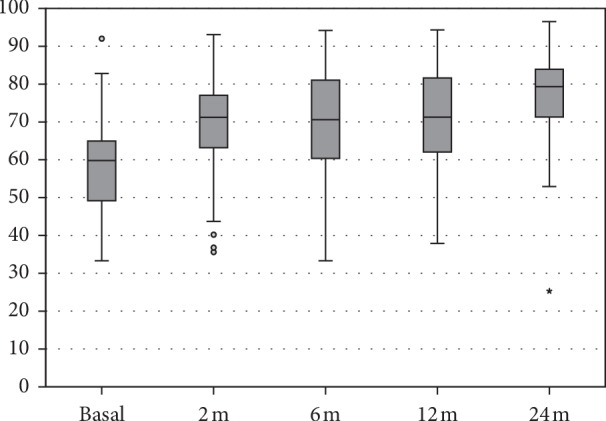
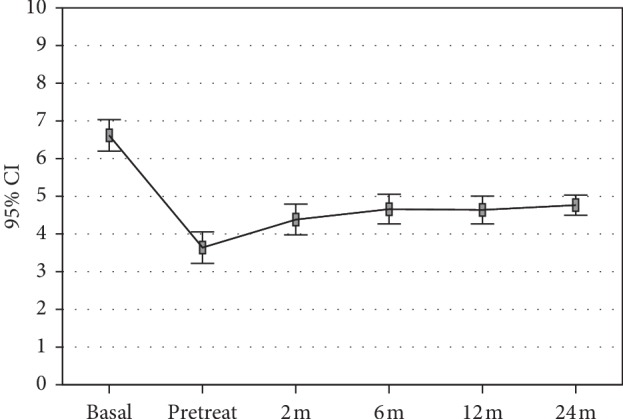
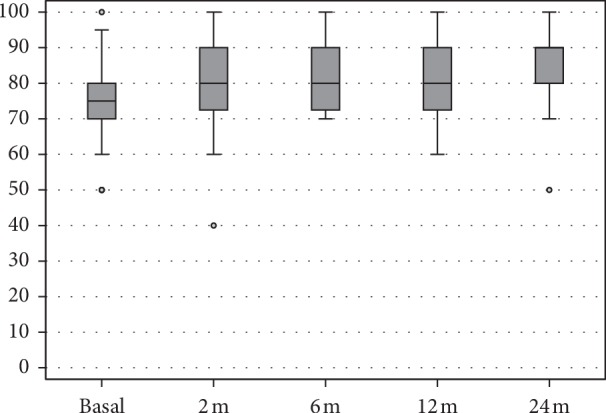
IKDC subjective score improved significantly at all follow-ups, changing from 59.2 ± 13.6 to 70.6 ± 13 at 12 months and to 76.7 ± 12.5 at 24 months ( < 0.0005). A similar outcome was observed with the EQ-VAS score. Tegner score improved from 3.6 ± 1.4 to 4.8 ± 0.9 at 24 months ( < 0.0005). A similar outcome was observed with the EQ-VAS score. Tegner score improved from 3.6 ± 1.4 to 4.8 ± 0.9 at 24 months ( < 0.0005). A similar outcome was observed with the EQ-VAS score. Tegner score improved from 3.6 ± 1.4 to 4.8 ± 0.9 at 24 months ( < 0.0005). A similar outcome was observed with the EQ-VAS score. Tegner score improved from 3.6 ± 1.4 to 4.8 ± 0.9 at 24 months (.
Sport-active patients affected by knee OA can benefit from PRP injections, with pain and function improvement over time. However, results are less satisfactory in terms of RTS since only half can achieve the same sport level as before the onset of symptoms. Patients undergoing PRP treatment should be made aware of their low chances to go back to high-impact sport activities.
评估一组患有软骨退变和 OA 的运动活跃患者,评估其在接受富含血小板的血浆(PRP)注射治疗后的临床结果和重返运动(RTS)情况。
本研究纳入了 47 名年龄≤50 岁的单侧膝关节软骨退变或 OA 症状性运动活跃患者。患者接受了 3 次 PRP 注射,并在基线时以及 2、6、12 和 24 个月的随访时,通过 IKDC 主观 EQ-VAS 和 Tegner 评分进行前瞻性评估。此外,患者被问及他们的 RTS,即返回任何运动水平或返回症状发作前的活动水平。
IKDC 主观评分在所有随访中均显著改善,从 12 个月时的 59.2±13.6 改善至 70.6±13,24 个月时改善至 76.7±12.5(<0.0005)。EQ-VAS 评分也观察到类似的结果。Tegner 评分从基线时的 3.6±1.4 改善至 24 个月时的 4.8±0.9(<0.0005)。EQ-VAS 评分也观察到类似的结果。Tegner 评分从基线时的 3.6±1.4 改善至 24 个月时的 4.8±0.9(<0.0005)。EQ-VAS 评分也观察到类似的结果。Tegner 评分从基线时的 3.6±1.4 改善至 24 个月时的 4.8±0.9(<0.0005)。EQ-VAS 评分也观察到类似的结果。
受膝骨关节炎影响的运动活跃患者可从 PRP 注射中获益,随着时间的推移,疼痛和功能得到改善。然而,在 RTS 方面的结果则不那么令人满意,因为只有一半的患者能够恢复到症状发作前的相同运动水平。接受 PRP 治疗的患者应意识到他们重返高影响运动活动的机会较低。