Boffa Angelo, Andriolo Luca, Franceschini Marco, Martino Alessandro Di, Asunis Emanuela, Grassi Alberto, Zaffagnini Stefano, Filardo Giuseppe
Clinica Ortopedica e Traumatologica 2, IRCCS Istituto Ortopedico Rizzoli, Bologna, Italy.
Applied and Translational Research Center, IRCCS Istituto Ortopedico Rizzoli, Bologna, Italy.
Orthop J Sports Med. 2021 Oct 5;9(10):23259671211026242. doi: 10.1177/23259671211026242. eCollection 2021 Oct.
Although several injection-based treatments have been proposed to address knee osteoarthritis (OA), it is often difficult to understand the clinical relevance of the obtained results. The psychometric measures of minimal clinically important difference (MCID) and Patient Acceptable Symptom State (PASS) were developed to better interpret study findings.
To establish the MCID and the PASS for the International Knee Documentation Committee (IKDC) Subjective score and the Knee injury and Osteoarthritis Outcome Score (KOOS) in patients treated with intra-articular platelet-rich plasma (PRP) injections for knee OA.
Case series; Level of evidence, 4.
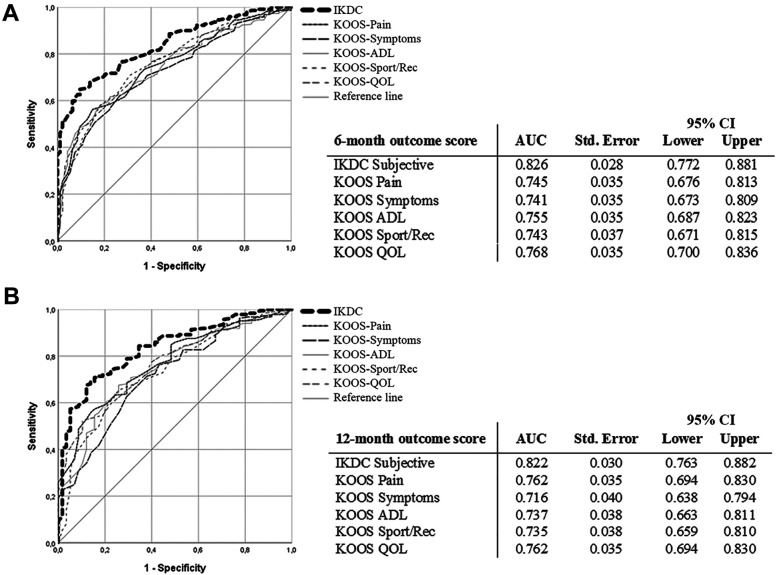
This study included 215 patients with knee OA (68% men, 32% women; age, 53.2 ± 11.3 years; body mass index, 26.8 ± 4.3 kg/m) who underwent intra-articular PRP injections. Patients were assessed through the IKDC Subjective score and KOOS subscales, and the MCID and the PASS for both measures were independently calculated at 6 and 12 months post-injection. The MCID was calculated using the value equal to half of the standard deviation of the overall cohort improvement. The PASS was assessed using a 2-point scale ( or ), with threshold values being detected through a receiver operating characteristic curve analysis and the Youden index to maximize the sensitivity and the specificity of the threshold values.
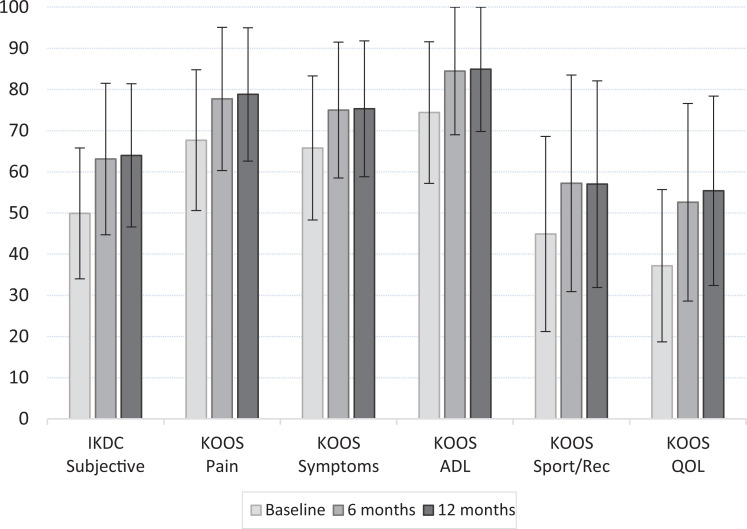
All scores improved significantly from baseline to 6 months and baseline to 12 months ( < .001 for all scores). All scores were stable from 6 to 12 months except for the KOOS Quality of Life subscale, which improved further ( = .033). For the IKDC, the MCID values were 8.6 and 8.5 points and the PASS scores were 59.7 and 62.1 at 6 and 12 months, respectively. Overall, the MCID and the PASS for all KOOS subscales remained constant at the 2 follow-up points. The percentage of patients who achieved the MCID and the PASS was higher than 85% at both 6 and 12 months post-injection.
This study provided the MCID and PASS thresholds for the IKDC and KOOS scores in patients with knee OA treated with PRP injections. These psychometric measures may allow a better interpretation of the clinical relevance of injection-based treatment outcomes for knee OA.
尽管已经提出了几种基于注射的治疗方法来解决膝关节骨关节炎(OA),但通常很难理解所获结果的临床相关性。最小临床重要差异(MCID)和患者可接受症状状态(PASS)的心理测量方法被开发出来以更好地解释研究结果。
确定接受关节内注射富血小板血浆(PRP)治疗膝关节OA患者的国际膝关节文献委员会(IKDC)主观评分以及膝关节损伤和骨关节炎疗效评分(KOOS)的MCID和PASS。
病例系列;证据等级,4级。
本研究纳入了215例膝关节OA患者(68%为男性,32%为女性;年龄53.2±11.3岁;体重指数26.8±4.3kg/m²),这些患者接受了关节内PRP注射。通过IKDC主观评分和KOOS子量表对患者进行评估,并在注射后6个月和12个月分别独立计算这两种测量方法的MCID和PASS。MCID使用等于整个队列改善标准差一半的值来计算。PASS使用2分制(是或否)进行评估,通过受试者工作特征曲线分析和约登指数检测阈值,以最大化阈值的敏感性和特异性。
从基线到6个月以及从基线到12个月,所有评分均有显著改善(所有评分P<0.001)。除KOOS生活质量子量表进一步改善外(P=0.033),所有评分从6个月到12个月保持稳定。对于IKDC,6个月和12个月时的MCID值分别为8.6分和8.5分,PASS评分分别为59.7分和62.1分。总体而言,在两个随访点,所有KOOS子量表的MCID和PASS保持不变。在注射后6个月和12个月,达到MCID和PASS的患者百分比均高于85%。
本研究提供了接受PRP注射治疗的膝关节OA患者IKDC和KOOS评分的MCID和PASS阈值。这些心理测量方法可能有助于更好地解释基于注射的膝关节OA治疗结果的临床相关性。