Korpershoek Jasmijn V, Vonk Lucienne A, Filardo Giuseppe, Kester Esmee C, van Egmond Nienke, Saris Daniël B F, Custers Roel J H
Department of Orthopaedics, University Medical Center Utrecht, Utrecht, the Netherlands.
Service of Orthopaedics and Traumatology, Department of Surgery, EOC, Lugano, Switzerland.
Orthop J Sports Med. 2023 Jul 28;11(7):23259671231184848. doi: 10.1177/23259671231184848. eCollection 2023 Jul.
Autologous conditioned plasma (ACP) is a commercially available platelet concentrate with promising results from clinical trials.
To evaluate the clinical outcome after 3 consecutive injections of ACP in patients with knee osteoarthritis (OA) and study the influence of ACP composition and different patient factors as predictors of treatment effect.
Case series; Level of evidence, 4.
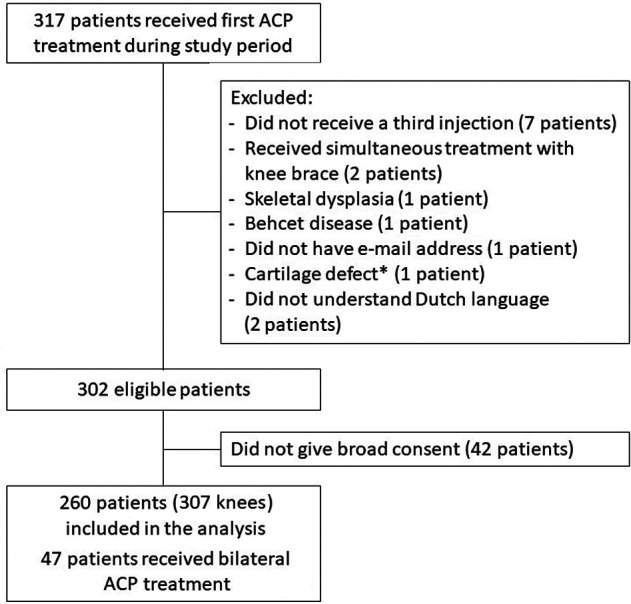
This prospective case series included 260 patients (307 knees) who received ACP treatment for knee OA. The mean patient age was 51 ± 10 years. Improvement up to 12 months' follow-up was measured using the Knee injury and Osteoarthritis Outcome Score (KOOS). ACP composition was analyzed in 100 patients. The predictive value of age, sex, history of knee trauma, Kellgren-Lawrence OA grade, body mass index, and ACP composition was evaluated using generalized estimating equations.
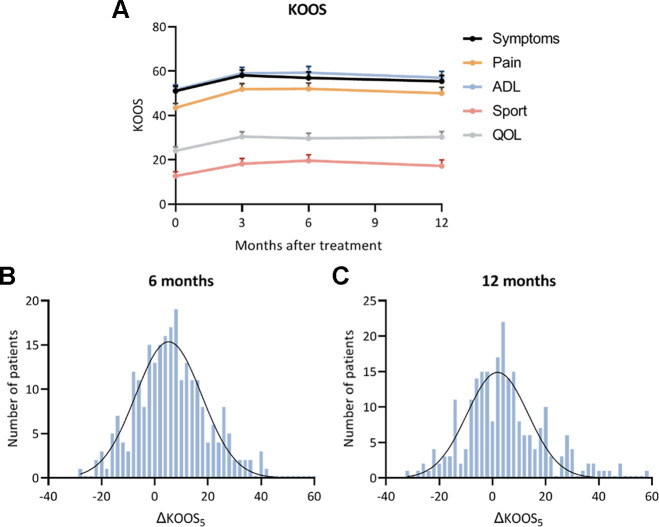
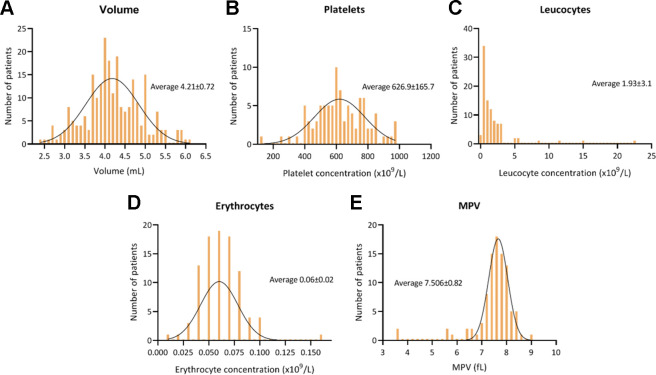
The mean overall KOOS improved from 38 ± 14 at baseline to 45 ± 18 at 3 months, 45 ± 18 at 6 months, and 43 ± 18 at 12 months (all < .05); 40% of patients achieved an improvement above the minimal clinically important difference (MCID) of 8 after 6 months and 33% after 12 months. The variation in ACP composition did not correlate with KOOS ( > .05). Older age led to a greater clinical benefit (β = 0.27; = .05), whereas bilateral treatment predicted worse outcomes (β = -5.6; < .05).
The improvement in KOOS after treatment with ACP did not reach the MCID in most study patients. Older age was a predictor for better outcomes. The composition of ACP varied between patients but did not predict outcomes within the evaluated range. The study findings show the limited benefit of ACP treatment for knee OA and call for caution with routine use in clinical practice.
自体浓缩血浆(ACP)是一种市售的血小板浓缩物,临床试验结果令人鼓舞。
评估连续3次注射ACP对膝骨关节炎(OA)患者的临床疗效,并研究ACP成分及不同患者因素对治疗效果预测的影响。
病例系列;证据等级,4级。
本前瞻性病例系列纳入260例接受ACP治疗膝OA的患者(307个膝关节)。患者平均年龄为51±10岁。使用膝关节损伤和骨关节炎疗效评分(KOOS)评估至12个月随访时的改善情况。对100例患者的ACP成分进行分析。使用广义估计方程评估年龄、性别、膝关节创伤史、凯尔格伦-劳伦斯OA分级、体重指数和ACP成分的预测价值。
KOOS平均总分从基线时的38±14提高到3个月时的45±18、6个月时的45±18和12个月时的43±18(均P<0.05);40%的患者在6个月后改善超过最小临床重要差异(MCID)8,12个月后为33%。ACP成分的差异与KOOS不相关(P>0.05)。年龄较大带来更大的临床获益(β=0.27;P=0.05),而双侧治疗预示结果较差(β=-5.6;P<0.05)。
在大多数研究患者中,ACP治疗后KOOS的改善未达到MCID。年龄较大是预后较好的预测因素。患者间ACP成分存在差异,但在评估范围内不能预测预后。研究结果表明ACP治疗膝OA的益处有限,临床实践中应谨慎常规使用。