Office on Smoking and Health, National Center for Chronic Disease Prevention and Health Promotion, CDC.
MMWR Morb Mortal Wkly Rep. 2020 Feb 21;69(7):189-192. doi: 10.15585/mmwr.mm6907a3.
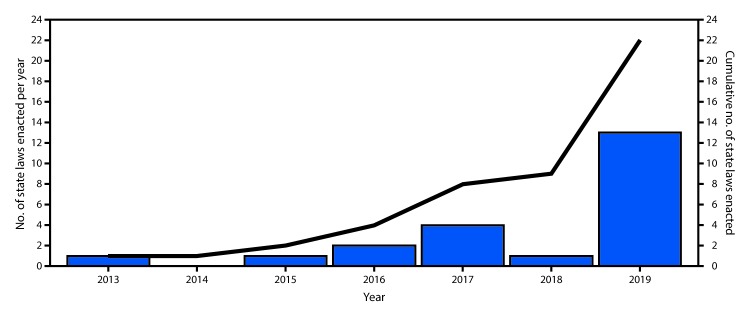
Raising the minimum legal sales age (MLSA) for tobacco products to 21 years (T21) is a strategy to help prevent and delay the initiation of tobacco product use (1). On December 20, 2019, Congress raised the federal MLSA for tobacco products from 18 to 21 years. Before enactment of the federal T21 law, localities, states, and territories were increasingly adopting their own T21 laws as part of a comprehensive approach to prevent youth initiation of tobacco products, particularly in response to recent increases in use of e-cigarettes among youths (2). Nearly all tobacco product use begins during adolescence, and minors have cited social sources such as older peers and siblings as a common source of access to tobacco products (1,3). State and territorial T21 laws vary widely and can include provisions that might not benefit the public's health, including penalties to youths for purchase, use, or possession of tobacco products; exemptions for military populations; phase-in periods; and preemption of local laws. To understand the landscape of U.S. state and territorial T21 laws before enactment of the federal law, CDC assessed state and territorial laws prohibiting sales of all tobacco products to persons aged <21 years. As of December 20, 2019, 19 states, the District of Columbia (DC), Guam, and Palau had enacted T21 laws, including 13 enacted in 2019. Compared with T21 laws enacted during 2013-2018, more laws enacted in 2019 have purchase, use, or possession penalties; military exemptions; phase-in periods of 1 year or more; and preemption of local laws related to tobacco product sales. T21 laws could help prevent and reduce youth tobacco product use when implemented as part of a comprehensive approach that includes evidence-based, population-based tobacco control strategies such as smoke-free laws and pricing strategies (1,4).
提高烟草制品最低法定销售年龄(MLSA)至 21 岁(T21)是一种帮助预防和延迟烟草制品使用起始的策略(1)。2019 年 12 月 20 日,国会将烟草制品的联邦 MLSA 从 18 岁提高到 21 岁。在联邦 T21 法律颁布之前,地方、州和地区越来越多地通过自己的 T21 法律,作为预防青少年开始使用烟草制品的综合方法的一部分,特别是为了应对最近青少年电子烟使用的增加(2)。几乎所有的烟草制品使用都是在青少年时期开始的,未成年人提到,年长的同龄人以及兄弟姐妹等社会来源是获取烟草制品的常见来源(1,3)。州和地区的 T21 法律差异很大,可能包括对青少年购买、使用或拥有烟草制品的处罚;对军事人群的豁免;过渡期;以及对地方法律的优先地位。为了在联邦法律颁布之前了解美国州和地区 T21 法律的情况,CDC 评估了禁止向年龄<21 岁的人销售所有烟草制品的州和地区法律。截至 2019 年 12 月 20 日,19 个州、哥伦比亚特区(DC)、关岛和帕劳已经颁布了 T21 法律,其中 13 个是在 2019 年颁布的。与 2013-2018 年颁布的 T21 法律相比,2019 年颁布的法律有更多关于购买、使用或拥有的处罚;军事豁免;1 年或更长时间的过渡期;以及对与烟草制品销售相关的地方法律的优先地位。T21 法律可以帮助预防和减少青少年烟草制品使用,当作为包括无烟法律和定价策略等基于证据、基于人口的烟草控制策略的综合方法的一部分时(1,4)。