Department of Neuroscience, University of Minnesota, Minneapolis, MN, USA.
Graduate Program in Neuroscience, University of Minnesota, Minneapolis, MN, USA.
Neuropsychopharmacology. 2020 Oct;45(11):1781-1792. doi: 10.1038/s41386-020-0643-x. Epub 2020 Feb 20.
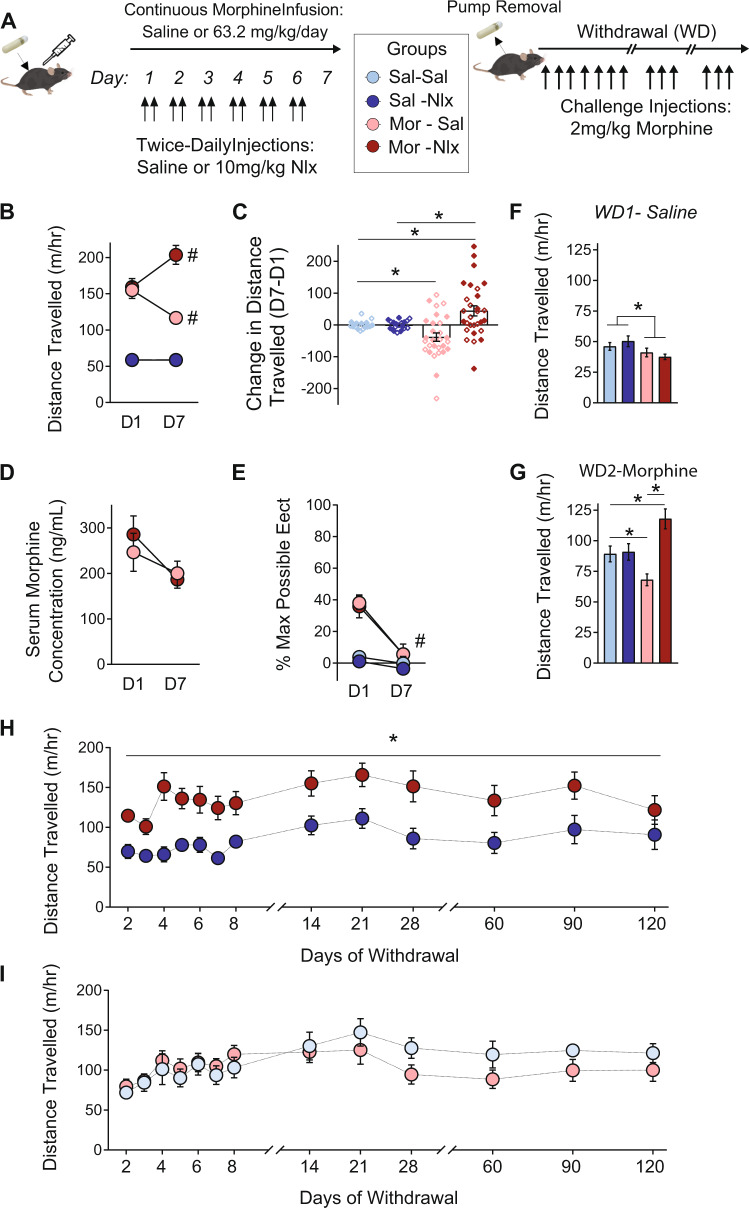
Drug-evoked adaptations in the mesolimbic dopamine system are postulated to drive opioid abuse and addiction. These adaptations vary in magnitude and direction following different patterns of opioid exposure, but few studies have systematically manipulated the pattern of opioid administration while measuring neurobiological and behavioral impact. We exposed male and female mice to morphine for one week, with administration patterns that were either intermittent (daily injections) or continuous (osmotic minipump infusion). We then interrupted continuous morphine exposure with either naloxone-precipitated or spontaneous withdrawal. Continuous morphine exposure caused tolerance to the psychomotor-activating effects of morphine, whereas both intermittent and interrupted morphine exposure caused long-lasting psychomotor sensitization. Given links between locomotor sensitization and mesolimbic dopamine signaling, we used fiber photometry and a genetically encoded dopamine sensor to conduct longitudinal measurements of dopamine dynamics in the nucleus accumbens. Locomotor sensitization caused by interrupted morphine exposure was accompanied by enhanced dopamine signaling in the nucleus accumbens. To further assess downstream consequences on striatal gene expression, we used next-generation RNA sequencing to perform genome-wide transcriptional profiling in the nucleus accumbens and dorsal striatum. The interruption of continuous morphine exposure exacerbated drug-evoked transcriptional changes in both nucleus accumbens and dorsal striatum, dramatically increasing differential gene expression and engaging unique signaling pathways. Our study indicates that opioid-evoked adaptations in brain function and behavior are critically dependent on the pattern of drug administration, and exacerbated by interruption of continuous exposure. Maintaining continuity of chronic opioid administration may, therefore, represent a strategy to minimize iatrogenic effects on brain reward circuits.
中脑边缘多巴胺系统的药物诱发适应性被认为是驱动阿片类药物滥用和成瘾的原因。这些适应性在不同的阿片类药物暴露模式下变化的幅度和方向都不同,但很少有研究系统地改变阿片类药物给药模式,同时测量神经生物学和行为学的影响。我们让雄性和雌性小鼠接受一周的吗啡治疗,给药模式分别为间歇性(每日注射)或连续性(渗透型迷你泵输注)。然后,我们用纳洛酮诱发或自发戒断来中断连续的吗啡暴露。连续的吗啡暴露导致对吗啡的精神运动激活作用产生耐受性,而间歇性和中断的吗啡暴露都会导致持久的精神运动敏感化。鉴于运动性敏感化与中脑边缘多巴胺信号之间的联系,我们使用光纤光度法和一种基因编码的多巴胺传感器对伏隔核中的多巴胺动态进行了纵向测量。中断的吗啡暴露引起的运动性敏感化伴随着伏隔核中多巴胺信号的增强。为了进一步评估对纹状体基因表达的下游影响,我们使用下一代 RNA 测序在伏隔核和背侧纹状体中进行全基因组转录谱分析。连续吗啡暴露的中断加剧了伏隔核和背侧纹状体中药物诱发的转录变化,显著增加了差异基因表达,并涉及独特的信号通路。我们的研究表明,阿片类药物引起的大脑功能和行为适应性严重依赖于药物给药模式,并且中断连续暴露会加剧这种适应性。因此,维持慢性阿片类药物连续给药可能是最大限度减少对大脑奖励回路的医源性影响的一种策略。