Institute of Biology, Biotechnology and Environmental Protection, Faculty of Natural Sciences, University of Silesia in Katowice, Jagiellońska 28, 40-032 Katowice, Poland.
Int J Mol Sci. 2020 Feb 16;21(4):1333. doi: 10.3390/ijms21041333.
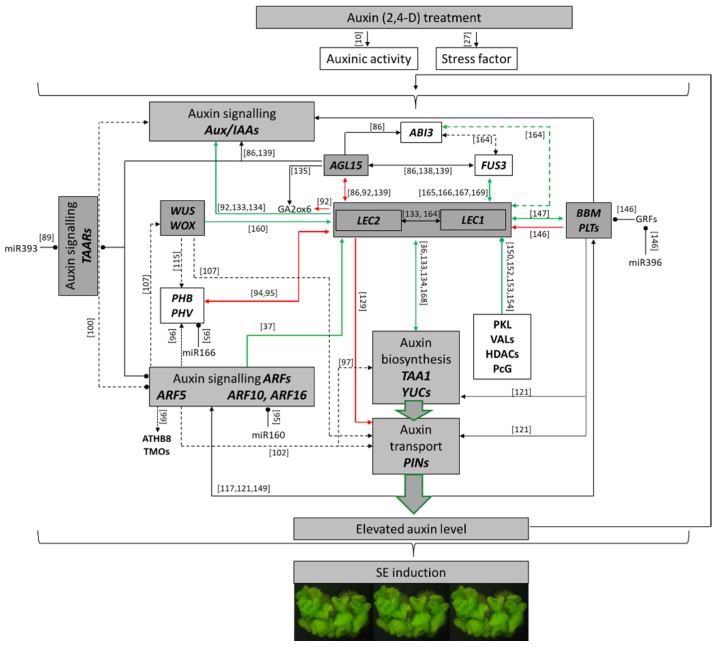
Auxin contributes to almost every aspect of plant development and metabolism as well as the transport and signalling of auxin-shaped plant growth and morphogenesis in response to endo- and exogenous signals including stress conditions. Consistently with the common belief that auxin is a central trigger of developmental changes in plants, the auxin treatment of explants was reported to be an indispensable inducer of somatic embryogenesis (SE) in a large number of plant species. Treating in vitro-cultured tissue with auxins (primarily 2,4-dichlorophenoxyacetic acid, which is a synthetic auxin-like plant growth regulator) results in the extensive reprogramming of the somatic cell transcriptome, which involves the modulation of numerous SE-associated transcription factor genes (s). A number of SE-modulated TFs that control auxin metabolism and signalling have been identified, and conversely, the regulators of the auxin-signalling pathway seem to control the SE-involved TFs. In turn, the different expression of the genes encoding the core components of the auxin-signalling pathway, the AUXIN/INDOLE-3-ACETIC ACIDs (Aux/IAAs) and AUXIN RESPONSE FACTORs (ARFs), was demonstrated to accompany SE induction. Thus, the extensive crosstalk between the hormones, in particular, auxin and the TFs, was revealed to play a central role in the SE-regulatory network. Accordingly, LEAFY COTYLEDON (LEC1 and LEC2), BABY BOOM (BBM), AGAMOUS-LIKE15 (AGL15) and WUSCHEL (WUS) were found to constitute the central part of the complex regulatory network that directs the somatic plant cell towards embryogenic development in response to auxin. The revealing picture shows a high degree of complexity of the regulatory relationships between the TFs of the SE-regulatory network, which involve direct and indirect interactions and regulatory feedback loops. This review examines the recent advances in studies on the auxin-controlled genetic network, which is involved in the mechanism of SE induction and focuses on the complex regulatory relationships between the down- and up-stream targets of the SE-regulatory TFs. In particular, the outcomes from investigations on Arabidopsis, which became a model plant in research on genetic control of SE, are presented.
生长素作为植物代谢和发育的重要参与者,在植物生长和形态建成的信号转导中起着关键作用,能响应内外源信号,包括胁迫条件。人们普遍认为生长素是植物发育变化的核心触发因素,因此生长素处理外植体被报道是许多植物物种体细胞胚胎发生(SE)不可或缺的诱导剂。用生长素(主要是 2,4-二氯苯氧基乙酸,一种合成的类似植物生长调节剂的生长素)处理体外培养的组织会导致体细胞转录组的广泛重编程,这涉及到许多 SE 相关转录因子基因(s)的调节。已经鉴定出一些控制生长素代谢和信号转导的 SE 调节 TF,相反,生长素信号通路的调节剂似乎控制着 SE 相关的 TF。反过来,生长素信号通路核心成分基因的不同表达,即生长素/吲哚-3-乙酸(Aux/IAAs)和生长素响应因子(ARFs),伴随着 SE 的诱导。因此,激素,特别是生长素和 TF 之间的广泛串扰被揭示在 SE 调控网络中起着核心作用。相应地,LEAFY COTYLEDON(LEC1 和 LEC2)、BABY BOOM(BBM)、AGAMOUS-LIKE15(AGL15)和 WUSCHEL(WUS)被发现构成了指导体细胞向胚胎发生发育的复杂调控网络的核心部分,该网络响应生长素的作用。揭示的图片显示了 SE 调控网络的 TF 之间调控关系的高度复杂性,其中涉及直接和间接相互作用以及调控反馈环。本综述考察了生长素控制的遗传网络研究的最新进展,该网络涉及 SE 诱导机制,并侧重于 SE 调控 TF 的上下游靶点之间的复杂调控关系。特别介绍了以拟南芥为模式植物的 SE 遗传调控研究的结果。