Arslan Esra, Aksoy Tamer, Gündoğan Cihan, Şen Çiğdem, Yılmaz Tatar Selda, Dursun Nevra, Çermik Tevfik Fikret
University of Health and Sciences, İstanbul Training and Research Hospital, Clinic of Nuclear Medicine, İstanbul, Turkey
Yeniyüzyıl University, Gaziosmanpaşa Hospital, Department of Nuclear Medicine, İstanbul, Turkey
Mol Imaging Radionucl Ther. 2020 Feb 17;29(1):25-32. doi: 10.4274/mirt.galenos.2020.75537.
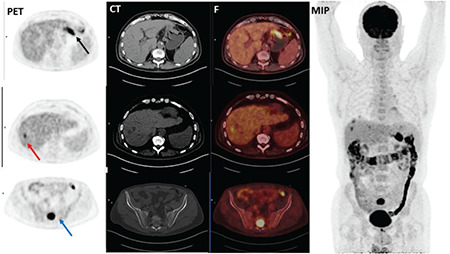
The aim of this study was to evaluate F-fluoro-2-deoxy-glucose (FDG) uptake patterns in primary tumors and metastatic lesions, and also to assess the diagnostic contribution of positron emission tomography/computed tomography (PET/CT) in the initial staging of gastric cancer (GC).
The total number of 341 patients with GC were included in this study. All F-FDG PET/CT imagings were performed for initial staging. The maximum standardized uptake value (SUV) of primary tumor, obtained from F-FDG PET/CT imaging was compared between subtypes of GC.
Mean SUV of 339 patients’ primary tumor was 12.9±8.6. The highest mean SUV was detected in patients with medullary subtype GC (17.8±9.9) while the lowest mean SUV (9.7±7.6) was seen in signet ring cell carcinoma (SRCC). The primary mean SUV was found statistically higher in tubular adenocarcinoma (TAC) group than SRCC group (p<0.001). Higher SUV values were found statistically significantly correlated with advanced age (aged ≥60) and increased tumor size (>3 cm) in patients with TAC (p=0.03). Primary tumor SUV was found statistically higher in regional lymph node (RLN) positive patients than in RLN negative patients in TAC and SRCC groups (p<0.001 and p=0.012, respectivelly). Also, in patients with SRCC, SUV was significantly higher in the distant metastatic group than in the group without metastasis (p=0.025).
Increased primary tumor SUV was associated with some of clinical parameters such as age and RLN metastasis in patients with TAC. However, there was no relationship between distant metastatic state and primary tumor F-FDG uptake in TAC. However, high SUV of primary tumor in SRCC was associated with regional and distant metastasis, and primary tumor F-FDG uptake may be a prognostic value for this subgroup.
本研究旨在评估原发性肿瘤和转移病灶中F - 氟 - 2 - 脱氧葡萄糖(FDG)的摄取模式,并评估正电子发射断层扫描/计算机断层扫描(PET/CT)在胃癌(GC)初始分期中的诊断作用。
本研究纳入了341例GC患者。所有F - FDG PET/CT成像均用于初始分期。比较了GC各亚型之间从F - FDG PET/CT成像获得的原发性肿瘤的最大标准化摄取值(SUV)。
339例患者原发性肿瘤的平均SUV为12.9±8.6。髓样亚型GC患者的平均SUV最高(17.8±9.9),而印戒细胞癌(SRCC)患者的平均SUV最低(9.7±7.6)。管状腺癌(TAC)组的原发性平均SUV在统计学上高于SRCC组(p<0.001)。在TAC患者中,较高的SUV值在统计学上与高龄(≥60岁)和肿瘤大小增加(>3 cm)显著相关(p = 0.03)。在TAC和SRCC组中,区域淋巴结(RLN)阳性患者的原发性肿瘤SUV在统计学上高于RLN阴性患者(分别为p<0.001和p = 0.012)。此外,在SRCC患者中,远处转移组的SUV显著高于无转移组(p = 0.025)。
TAC患者原发性肿瘤SUV升高与年龄和RLN转移等一些临床参数相关。然而,TAC患者的远处转移状态与原发性肿瘤F - FDG摄取之间没有关系。然而,SRCC患者原发性肿瘤的高SUV与区域和远处转移相关,原发性肿瘤F - FDG摄取可能对该亚组具有预后价值。