Division of Clinical Epidemiology and Ageing Research, German Cancer Research Center, Heidelberg, Germany.
Network Aging Research, University of Heidelberg, Heidelberg, Germany.
BMJ Open Diabetes Res Care. 2020 Feb;8(1). doi: 10.1136/bmjdrc-2019-000933.
Our objective is to identify the potential factors associated with serum Diacron's reactive oxygen metabolites test (D-ROM) levels of patients with type 2 diabetes mellitus (T2DM) by conducting cross-sectional and longitudinal analyses in two large cohorts and further strengthening these results by performing a meta-analysis.
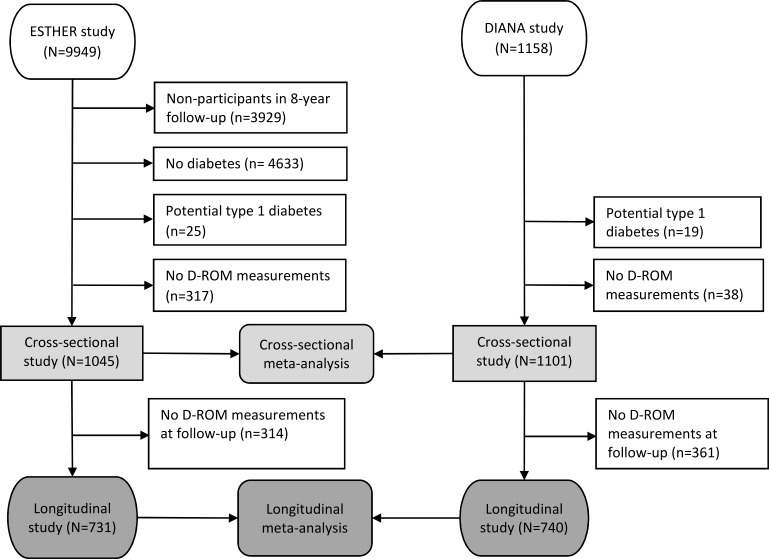
Serum D-ROM concentrations were measured in 1045 and 1101 patients with T2DM from two independent cohort studies from Germany at baseline and repeatedly 3-4 years later. The cross-sectional and longitudinal associations of various potential determinants with D-ROM levels were assessed with a backwards selection algorithm in multivariable adjusted models.
In the meta-analysis of the cross-sectional analysis, female sex, low education, obesity, smoking, high total cholesterol, hemoglobin A ≥7%, no diabetes medication, a history of myocardial infarction, heart failure, a history of cancer and C reactive protein levels (CRP) >3 mg/L were statistically significantly associated with increased D-ROM levels in patients with T2DM. The meta-analysis of the longitudinal analysis revealed that old age, female sex, obesity, smoking, physical inactivity, high alcohol consumption, ≥5 years since diabetes diagnosis and CRP levels between 3 mg/L and 10 mg/L were statistically significantly associated with D-ROM levels measured 3-4 years later.
CONCLUSIONS VALIDITY, LIMITATIONS AND CLINICAL APPLICABILITY: This comprehensive analysis confirmed that several modifiable risk factors are being associated with oxidative stress in patients with T2DM within an observational study design. We discuss potential prevention measures against these risk factors that might help to reduce oxidative stress and to prevent some cases of premature mortality in patients with T2DM.
通过对两个大型队列的横断面和纵向分析,并通过荟萃分析进一步加强这些结果,确定 2 型糖尿病(T2DM)患者血清 Diacron 活性氧代谢物检测(D-ROM)水平相关的潜在因素。
在德国的两项独立队列研究中,在基线时和 3-4 年后重复测量了 1045 名和 1101 名 T2DM 患者的血清 D-ROM 浓度。使用多元调整模型中的向后选择算法评估了各种潜在决定因素与 D-ROM 水平的横断面和纵向关联。
在横断面分析的荟萃分析中,女性、低教育程度、肥胖、吸烟、总胆固醇高、糖化血红蛋白≥7%、无糖尿病药物治疗、心肌梗死、心力衰竭、癌症病史和 C 反应蛋白(CRP)水平>3mg/L 与 T2DM 患者的 D-ROM 水平升高有统计学显著关联。纵向分析的荟萃分析显示,年龄较大、女性、肥胖、吸烟、缺乏体力活动、大量饮酒、糖尿病诊断后≥5 年和 CRP 水平在 3mg/L 至 10mg/L 之间与 3-4 年后测量的 D-ROM 水平有统计学显著关联。
有效性、局限性和临床适用性:这项综合分析证实,在观察性研究设计中,一些可改变的危险因素与 T2DM 患者的氧化应激有关。我们讨论了针对这些危险因素的潜在预防措施,这些措施可能有助于降低氧化应激,并预防一些 T2DM 患者的过早死亡。