Max Planck Institute for Plant Breeding Research, Department of Chromosome Biology, Carl-von-Linné-Weg 10, 50829, Cologne, Germany.
Faculty of Biology, LMU Munich, Großhaderner Str. 2, 82152, Planegg-Martinsried, Germany.
Nat Commun. 2020 Feb 20;11(1):989. doi: 10.1038/s41467-020-14779-y.
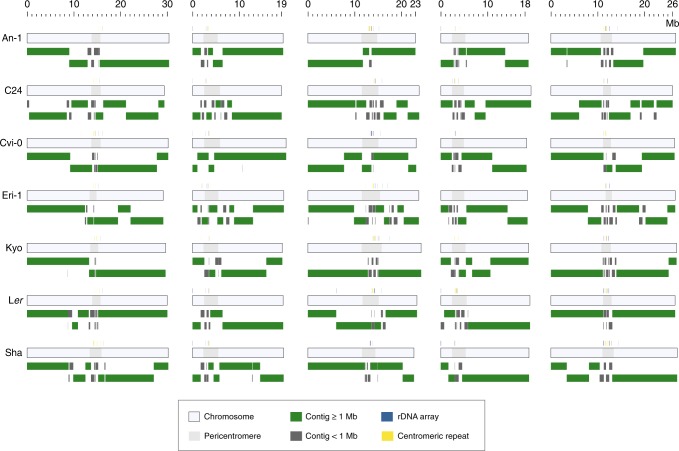
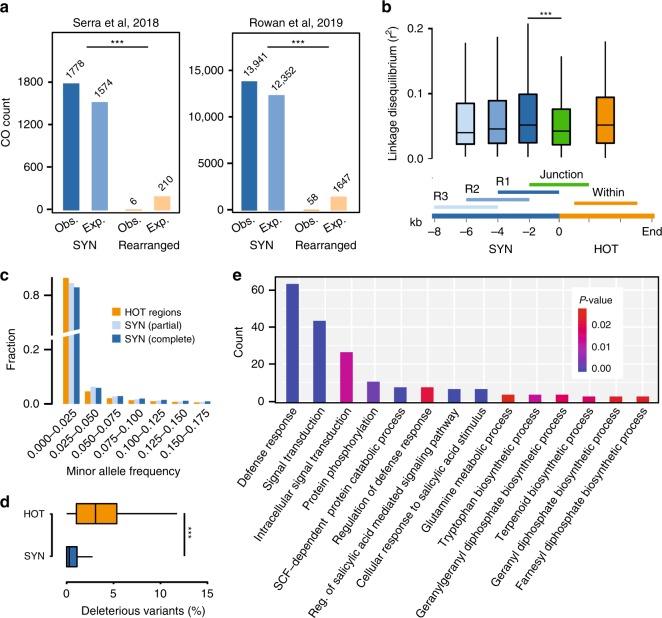
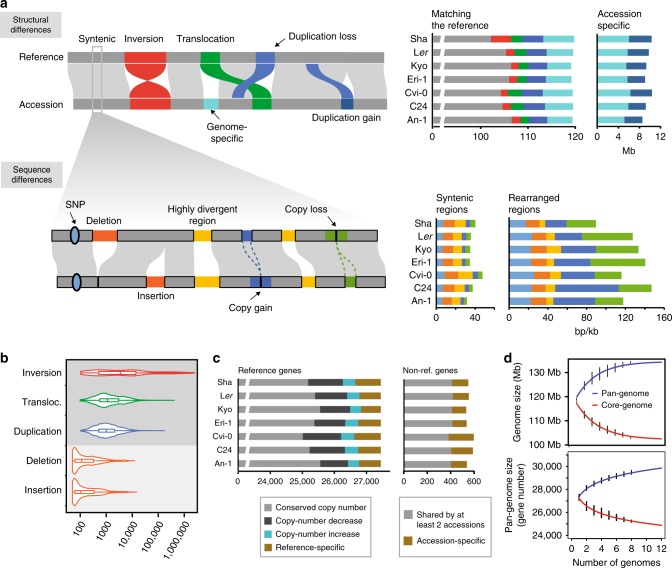
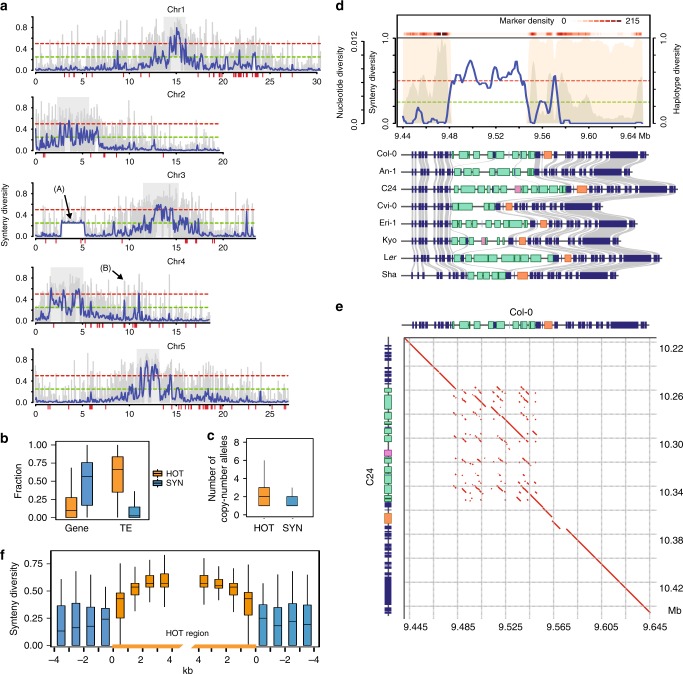
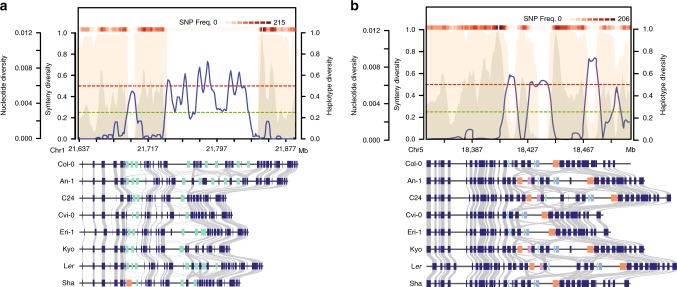
Despite hundreds of sequenced Arabidopsis genomes, very little is known about the degree of genomic collinearity within single species, due to the low number of chromosome-level assemblies. Here, we report chromosome-level reference-quality assemblies of seven Arabidopsis thaliana accessions selected across its global range. Each genome reveals between 13-17 Mb rearranged, and 5-6 Mb non-reference sequences introducing copy-number changes in ~5000 genes, including ~1900 non-reference genes. Quantifying the collinearity between the genomes reveals ~350 euchromatic regions, where accession-specific tandem duplications destroy the collinearity between the genomes. These hotspots of rearrangements are characterized by reduced meiotic recombination in hybrids and genes implicated in biotic stress response. This suggests that hotspots of rearrangements undergo altered evolutionary dynamics, as compared to the rest of the genome, which are mostly based on the accumulation of new mutations and not on the recombination of existing variation, and thereby enable a quick response to the biotic stress.
尽管已经对数百个拟南芥基因组进行了测序,但由于染色体水平的组装数量较少,对于同一物种内基因组共线性的程度,我们知之甚少。在这里,我们报告了七个拟南芥品系的染色体水平参考质量组装,这些品系是在其全球范围内选择的。每个基因组都揭示了 13-17Mb 的重排和 5-6Mb 的非参考序列,在大约 5000 个基因中引入了拷贝数变化,包括大约 1900 个非参考基因。对基因组之间的共线性进行定量分析,揭示了大约 350 个常染色质区域,其中特定于品系的串联重复破坏了基因组之间的共线性。这些重排的热点区域的特征是杂种减数分裂重组减少,并且涉及生物胁迫反应的基因。这表明,与基因组的其余部分相比,重排热点区域经历了不同的进化动态,后者主要基于新突变的积累,而不是基于现有变异的重组,从而能够快速应对生物胁迫。