Sanquin Research, Department of Experimental Immunohematology, Amsterdam, The Netherlands and Landsteiner Laboratory, Amsterdam UMC, University of Amsterdam, Amsterdam, The Netherlands.
Center for Proteomics and Metabolomics, Leiden University Medical Center, Leiden, The Netherlands.
Sci Rep. 2020 Feb 20;10(1):3051. doi: 10.1038/s41598-020-59651-7.
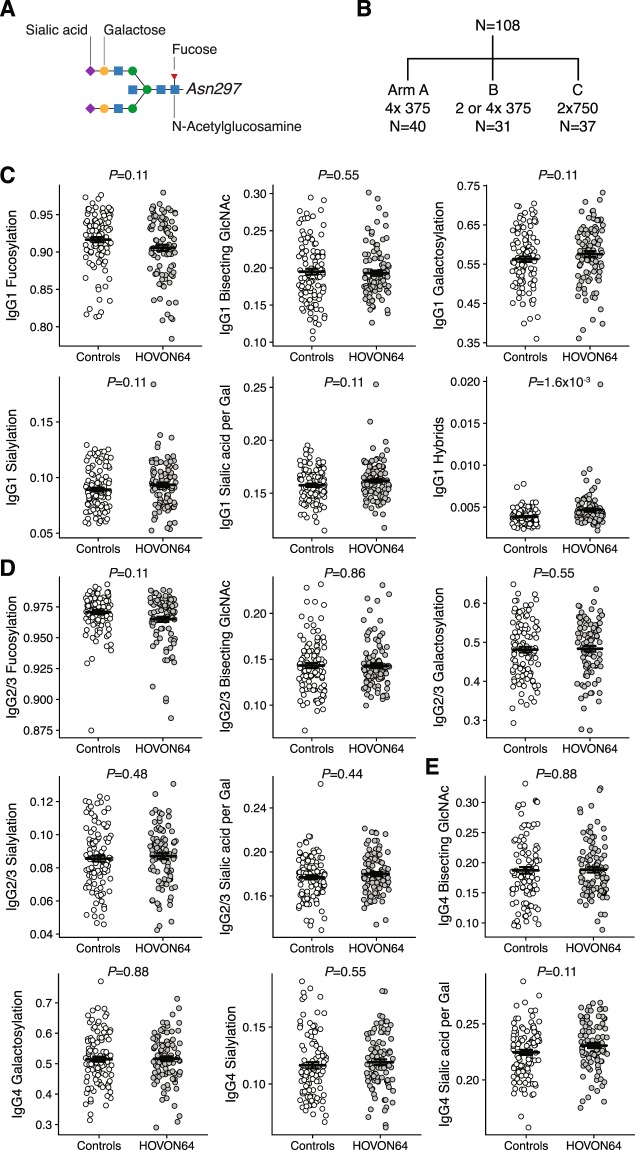
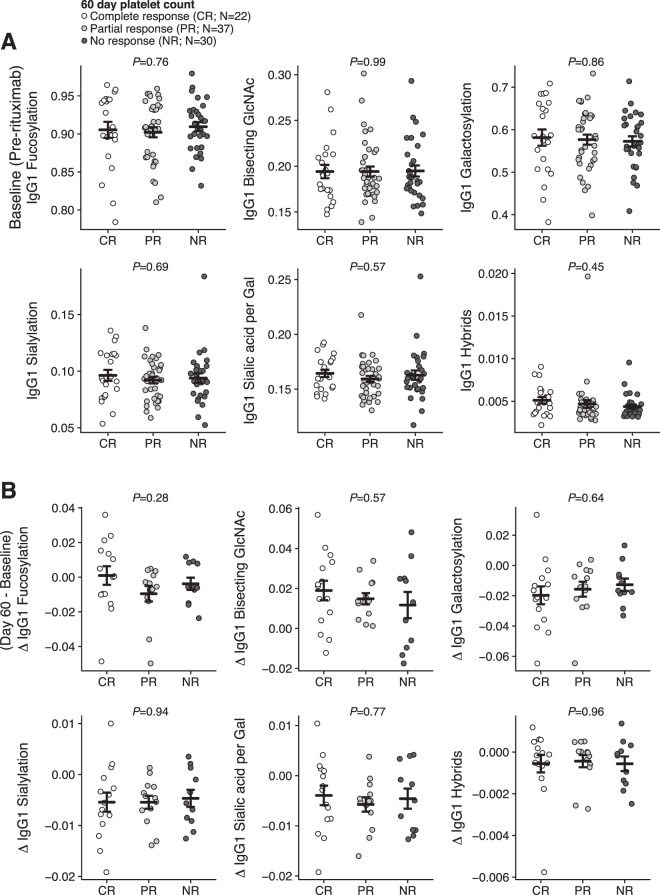
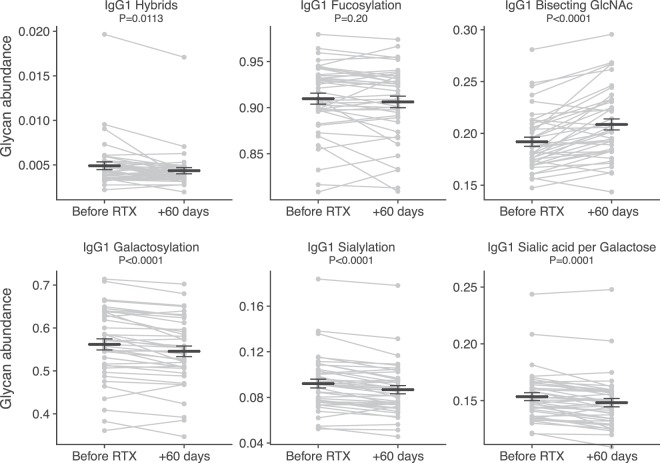
The interactions of antibodies with myeloid Fcγ receptors and the complement system are regulated by an Asn297-linked glycan in the Fc portion of IgG. Alterations of serum IgG-Fc glycosylation have been reported in various autoimmune diseases, and correlate with treatment response and disease activity. We hypothesized that IgG-Fc glycosylation is altered in immune thrombocytopenia (ITP) and associates with response to anti-CD20 monoclonal antibody treatment (rituximab). IgG-Fc glycosylation was analyzed by liquid chromatography-mass spectrometry. We found that IgG-Fc glycosylation was identical between refractory ITP patients (HOVON64 trial; N = 108) and healthy controls (N = 120). Two months after rituximab treatment, we observed a shift in Fc glycosylation, with a mean 1.7% reduction in galactosylation for IgG1 and IgG4 and a mean 1.5% increase for bisection in IgG1, IgG2/3 and IgG4 (adjusted p < 1.7 × 10 and p < 2 × 10, respectively). Neither baseline nor longitudinal changes in IgG-Fc glycosylation after rituximab were associated with clinical treatment response. We conclude that IgG-Fc glycosylation in refractory ITP is similar to healthy controls and does not predict treatment responses to rituximab. The observed changes two months after treatment suggest that rituximab may influence total serum IgG-Fc glycosylation. Overall, our study suggests that the pathophysiology of refractory ITP may differ from other autoimmune diseases.
抗体与髓样 Fcγ 受体和补体系统的相互作用受 IgG Fc 部分中 Asn297 连接的聚糖调节。各种自身免疫性疾病中均报道了血清 IgG-Fc 糖基化的改变,且与治疗反应和疾病活动度相关。我们假设免疫性血小板减少症 (ITP) 中 IgG-Fc 糖基化发生改变,并与抗 CD20 单克隆抗体治疗(利妥昔单抗)的反应相关。采用液相色谱-质谱法分析 IgG-Fc 糖基化。我们发现难治性 ITP 患者(HOVON64 试验;N=108)与健康对照者(N=120)之间 IgG-Fc 糖基化无差异。利妥昔单抗治疗 2 个月后,我们观察到 Fc 糖基化发生了转变,IgG1 和 IgG4 的半乳糖基化平均降低 1.7%,IgG1、IgG2/3 和 IgG4 的二硫键连接平均增加 1.5%(调整后 p<1.7×10 和 p<2×10,分别)。利妥昔单抗治疗后基线或纵向 IgG-Fc 糖基化变化均与临床治疗反应无关。我们的结论是,难治性 ITP 的 IgG-Fc 糖基化与健康对照者相似,不能预测利妥昔单抗的治疗反应。治疗 2 个月后观察到的变化提示利妥昔单抗可能影响总血清 IgG-Fc 糖基化。总的来说,我们的研究表明难治性 ITP 的病理生理学可能与其他自身免疫性疾病不同。