Rutgers, The State University of New Jersey, Department of Biomedical Engineering, Piscataway, 08854, United States.
Rutgers, The State University of New Jersey, Department of Mechanical and Aerospace Engineering, Piscataway, 08854, United States.
Sci Rep. 2020 Feb 20;10(1):3053. doi: 10.1038/s41598-020-59790-x.
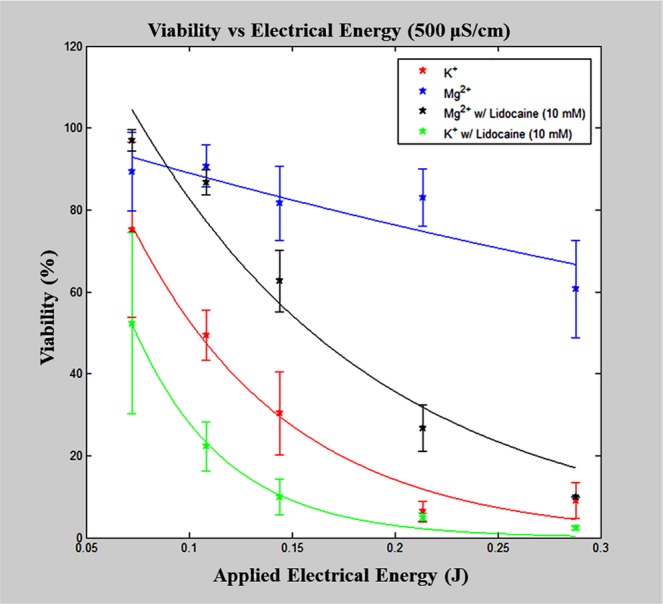
Electroporation is an electro-physical, non-viral approach to perform DNA, RNA, and protein transfections of cells. Upon application of an electric field, the cell membrane is compromised, allowing the delivery of exogenous materials into cells. Cell viability and electro-transfection efficiency (eTE) are dependent on various experimental factors, including pulse waveform, vector concentration, cell type/density, and electroporation buffer properties. In this work, the effects of buffer composition on cell viability and eTE were systematically explored for plasmid DNA encoding green fluorescent protein following electroporation of 3T3 fibroblasts. A HEPES-based buffer was used in conjunction with various salts and sugars to modulate conductivity and osmolality, respectively. Pulse applications were chosen to maintain constant applied electrical energy (J) or total charge flux (C/m). The energy of the pulse application primarily dictated cell viability, with Mg-based buffers expanding the reversible electroporation range. The enhancement of viability with Mg-based buffers led to the hypothesis that this enhancement is due to ATPase activation via re-establishing ionic homeostasis. We show preliminary evidence for this mechanism by demonstrating that the enhanced viability is eliminated by introducing lidocaine, an ATPase inhibitor. However, Mg also hinders eTE compared to K-based buffers. Collectively, the results demonstrate that the rational selection of pulsing conditions and buffer compositions are critical for the design of electroporation protocols to maximize viability and eTE.
电穿孔是一种非病毒的电物理方法,用于对细胞进行 DNA、RNA 和蛋白质转染。在施加电场时,细胞膜会受到损害,允许外源物质进入细胞。细胞活力和电转染效率(eTE)取决于多种实验因素,包括脉冲波形、载体浓度、细胞类型/密度和电穿孔缓冲液特性。在这项工作中,我们系统地研究了缓冲液组成对转染 3T3 成纤维细胞后编码绿色荧光蛋白的质粒 DNA 的细胞活力和 eTE 的影响。使用 HEPES 缓冲液与各种盐和糖结合使用,分别调节导电性和渗透压。选择脉冲应用以保持恒定的施加电能(J)或总电荷通量(C/m)。脉冲应用的能量主要决定细胞活力,Mg 基缓冲液扩大了可逆电穿孔范围。Mg 基缓冲液增强细胞活力的假设是,通过重新建立离子平衡来激活 ATP 酶。我们通过证明引入 ATP 酶抑制剂利多卡因可消除增强的活力来初步证明这种机制。然而,与 K 基缓冲液相比,Mg 也会阻碍 eTE。总之,结果表明,合理选择脉冲条件和缓冲液组成对于设计电穿孔方案以最大限度地提高细胞活力和 eTE 至关重要。