Ding Xiaoyun, Stewart Martin, Sharei Armon, Weaver James C, Langer Robert S, Jensen Klavs F
Department of Chemical Engineering, Massachusetts Institute of Technology, Cambridge, MA 02139, USA.
The David Koch Institute for Integrative Cancer Research, Massachusetts Institute of Technology, Cambridge, MA 02139, USA.
Nat Biomed Eng. 2017;1. doi: 10.1038/s41551-017-0039. Epub 2017 Mar 9.
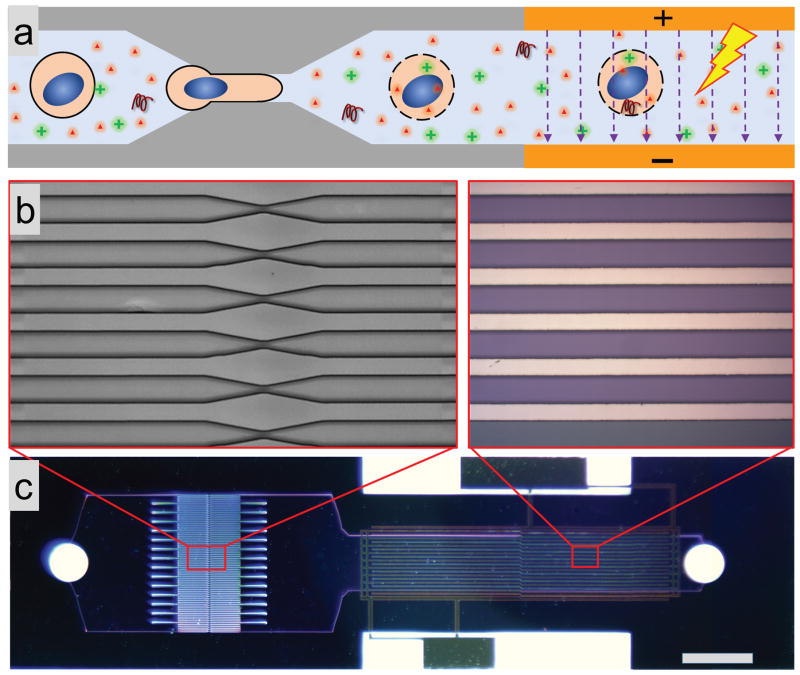
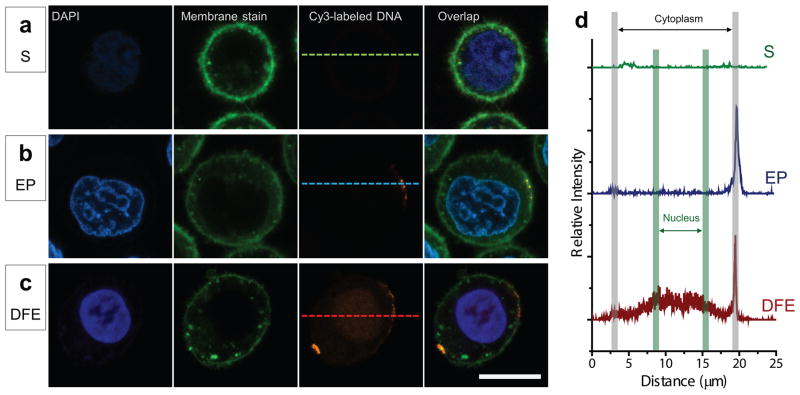
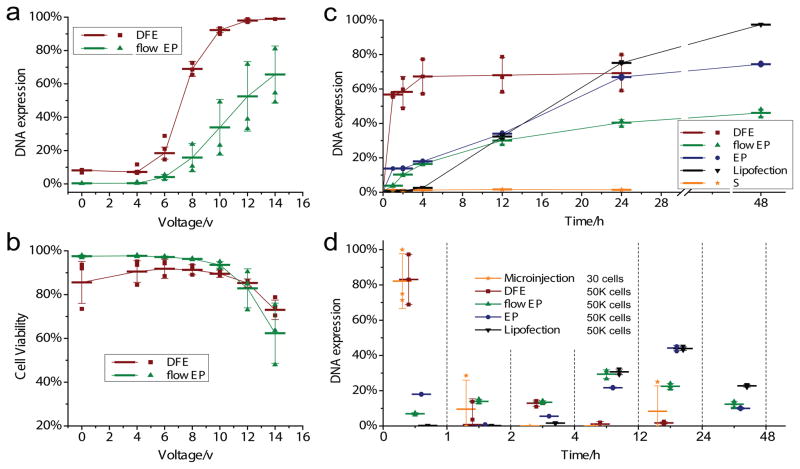
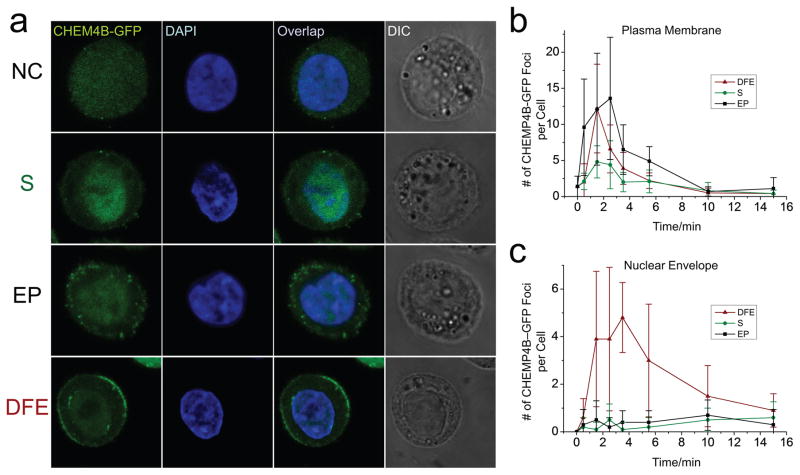
Nuclear transfection of DNA into mammalian cells is challenging yet critical for many biological and medical studies. Here, by combining cell squeezing and electric-field-driven transport in a device that integrates microfluidic channels with constrictions and microelectrodes, we demonstrate nuclear delivery of plasmid DNA within 1 hour after treatment, the most rapid DNA expression in a high-throughput setting (up to millions of cells per minute per device). Passing cells at high speed through microfluidic constrictions smaller than the cell diameter mechanically disrupts the cell membrane, allowing a subsequent electric field to further disrupt the nuclear envelope and drive DNA molecules into the cytoplasm and nucleus. By tracking the localization of the ESCRT-III (endosomal sorting complexes required for transport) protein CHMP4B, we show that the integrity of the nuclear envelope is recovered within 15 minutes of treatment. We also provide insight into subcellular delivery by comparing the performance of the disruption-and-field-enhanced method with those of conventional chemical, electroporation, and manual-injection systems.
将DNA核转染到哺乳动物细胞中具有挑战性,但对许多生物学和医学研究至关重要。在此,我们通过在一种集成了带有缩窄结构的微流体通道和微电极的装置中结合细胞挤压和电场驱动运输,证明了在处理后1小时内实现质粒DNA的核递送,这是高通量条件下最快速的DNA表达(每个装置每分钟可达数百万个细胞)。使细胞高速通过小于细胞直径的微流体缩窄结构会机械破坏细胞膜,从而使随后的电场进一步破坏核膜并将DNA分子驱动到细胞质和细胞核中。通过追踪转运所需内体分选复合物(ESCRT-III)蛋白CHMP4B的定位,我们表明在处理后15分钟内核膜完整性得以恢复。我们还通过比较破坏和场增强方法与传统化学、电穿孔和手动注射系统的性能,深入了解亚细胞递送情况。