CHILI Lab, EPFL, Route Cantonale, 1015, Lausanne, Switzerland.
Sci Rep. 2020 Feb 21;10(1):3140. doi: 10.1038/s41598-020-60011-8.
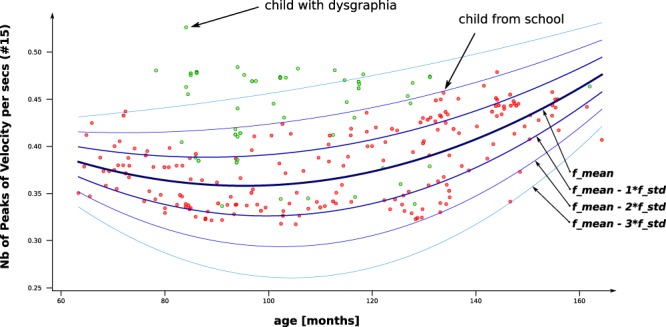
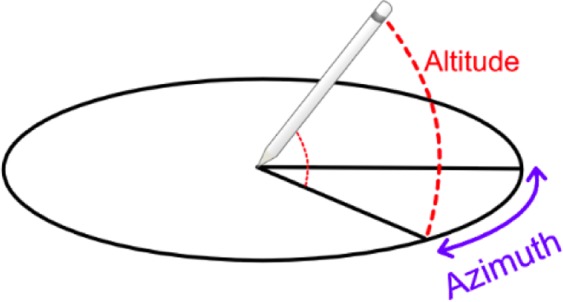
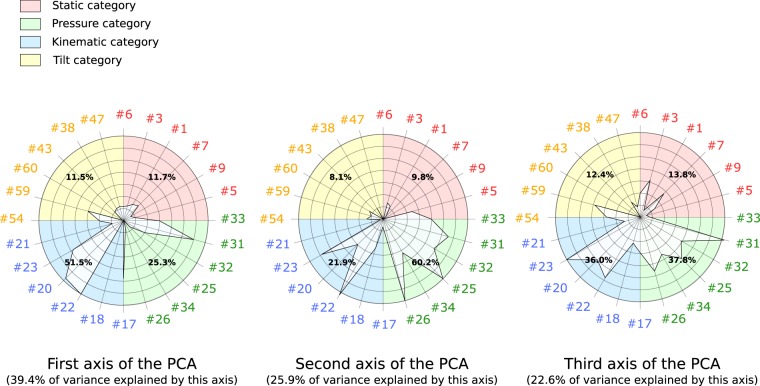
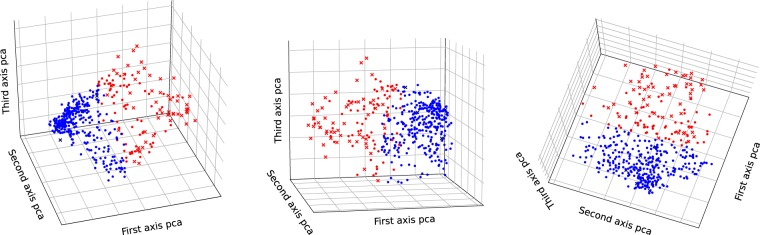
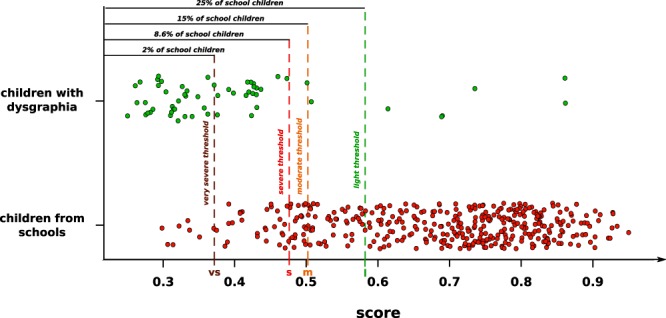
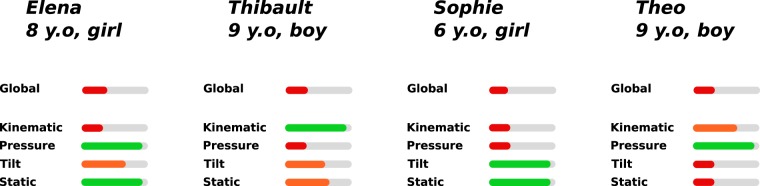
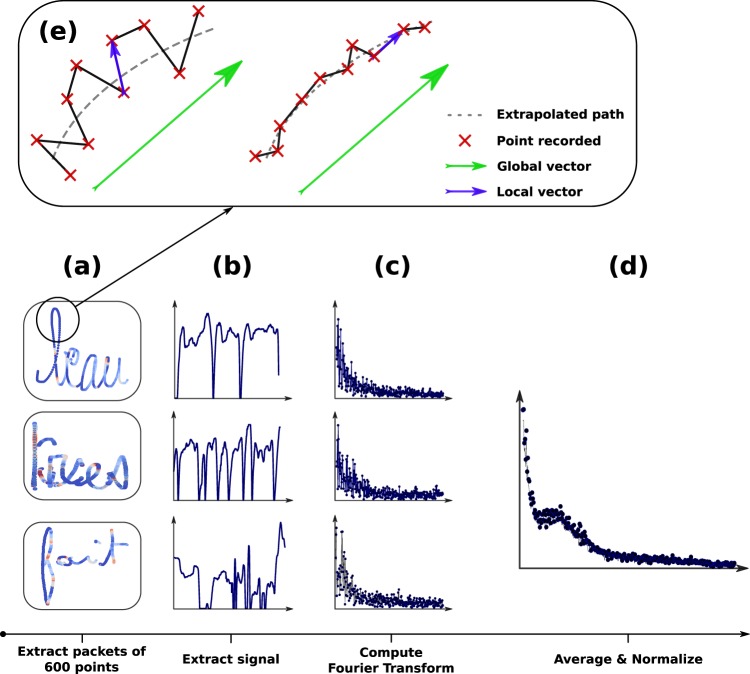
This paper proposes new ways to assess handwriting, a critical skill in any child's school journey. Traditionally, a pen and paper test called the BHK test (Concise Evaluation Scale for Children's Handwriting) is used to assess children's handwriting in French-speaking countries. Any child with a BHK score above a certain threshold is diagnosed as 'dysgraphic', meaning that they are then eligible for financial coverage for therapeutic support. We previously developed a version of the BHK for tablet computers which provides rich data on the dynamics of writing (acceleration, pressure, and so forth). The underlying model was trained on dysgraphic and non-dysgraphic children. In this contribution, we deviate from the original BHK for three reasons. First, in this instance, we are interested not in a binary output but rather a scale of handwriting difficulties, from the lightest cases to the most severe. Therefore, we wish to compute how far a child's score is from the average score of children of the same age and gender. Second, our model analyses dynamic features that are not accessible on paper; hence, the BHK is useful in this instance. Using the PCA (Principal Component Analysis) reduced the set of 53 handwriting features to three dimensions that are independent of the BHK. Nonetheless, we double-checked that, when clustering our data set along any of these three axes, we accurately detected dysgraphic children. Third, dysgraphia is an umbrella concept that embraces a broad variety of handwriting difficulties. Two children with the same global score can have totally different types of handwriting difficulties. For instance, one child could apply uneven pen pressure while another one could have trouble controlling their writing speed. Our new test not only provides a global score, but it also includes four specific score for kinematics, pressure, pen tilt and static features (letter shape). Replacing a global score with a more detailed profile enables the selection of remediation games that are very specific to each profile.
本文提出了新的方法来评估手写技能,这是孩子学校生涯中的一项关键技能。在法语国家,传统上使用一种名为 BHK 测试(儿童手写简明评估量表)的纸笔测试来评估儿童的手写能力。任何 BHK 得分高于一定阈值的儿童都被诊断为“书写困难症”,这意味着他们有资格获得治疗支持的经济覆盖。我们之前开发了一种用于平板电脑的 BHK 版本,该版本提供了有关书写动态(加速度、压力等)的丰富数据。基础模型是在书写困难症和非书写困难症儿童上进行训练的。在本研究中,我们出于三个原因偏离了原始的 BHK。首先,在这种情况下,我们感兴趣的不是二进制输出,而是从最轻微到最严重的书写困难程度的范围。因此,我们希望计算孩子的得分与同年龄和性别儿童的平均得分相差多远。其次,我们的模型分析了在纸上无法获取的动态特征;因此,在这种情况下,BHK 是有用的。使用 PCA(主成分分析)将 53 个手写特征集简化为三个与 BHK 无关的维度。尽管如此,我们还是双重检查了,当沿着这三个轴中的任何一个对我们的数据集进行聚类时,我们准确地检测到了书写困难症儿童。第三,书写困难症是一个涵盖广泛书写困难类型的伞式概念。两个具有相同总得分的孩子可能有完全不同类型的书写困难。例如,一个孩子可能施加不均匀的笔压,而另一个孩子可能难以控制书写速度。我们的新测试不仅提供了一个总得分,还包括四个特定于运动学、压力、笔倾斜和静态特征(字母形状)的得分。用更详细的档案替代总得分,可以选择非常针对每个档案的矫正游戏。