Kobayashi Ryota, Shigematsu Jun, Miyatani Makoto, Nakao Takashi
Department of Psychology, Graduate School of Education, Hiroshima University, Hiroshima, Japan.
Japan Society for the Promotion of Science, Tokyo, Japan.
Front Psychol. 2020 Jan 31;11:103. doi: 10.3389/fpsyg.2020.00103. eCollection 2020.
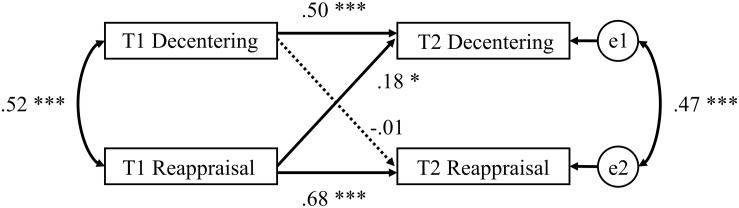
Previous studies have suggested that cognitive reappraisal, which is an effective emotion regulation strategy, enhances decentering. On the other hand, other studies have implied the reverse in regard to this relationship: that decentering supports cognitive reappraisal. However, these possibilities have not yet been examined empirically. In the present study, we investigated the causal relationship between decentering and cognitive reappraisal by conducting two wave cross-lagged analysis. One hundred and thirty-eight Japanese university students responded to a questionnaire comprising measures of decentering and cognitive reappraisal tendency; the questionnaire was administered on two occasions, with an interval of 1 month. Cross-lagged analysis indicated the positive effect of cognitive reappraisal on decentering; however, the reverse possibility, that decentering influences cognitive reappraisal, was not significant. These results suggested that habitual use of cognitive reappraisal fosters decentering.
以往的研究表明,认知重评作为一种有效的情绪调节策略,能增强去中心化。另一方面,其他研究则暗示了这种关系的相反情况:即去中心化支持认知重评。然而,这些可能性尚未得到实证检验。在本研究中,我们通过进行两波交叉滞后分析,调查了去中心化与认知重评之间的因果关系。138名日本大学生回答了一份包含去中心化和认知重评倾向测量的问卷;该问卷分两次发放,间隔1个月。交叉滞后分析表明认知重评对去中心化有积极影响;然而,去中心化影响认知重评这种相反的可能性并不显著。这些结果表明,习惯性地使用认知重评会促进去中心化。