Sai Liyang, Wang Sisi, Ward Anne, Ku Yixuan, Sang Biao
The Key Lab of Brain Functional Genomics, MOE & STCSM, School of Psychology and Cognitive Science, East China Normal University , Shanghai, China.
Department of Psychology, Northwestern University , Evanston, IL, USA.
Front Psychol. 2015 Sep 1;6:1256. doi: 10.3389/fpsyg.2015.01256. eCollection 2015.
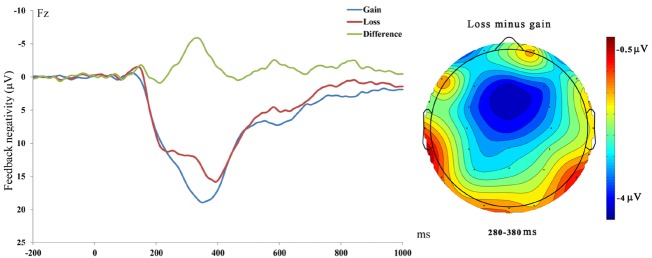
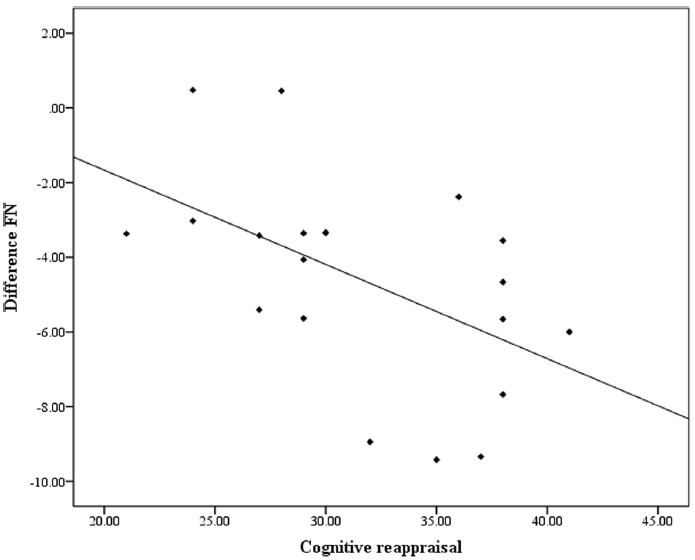
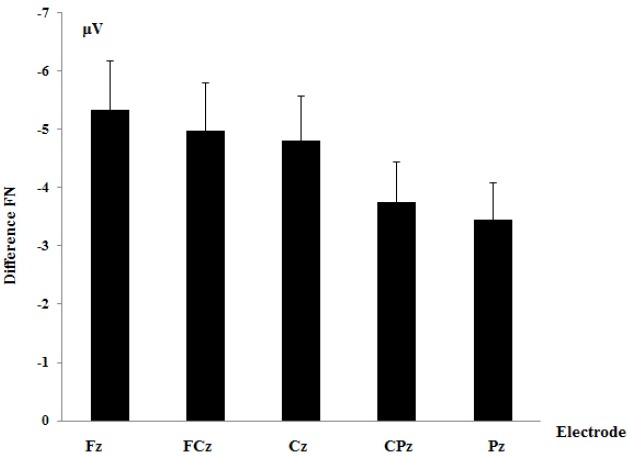
Recent studies have shown that instructed cognitive reappraisal can regulate the neural processing of reward. However, it is still unclear whether the habitual use of cognitive reappraisal in everyday life is related to brain activity involved in reward processing. In the present study, participants' neural responses to reward were measured using electroencephalography (EEG) recorded during a gambling task and their tendency to use cognitive reappraisal was assessed using the Emotion Regulation Questionnaire (ERQ). Event-related potential (ERP) results indicated that losses on the gambling task elicited greater negative reward-related feedback negativity (FN) than gains. The differential FN between losses and gains was significantly correlated with cognitive reappraisal scores across participants such that individuals with a higher tendency to use cognitive reappraisal showed stronger reward processing (i.e., amplified FN difference between losses and gains). This correlation remained significant after controlling for expressive suppression scores. However, expressive suppression per se was not correlated with FN differences. Taken together, these results suggest that the habitual use of cognitive reappraisal is associated with increased neural processing of reward.
近期研究表明,指导性认知重评能够调节奖赏的神经加工过程。然而,日常生活中习惯性地使用认知重评是否与奖赏加工所涉及的大脑活动相关,目前仍不清楚。在本研究中,参与者在赌博任务期间通过脑电图(EEG)记录来测量其对奖赏的神经反应,并使用情绪调节问卷(ERQ)评估他们使用认知重评的倾向。事件相关电位(ERP)结果表明,赌博任务中的损失比收益引发了更大的与负性奖赏相关的反馈负波(FN)。参与者中损失与收益之间的差异FN与认知重评得分显著相关,即使用认知重评倾向较高的个体表现出更强的奖赏加工(即损失与收益之间的FN差异增大)。在控制了表达抑制得分后,这种相关性仍然显著。然而,表达抑制本身与FN差异无关。综上所述,这些结果表明,习惯性地使用认知重评与奖赏的神经加工增加有关。