Lingam Thava Malar Changra, Tan Kae Yi, Tan Choo Hock
Department of Molecular Medicine, University of Malaya, Kuala Lumpur, Malaysia.
Department of Pharmacology, University of Malaya, Kuala Lumpur, Malaysia.
J Venom Anim Toxins Incl Trop Dis. 2020 Jan 31;26:e20190048. doi: 10.1590/1678-9199-JVATITD-2019-0048. eCollection 2020.
The Eastern Russell's viper, , is a WHO Category 1 medically important venomous snake. It has a wide but disjunct distribution in Southeast Asia. The specific antivenom, Monovalent Antivenom (DsMAV-Thailand) is produced in Thailand but not available in Indonesia, where a heterologous trivalent antivenom, Serum Anti Bisa Ular (SABU), is used instead. This study aimed to investigate the geographical venom variation of from Thailand (Ds-Thailand) and Indonesia (Ds-Indonesia), and the immunorecognition of the venom proteins by antivenoms.
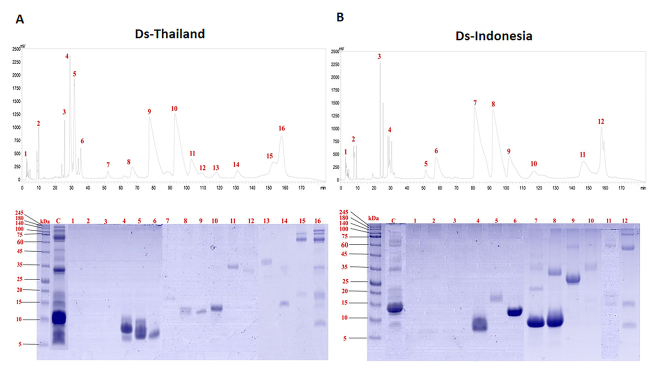
The venom proteins were decomplexed with reverse-phase high-performance liquid chromatography and sodium dodecyl sulfate-polyacrylamide gel electrophoresis, followed by in-solution tryptic digestion, nano-liquid chromatography-tandem mass spectrometry and protein identification. The efficacies of DsMAV-Thailand and SABU in binding the various venom fractions were assessed using an enzyme-linked immunosorbent assay optimized for immunorecognition profiling.
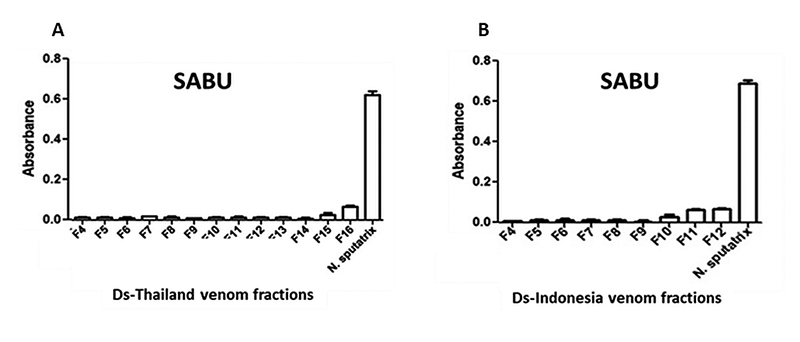
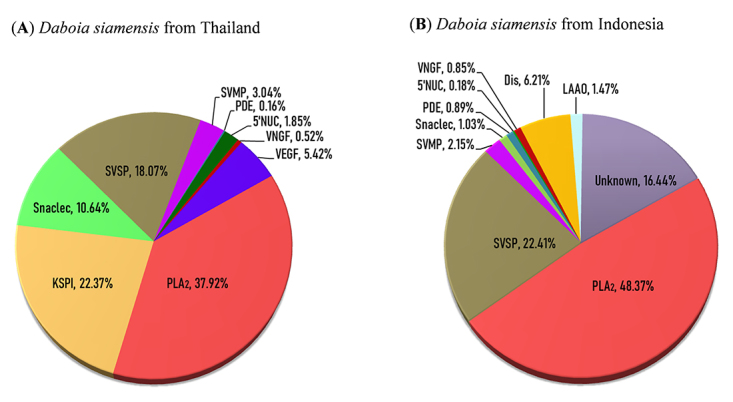
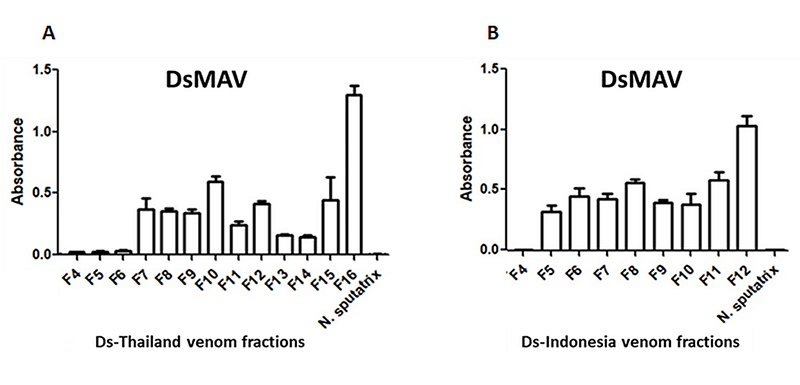
The two most abundant protein families in Ds-Thailand venom are phospholipase A (PLA) and Kunitz-type serine protease inhibitor (KSPI). Those abundant in Ds-Indonesia venom are PLA and serine protease. KSPI and vascular endothelial growth factor were detected in Ds-Thailand venom, whereas L-amino acid oxidase and disintegrin were present in Ds-Indonesia venom. Common proteins shared between the two included snaclecs, serine proteases, metalloproteinases, phosphodiesterases, 5'nucleotidases and nerve growth factors at varying abundances. DsMAV-Thailand exhibited strong immunorecognition of the major protein fractions in both venoms, but low immunoreactivity toward the low molecular weight proteins e.g. KSPI and disintegrins. On the other hand, SABU was virtually ineffective in binding all fractionated venom proteins.
venoms from Thailand and Indonesia varied geographically in the protein subtypes and abundances. The venoms, nevertheless, shared conserved antigenicity that allowed effective immunorecognition by DsMAV-Thailand but not by SABU, consistent with the neutralization efficacy of the antivenoms. A specific, appropriate antivenom is needed in Indonesia to treat Russell's viper envenomation.
东方罗素蝰蛇(Daboia siamensis)是世界卫生组织第1类具有重要医学意义的毒蛇。它在东南亚分布广泛但不连续。特定抗蛇毒血清,单价抗蛇毒血清(DsMAV - 泰国)在泰国生产,但在印度尼西亚无法获得,在印度尼西亚使用的是一种异源三价抗蛇毒血清,抗双斑蝰蛇血清(SABU)。本研究旨在调查泰国(Ds - 泰国)和印度尼西亚(Ds - 印度尼西亚)的Daboia siamensis蛇毒的地理变异,以及抗蛇毒血清对蛇毒蛋白的免疫识别。
蛇毒蛋白通过反相高效液相色谱和十二烷基硫酸钠 - 聚丙烯酰胺凝胶电泳进行解聚,然后进行溶液内胰蛋白酶消化、纳升液相色谱 - 串联质谱分析和蛋白质鉴定。使用针对免疫识别谱分析优化的酶联免疫吸附测定评估DsMAV - 泰国和SABU结合各种蛇毒组分的效力。
Ds - 泰国蛇毒中两个最丰富的蛋白家族是磷脂酶A(PLA)和库尼茨型丝氨酸蛋白酶抑制剂(KSPI)。Ds - 印度尼西亚蛇毒中丰富的是PLA和丝氨酸蛋白酶。在Ds - 泰国蛇毒中检测到KSPI和血管内皮生长因子,而在Ds - 印度尼西亚蛇毒中存在L - 氨基酸氧化酶和去整合素。两者共有的常见蛋白包括不同丰度的蛇毒C型凝集素、丝氨酸蛋白酶、金属蛋白酶、磷酸二酯酶、5'核苷酸酶和神经生长因子。DsMAV - 泰国对两种蛇毒中的主要蛋白组分表现出强烈的免疫识别,但对低分子量蛋白如KSPI和去整合素的免疫反应性较低。另一方面,SABU在结合所有分级分离的蛇毒蛋白方面几乎无效。
泰国和印度尼西亚的Daboia siamensis蛇毒在蛋白亚型和丰度上存在地理差异。然而,这些蛇毒具有保守的抗原性,使得DsMAV - 泰国能够进行有效的免疫识别,而SABU则不能,这与抗蛇毒血清的中和效力一致。印度尼西亚需要一种特定的、合适的抗蛇毒血清来治疗罗素蝰蛇咬伤。