Hu Liang, Kristensen Niels Bastian, Che Lianqiang, Wu De, Theil Peter Kappel
1Key Laboratory for Animal Disease-Resistance Nutrition of China Ministry of Education, Institute of Animal Nutrition, Sichuan Agricultural University, No. 211, Huimin Road, Wenjiang District, Chengdu, Sichuan 611130 People's Republic of China.
2Department of Animal Science, Faculty of Science and Technology, Aarhus University, DK-8830 Tjele, Denmark.
J Anim Sci Biotechnol. 2020 Feb 12;11:5. doi: 10.1186/s40104-019-0417-7. eCollection 2020.
Determination of nutrient requirements in the late gestating and lactating sows is essential to optimize sow productivity. The objectives of the present study were to quantify amino acid (AA) fluxes and heat production across portal-drained viscera (PDV) and liver in multiparous sows during transition and lactation.
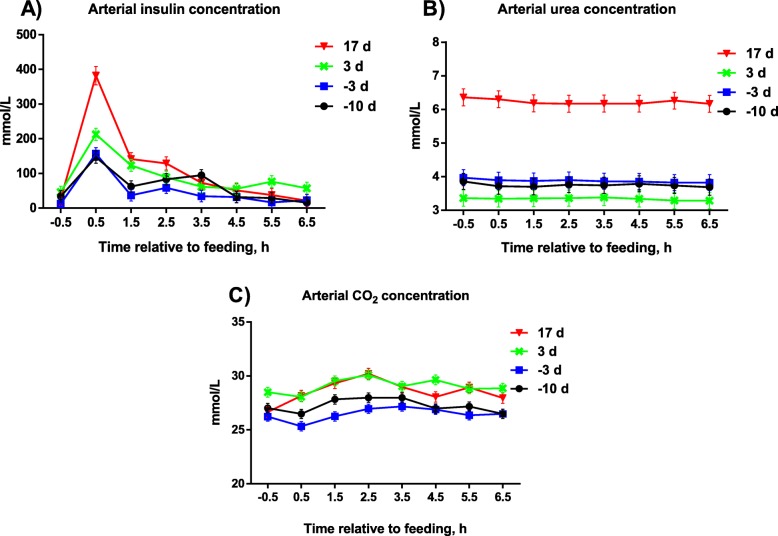
Eight second parity sows were fitted with indwelling catheters in the femoral artery and in the mesenteric, portal and hepatic veins. Eight hourly sets of blood samples were taken starting 0.5 h before feeding at - 10, - 3, + 3, and + 17 d in milk (DIM). Blood gases, plasma metabolites and apparent total tract digestibility (ATTD) of nutrients were measured.
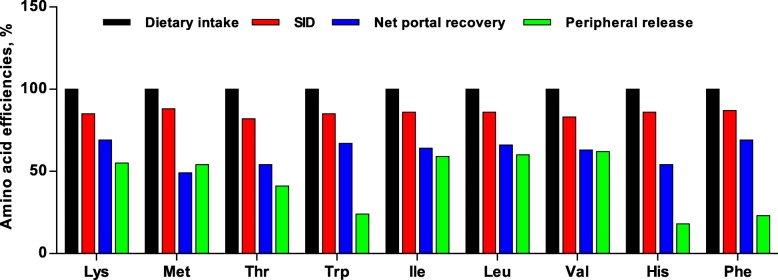
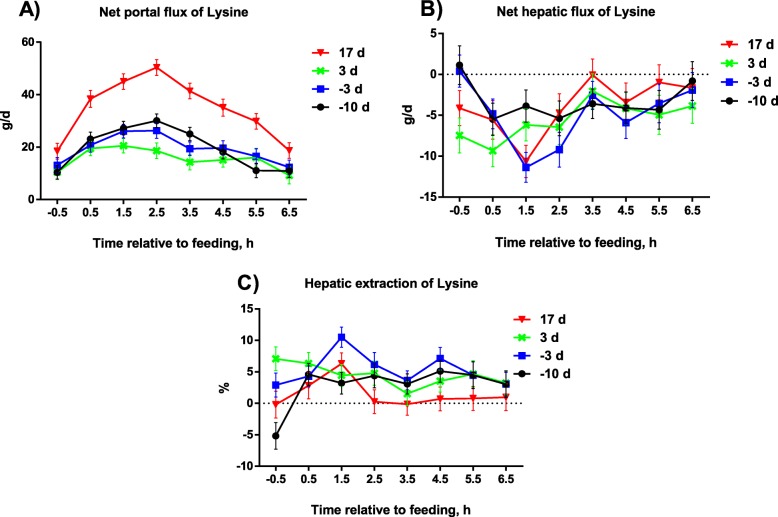
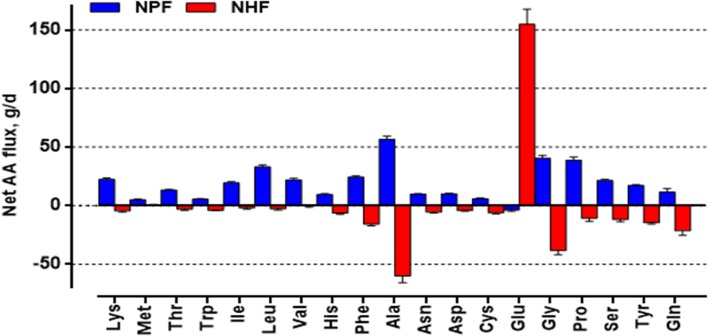
Feed intake, the ATTD of DM, energy, nitrogen, fat and crude fiber changed with DIM ( < 0.001). Except for Glu, O, and urea, all net portal fluxes were positive, and all were affected by DIM ( < 0.05) and by sampling time ( < 0.01). Compared with pre partum levels, net portal uptake of AA was 3-63% lower at + 3 DIM but 40-100% higher at + 17 DIM. Net portal fluxes of AA peaked at 1.5 to 2.5 h after feeding except for Glu, and they were positively correlated with changes in sow feed intake across DIM. The net portal recovery was low for Met (49%), Thr (54%), and His (54%) and high for the remaining essential AA (63-69%) and none of them differed across DIM. Net hepatic uptake (i.e. hepatic oxidation) of Lys, Thr, Ile, Leu and Phe peaked at 0.5 to 2.5 h after feeding, whereas uptake of Trp, Val, and His was constant, while that of Met was close to zero.
The net portal recovery was substantially lower for Met, Thr, and His than the remaining essential AA. Hepatic AA oxidation peaks 0.5 to 2.5 h after feeding. The heat production in PDV and liver was approximately two-fold higher at peak lactation compared to other stages. The study suggests that lysine was the limiting AA in peak lactation but not in early lactation.
确定妊娠后期和泌乳期母猪的营养需求对于优化母猪生产性能至关重要。本研究的目的是量化经产母猪在过渡期和泌乳期门静脉引流内脏(PDV)和肝脏中的氨基酸(AA)通量及产热情况。
八头经产二胎母猪在股动脉以及肠系膜静脉、门静脉和肝静脉中植入了留置导管。在泌乳期第-10、-3、+3和+17天,于饲喂前0.5小时开始,每小时采集一组血样。测量了血气、血浆代谢物以及养分的表观全肠道消化率(ATTD)。
采食量、干物质、能量、氮、脂肪和粗纤维的ATTD随泌乳天数(DIM)变化(P<0.001)。除谷氨酸、氧和尿素外,所有门静脉净通量均为正值,且均受DIM(P<0.05)和采样时间(P<0.01)影响。与产前水平相比,在泌乳第+3天,AA的门静脉净摄取量降低了3%-63%,但在泌乳第+17天则升高了40%-100%。除谷氨酸外,AA的门静脉净通量在采食后1.5至2.5小时达到峰值,且与整个泌乳天数内母猪采食量的变化呈正相关。蛋氨酸(49%)、苏氨酸(54%)和组氨酸(54%)的门静脉净回收率较低,其余必需氨基酸的回收率较高(63%-69%),且在不同泌乳天数间无差异。赖氨酸、苏氨酸、异亮氨酸、亮氨酸和苯丙氨酸的肝脏净摄取量(即肝脏氧化量)在采食后0.5至2.5小时达到峰值,而色氨酸、缬氨酸和组氨酸的摄取量保持恒定,蛋氨酸的摄取量接近零。
蛋氨酸、苏氨酸和组氨酸的门静脉净回收率显著低于其余必需氨基酸。肝脏AA氧化在采食后0.5至2.5小时达到峰值。与其他阶段相比,泌乳高峰期PDV和肝脏的产热大约高出两倍。该研究表明,赖氨酸在泌乳高峰期是限制性氨基酸,但在泌乳早期不是。