Department of Rheumatology and Immunology, West China Hospital, Sichuan University, 37 Guoxue Xiang, Chengdu, Sichuan 610041, China.
J Immunol Res. 2019 Dec 31;2019:5727516. doi: 10.1155/2019/5727516. eCollection 2019.
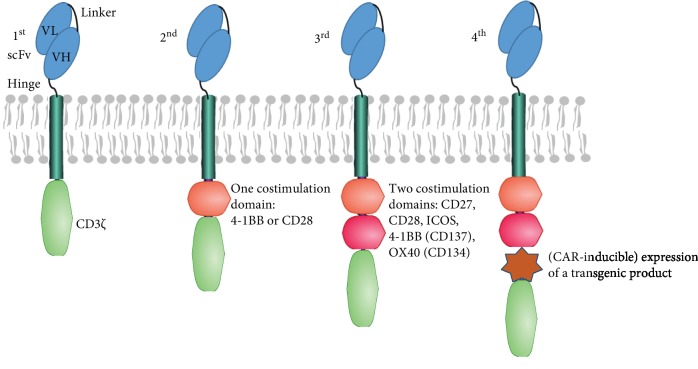
Chimeric antigen receptor T (CAR-T) cells are T cells engineered to express specific synthetic antigen receptors that can recognize antigens expressed by tumor cells, which after the binding of these antigens to the receptors are eliminated, and have been adopted to treat several kinds of malignancies. Autoimmune diseases (AIDs), a class of chronic disease conditions, can be broadly separated into autoantibody-mediated and T cell-mediated diseases. Treatments for AIDs are focused on restoring immune tolerance. However, current treatments have little effect on immune tolerance inverse; even the molecular target biologics like anti-TNF inhibitors can only mildly restore immune balance. By using the idea of CAR-T cell treatment in tumors, CAR-T cell-derived immunotherapies, chimeric autoantibody receptor T (CAAR-T) cells, and CAR regulatory T (CAR-T) cells bring new hope of treatment choice for AIDs.
嵌合抗原受体 T(CAR-T)细胞是经过基因工程改造的 T 细胞,表达特定的合成抗原受体,能够识别肿瘤细胞表达的抗原,这些抗原与受体结合后被清除,已被用于治疗多种恶性肿瘤。自身免疫性疾病(AIDs)是一类慢性疾病,可以广泛分为自身抗体介导和 T 细胞介导的疾病。AIDs 的治疗方法集中在恢复免疫耐受上。然而,目前的治疗方法对免疫耐受的逆转几乎没有效果;即使是像抗 TNF 抑制剂这样的分子靶向生物制剂,也只能轻微地恢复免疫平衡。通过在肿瘤中使用 CAR-T 细胞治疗的思路,CAR-T 细胞衍生的免疫疗法、嵌合自身抗体受体 T(CAAR-T)细胞和 CAR 调节性 T(CAR-T)细胞为 AIDs 的治疗选择带来了新的希望。