Yan Jianhua, Zhang Yuanyuan, Zhao Yun, Song Jun, Xia Shuhui, Liu Shujie, Yu Jianyong, Ding Bin
State Key Laboratory for Modification of Chemical Fibers and Polymer Materials, College of Textiles, Donghua University, Shanghai, China.
Innovation Center for Textile Science and Technology, Donghua University, Shanghai, China.
Sci Adv. 2020 Feb 7;6(6):eaay8538. doi: 10.1126/sciadv.aay8538. eCollection 2020 Feb.
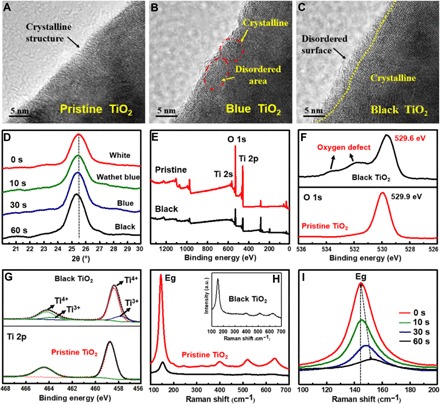
Oxide ceramics are considered to be nonconductive brittle materials, which limits their applications in emerging fields such as conductive textiles. Here, we show a facile domino-cascade reduction method that enables rapid transformation of ceramic nanofiber textiles from insulation to conduction at room temperature. After putting dimethylacetamide-wetted textiles, including TiO, SnO, BaTiO, and LiLaTiO, on lithium plates, the self-driven chemical reactions induce defects in oxides. These defects initiate an interfacial insulation-to-conductive phase transition, which triggers the domino-cascade reduction from the interface to the whole textile. Correspondingly, the conductivity of the textile sharply increased from 0 to 40 S/m over a period of 1 min. The modified oxide textiles exhibit enhanced electrochemical performance when substituting the metallic current collectors of lithium batteries. This room temperature reduction method can protect the nanostructures while inducing defects in oxide ceramic textiles, appealing for numerous applications.
氧化物陶瓷被认为是不导电的脆性材料,这限制了它们在诸如导电纺织品等新兴领域的应用。在此,我们展示了一种简便的多米诺级联还原方法,该方法能够在室温下使陶瓷纳米纤维纺织品从绝缘快速转变为导电。将包括TiO、SnO、BaTiO和LiLaTiO在内的用二甲基乙酰胺浸湿的纺织品放在锂片上后,自驱动化学反应会在氧化物中引发缺陷。这些缺陷引发界面绝缘到导电的相变,从而触发从界面到整个纺织品的多米诺级联还原。相应地,纺织品的电导率在1分钟内从0急剧增加到40 S/m。当替代锂电池的金属集流体时,改性氧化物纺织品表现出增强的电化学性能。这种室温还原方法在诱导氧化物陶瓷纺织品产生缺陷的同时可以保护纳米结构,在众多应用中颇具吸引力。