State Key Laboratory of New Ceramics and Fine Processing, School of Materials Science and Engineering, Tsinghua University, 100084, Beijing, China.
Department of Chemistry and Collaborative Innovation Center for Nanomaterial Science and Engineering, Tsinghua University, 100084, Beijing, China.
Nat Commun. 2018 Apr 3;9(1):1302. doi: 10.1038/s41467-018-03765-0.
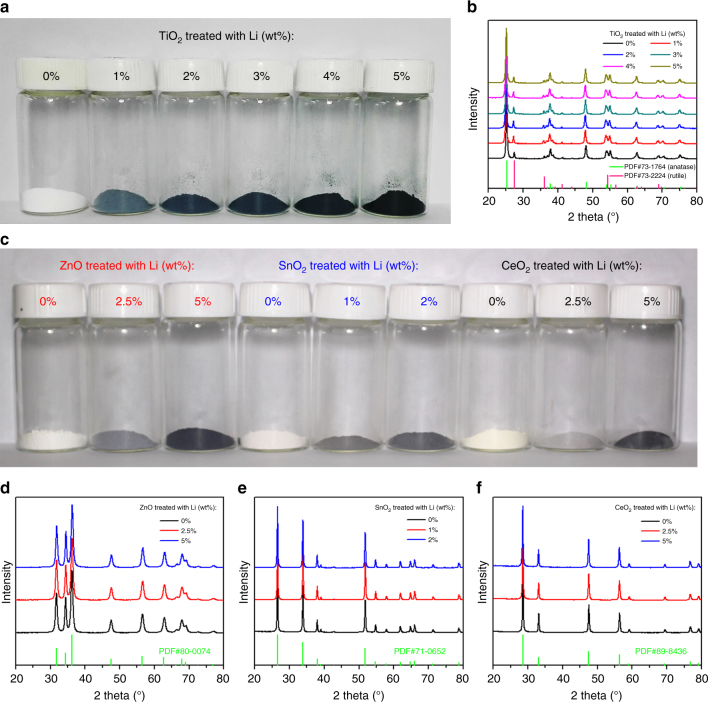
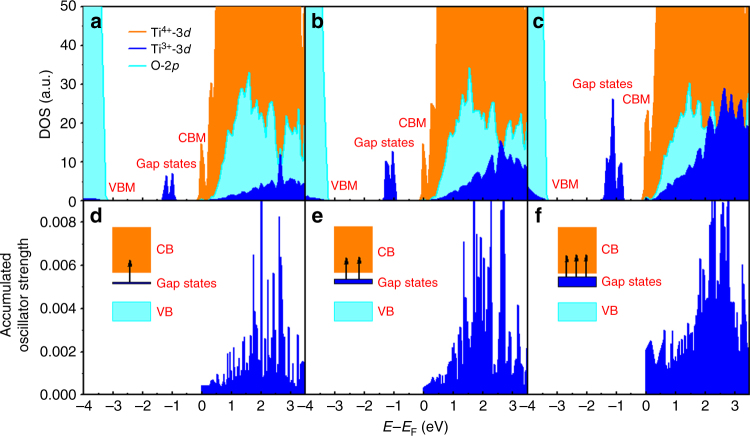
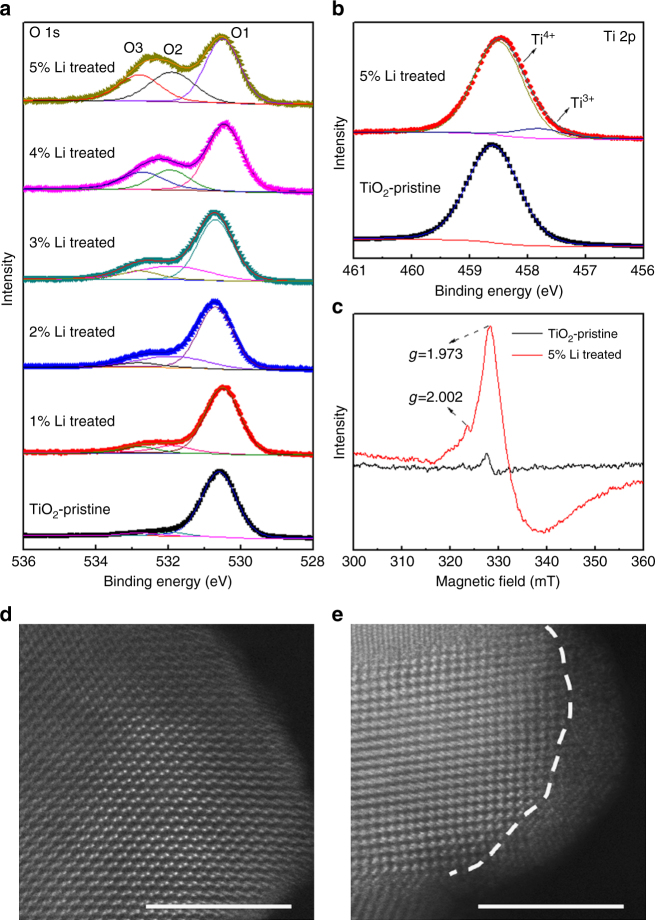
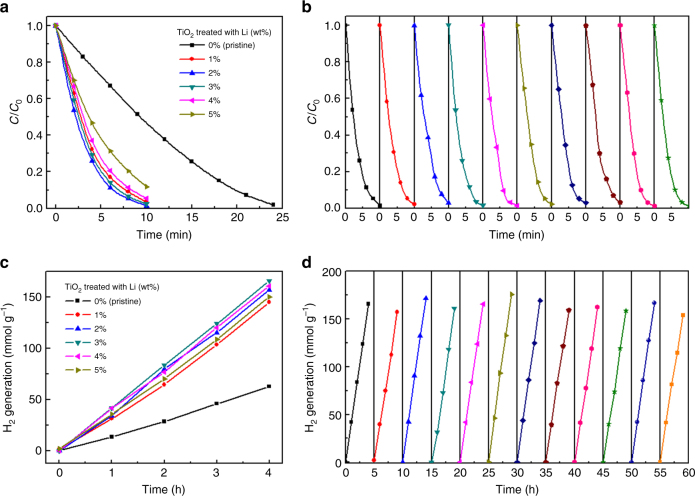
Defects can greatly influence the properties of oxide materials; however, facile defect engineering of oxides at room temperature remains challenging. The generation of defects in oxides is difficult to control by conventional chemical reduction methods that usually require high temperatures and are time consuming. Here, we develop a facile room-temperature lithium reduction strategy to implant defects into a series of oxide nanoparticles including titanium dioxide (TiO), zinc oxide (ZnO), tin dioxide (SnO), and cerium dioxide (CeO). Our lithium reduction strategy shows advantages including all-room-temperature processing, controllability, time efficiency, versatility and scalability. As a potential application, the photocatalytic hydrogen evolution performance of defective TiO is examined. The hydrogen evolution rate increases up to 41.8 mmol g h under one solar light irradiation, which is ~3 times higher than that of the pristine nanoparticles. The strategy of tuning defect oxides used in this work may be beneficial for many other related applications.
缺陷会极大地影响氧化物材料的性能;然而,在室温下实现氧化物的易缺陷工程仍然具有挑战性。传统的化学还原方法很难控制氧化物中的缺陷生成,这些方法通常需要高温且耗时。在这里,我们开发了一种简便的室温锂还原策略,可将缺陷植入一系列氧化物纳米粒子中,包括二氧化钛 (TiO)、氧化锌 (ZnO)、氧化锡 (SnO) 和二氧化铈 (CeO)。我们的锂还原策略具有以下优点:全室温处理、可控性、时间效率、多功能性和可扩展性。作为潜在的应用,我们研究了缺陷二氧化钛的光催化析氢性能。在一个太阳光照下,氢的析出速率高达 41.8 mmol g h,比原始纳米粒子高约 3 倍。本工作中用于调节缺陷氧化物的策略可能对许多其他相关应用有益。