Oral and Maxillofacial Diseases, University of Helsinki, Helsinki, Finland.
Institute of Global Health, University of Heidelberg, Heidelberg, Germany.
PLoS One. 2020 Feb 21;15(2):e0228806. doi: 10.1371/journal.pone.0228806. eCollection 2020.
Periodontitis is associated with increased serum lipopolysaccharide (LPS) activity, which may be one mechanism linking periodontitis with the risk of cardiovascular diseases. As LPS-carrying proteins including lipoproteins modify LPS-activity, we investigated the determinants of serum LPS-neutralizing capacity (LPS-NC) in ischemic stroke. The association of LPS-NC and Aggregatibacter actinomycetemcomitans, a major microbial biomarker in periodontitis, was also investigated.
The assay to measure LPS-NC was set up by spiking serum samples with E. coli LPS. The LPS-NC, LPS-binding protein (LBP), soluble CD14 (sCD14), lipoprotein profiles, apo(lipoprotein) A-I, apoB, and phospholipid transfer protein (PLTP) activity, were determined in 98 ischemic stroke patients and 100 age- and sex-matched controls. Serum and saliva immune response to A. actinomycetemcomitans, its concentration in saliva, and serotype-distribution were examined.
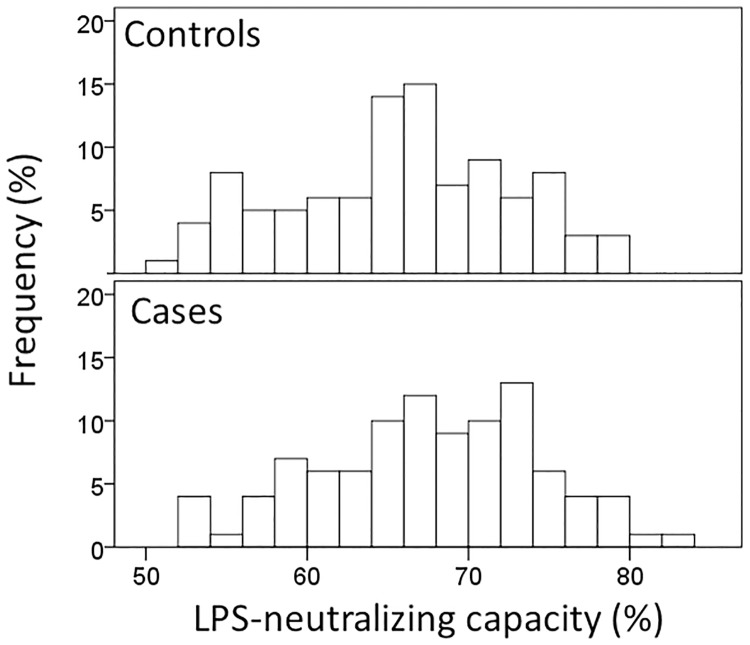
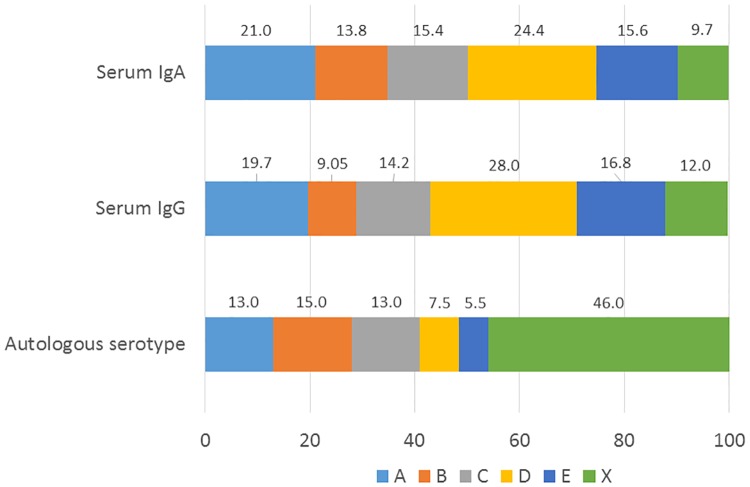
LPS-NC values ranged between 51-83% in the whole population. Although several of the LPS-NC determinants differed significantly between cases and controls (PLTP, sCD14, apoA-I, HDL-cholesterol), the levels did not (p = 0.056). The main determinants of LPS-NC were i) triglycerides (β = -0.68, p<0.001), and ii) HDL cholesterol (0.260, <0.001), LDL cholesterol (-0.265, <0.001), PLTP (-0.196, 0.011), and IgG against A. actinomycetemcomitans (0.174, 0.011). Saliva A. actinomycetemcomitans concentration was higher [log mean (95% CI), 4.39 (2.35-8.19) vs. 10.7 (5.45-21) genomes/ml, p = 0.023) and serotype D more frequent (4 vs. 0%, p = 0.043) in cases than controls. Serotypeablity or serotypes did not, however, relate to the LPS-NC.
Serum LPS-NC comprised low PLTP-activity, triglyceride and LDL cholesterol concentrations, as well as high HDL cholesterol and IgG against A. actinomycetemcomitans. The present findings let us to conclude that LPS-NC did not associate with stroke.
牙周炎与血清脂多糖(LPS)活性增加有关,这可能是牙周炎与心血管疾病风险相关的机制之一。由于携带 LPS 的蛋白质(包括脂蛋白)会改变 LPS 的活性,我们研究了缺血性中风患者血清 LPS 中和能力(LPS-NC)的决定因素。还研究了 LPS-NC 与牙周炎主要微生物生物标志物聚集放线杆菌之间的关联。
通过向血清样本中加入大肠杆菌 LPS 来建立测量 LPS-NC 的测定方法。在 98 名缺血性中风患者和 100 名年龄和性别匹配的对照者中,测定了 LPS-NC、LPS 结合蛋白(LBP)、可溶性 CD14(sCD14)、脂蛋白谱、载脂蛋白(脂蛋白)A-I、载脂蛋白 B 和磷脂转移蛋白(PLTP)活性。检测了血清和唾液对聚集放线杆菌的免疫反应、唾液中的浓度和血清型分布。
整个人群的 LPS-NC 值范围在 51%-83%之间。尽管病例组和对照组之间的一些 LPS-NC 决定因素差异显著(PLTP、sCD14、apoA-I、HDL 胆固醇),但水平没有差异(p=0.056)。LPS-NC 的主要决定因素是 i)甘油三酯(β=-0.68,p<0.001),ii)HDL 胆固醇(0.260,<0.001),LDL 胆固醇(-0.265,<0.001),PLTP(-0.196,0.011)和针对聚集放线杆菌的 IgG(0.174,0.011)。与对照组相比,病例组唾液中聚集放线杆菌的浓度更高[对数平均值(95%CI),4.39(2.35-8.19)vs. 10.7(5.45-21)基因组/ml,p=0.023)和血清型 D 更为频繁(4 对 0%,p=0.043)。然而,血清型或血清型与 LPS-NC 无关。
血清 LPS-NC 包含低 PLTP 活性、甘油三酯和 LDL 胆固醇浓度,以及高 HDL 胆固醇和针对聚集放线杆菌的 IgG。本研究结果表明,LPS-NC 与中风无关。