Pallangyo Pedro, Millinga Jalack, Bhalia Smita, Mkojera Zabella, Misidai Nsajigwa, Swai Happiness J, Hemed Naairah R, Kaijage Alice, Janabi Mohamed
Unit of Research, Jakaya Kikwete Cardiac Institute, P.O Box 65141, Dar es Salaam, Tanzania.
Department of Adult Cardiology, Jakaya Kikwete Cardiac Institute, P.O Box 65141, Dar es Salaam, Tanzania.
BMC Res Notes. 2020 Feb 21;13(1):89. doi: 10.1186/s13104-020-04959-w.
Management of heart failure is complex and multifaceted but adherence to medications remains the cornerstone of preventing avoidable readmissions, premature deaths, and unnecessary healthcare expenses. Despite of evidence-based efficacy on anti-failure drugs, poor adherence is pervasive and remains a significant barrier to improving clinical outcomes in heart failure population.
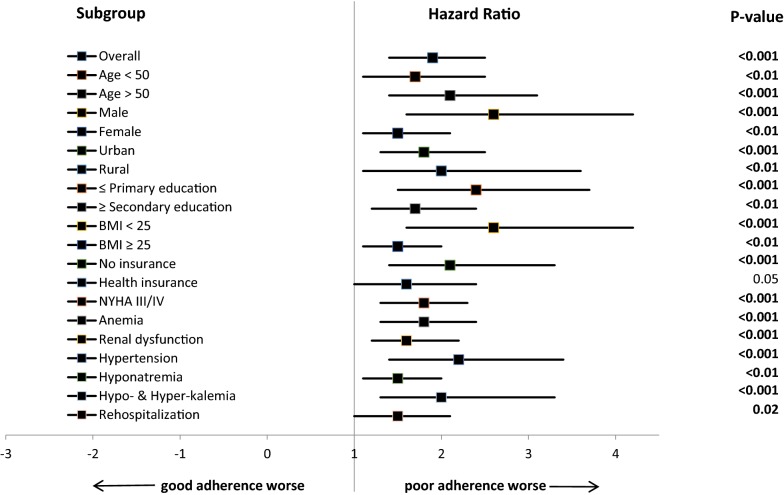
We enrolled 459 patients with diagnosis of heart failure admitted at a tertiary cardiovascular hospital in Dar es Salaam, Tanzania. The mean age was 46.4 years, there was a female predominance (56.5%), 67.5% resided in urban areas and 74.2% had primary education. Of the 419 participants eligible for assessment of medication adherence, 313 (74.7%) had poor adherence and 106 (25.3%) had good adherence. Possession of a health insurance was found to be the strongest associated factor for adherence (adjusted OR 8.7, 95% CI 4.7-16.0, p < 0.001). Participants with poor adherence displayed a 70% increased risk for rehospitalization compared to their counterparts with good adherence (adjusted RR 1.7, 95% CI 1.2-2.9, p = 0.04). Poor adherence was found to be the strongest predictor of early mortality (HR 2.5, 95% CI 1.3-4.6, p < 0.01). In conclusion, Poor medication adherence in patients with heart failure is associated with increased readmissions and mortality.
心力衰竭的管理复杂且涉及多方面,但坚持用药仍然是预防可避免的再入院、过早死亡和不必要医疗费用的基石。尽管抗心力衰竭药物有循证疗效,但用药依从性差的情况普遍存在,仍然是改善心力衰竭患者临床结局的重大障碍。
我们纳入了坦桑尼亚达累斯萨拉姆一家三级心血管医院收治的459例心力衰竭确诊患者。平均年龄为46.4岁,女性占多数(56.5%),67.5%居住在城市地区,74.2%接受过小学教育。在419名符合用药依从性评估条件的参与者中,313人(74.7%)依从性差,106人(25.3%)依从性好。结果发现,拥有医疗保险是与依从性最相关的因素(调整后的比值比为8.7,95%置信区间为4.7 - 16.0,p < 0.001)。与依从性好的参与者相比,依从性差的参与者再次住院的风险增加了70%(调整后的风险比为1.7,95%置信区间为1.2 - 2.9,p = 0.04)。结果发现,依从性差是早期死亡的最强预测因素(风险比为2.5,95%置信区间为1.3 - 4.6,p < 0.01)。总之,心力衰竭患者用药依从性差与再入院率和死亡率增加有关。