Department of Neurobiology, Duke University School of Medicine, Durham, NC 27705, United States.
Curr Opin Neurobiol. 2020 Oct;64:24-31. doi: 10.1016/j.conb.2020.01.004. Epub 2020 Feb 18.
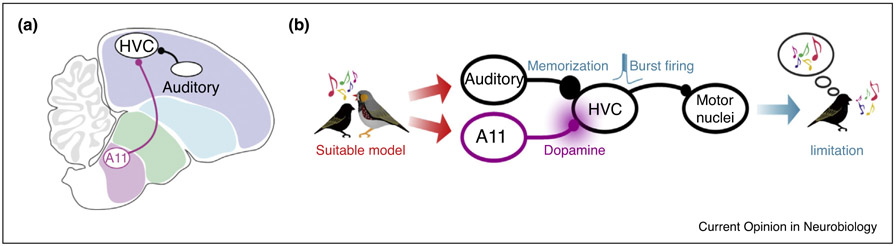
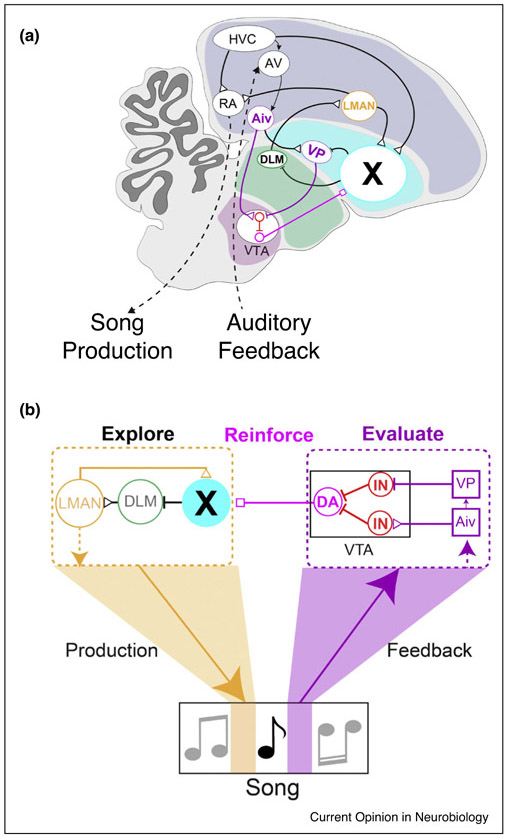
Vocalizations are an important medium for sexual and social signaling in mammals and birds. In most mammals other than humans, vocalizations are specified by innate mechanisms and develop normally in the absence of auditory experience. By contrast, juvenile songbirds memorize and copy the songs of adult tutors, a process with many parallels to human speech learning. Despite the centrality of vocal learning to human speech, vocal production in humans as well as in songbirds exploits ancestral circuitry for innate vocalizations, and effective vocal communication depends on the fluent blending of innate and learned elements. This review covers recent advances in our understanding of central mechanisms for learned and innate vocalizations in birds and mice, including brainstem mechanisms that help to 'gate' vocalizations on or off, cortical involvement in learned and innate vocalizations, and the delineation of circuits that evaluate and reinforce song performance to facilitate vocal learning.
发声是哺乳动物和鸟类进行性和社交信号传递的重要媒介。在除人类以外的大多数哺乳动物中,发声是由先天机制决定的,并且在没有听觉经验的情况下也能正常发育。相比之下,幼年鸣禽会记住并模仿成年导师的歌曲,这一过程与人类言语学习有许多相似之处。尽管声乐学习对人类言语至关重要,但人类和鸣禽的发声都利用了先天发声的祖传电路,有效的声乐交流取决于先天和后天元素的流畅融合。这篇综述涵盖了我们对鸟类和老鼠学习和先天发声的中枢机制的最新理解,包括有助于开启或关闭发声的脑干机制、皮层参与学习和先天发声、以及评估和强化歌曲表现以促进声乐学习的回路的描绘。