Department of Pharmaceutical Sciences, College of Pharmacy, The University of Oklahoma Health Sciences Center, Oklahoma City, Oklahoma, USA.
Department of Obstetrics and Gynecology, College of Medicine, The University of Oklahoma Health Sciences Center, Oklahoma City, Oklahoma, USA.
AAPS J. 2020 Feb 21;22(2):51. doi: 10.1208/s12248-020-0421-z.
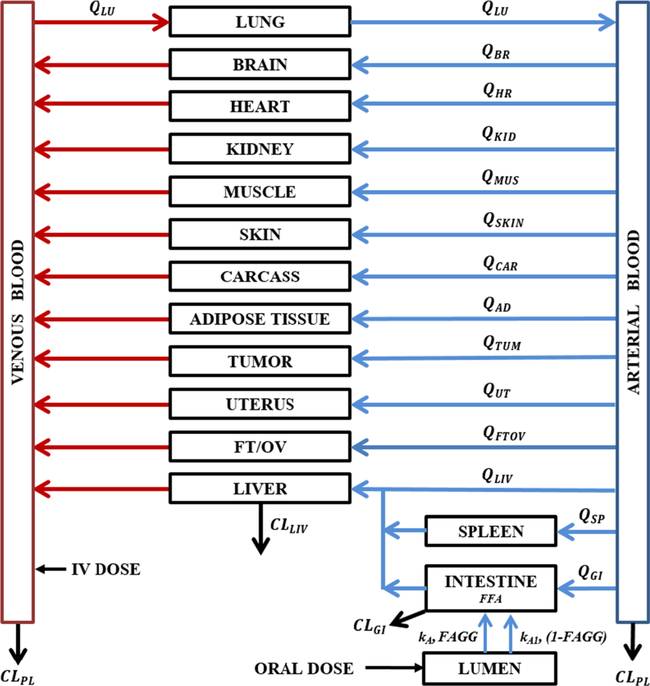
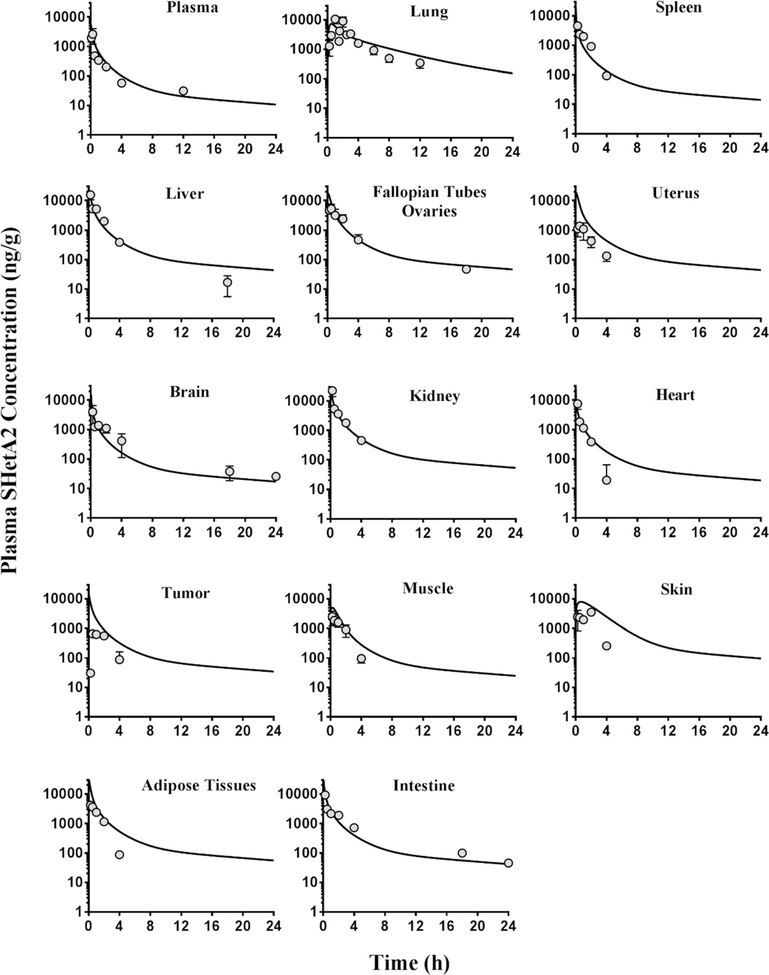
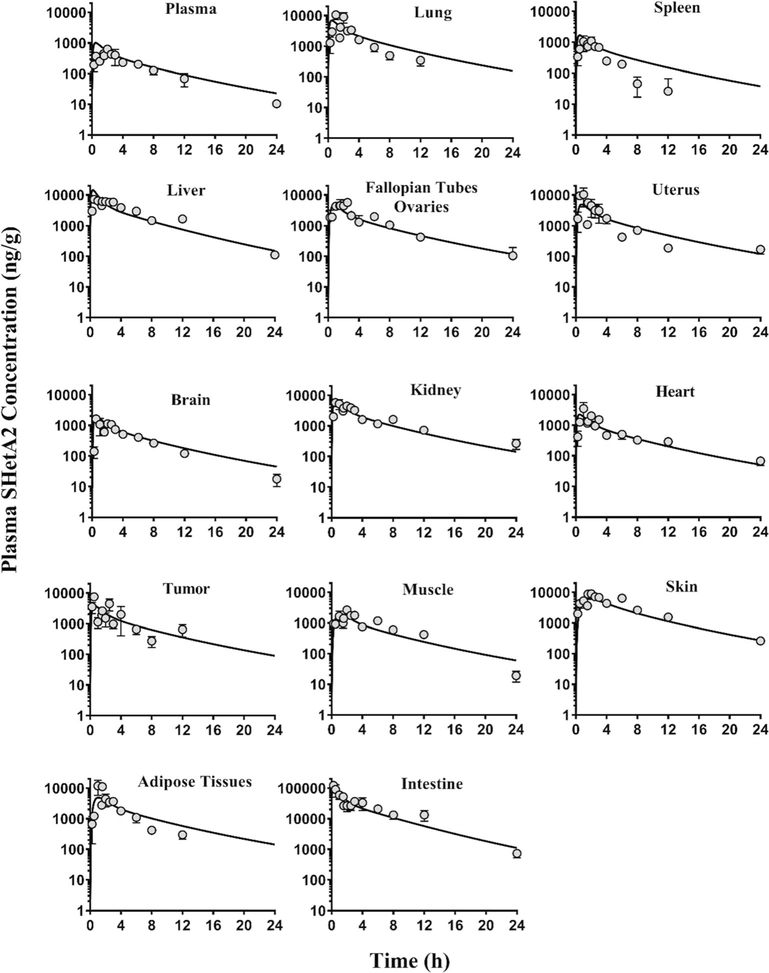
The orally available novel small molecule SHetA2 is the lead sulfur-containing heteroarotinoid that selectively inhibits cancer cells over normal cells, and is currently under clinical development for anticancer treatment and cancer prevention. The objective of this study was to assess and characterize the tissue distribution of SHetA2 in tumor-bearing mice by developing a physiologically based pharmacokinetic (PBPK) model. An orthotopic SKOV3 ovarian cancer xenograft mouse model was used to most accurately mimic the ovarian cancer tumor microenvironment in the peritoneal cavity. SHetA2 concentrations in plasma and 14 different tissues were measured at various time points after a single intravenous dose of 10 mg/kg and oral dose of 60 mg/kg, and these data were used to develop a whole-body PBPK model. SHetA2 exhibited a multi-exponential plasma concentration decline with an elimination half-life of 4.5 h. Rapid and extensive tissue distribution, which was best described by a perfusion rate-limited model, was observed with the tissue-to-plasma partition coefficients (k = 1.4-21.2). The PBPK modeling estimated the systemic clearance (76.4 mL/h) from circulation as a main elimination pathway of SHetA2. It also indicated that the amount absorbed into intestine was the major determining factor for the oral bioavailability (22.3%), while the first-pass loss from liver and intestine contributed minimally (< 1%). Our results provide an insight into SHetA2 tissue distribution characteristics. The developed PBPK model can be used to predict the drug exposure at tumors or local sites of action for different dosing regimens and scaled up to humans to correlate with efficacy.
口服新型小分子 SHetA2 是一种含硫杂芳环类化合物,选择性抑制癌细胞而不影响正常细胞,目前正在进行临床开发,用于癌症治疗和癌症预防。本研究旨在通过建立基于生理的药代动力学(PBPK)模型来评估和描述 SHetA2 在荷瘤小鼠中的组织分布。使用原位 SKOV3 卵巢癌异种移植小鼠模型最准确地模拟了腹腔内卵巢癌肿瘤微环境。在单次静脉注射 10mg/kg 和口服 60mg/kg 后,在不同时间点测量了 SHetA2 在血浆和 14 种不同组织中的浓度,并使用这些数据来建立全身 PBPK 模型。SHetA2 表现出多指数血浆浓度下降,消除半衰期为 4.5 小时。快速广泛的组织分布,最好用灌注速率限制模型来描述,组织与血浆分配系数(k=1.4-21.2)。PBPK 模型估计从循环中清除的全身清除率(76.4 mL/h)是 SHetA2 的主要消除途径。它还表明,进入肠道的吸收量是口服生物利用度(22.3%)的主要决定因素,而肝脏和肠道的首过损失贡献最小(<1%)。我们的结果提供了对 SHetA2 组织分布特征的深入了解。所建立的 PBPK 模型可用于预测不同给药方案下肿瘤或局部作用部位的药物暴露,并推广到人体以与疗效相关联。