• 文献检索
  • 文档翻译
  • 深度研究
  • 学术资讯
  • Suppr Zotero 插件Zotero 插件
  • 邀请有礼
  • 套餐&价格
  • 历史记录
应用&插件
Suppr Zotero 插件Zotero 插件浏览器插件Mac 客户端Windows 客户端微信小程序
定价
高级版会员购买积分包购买API积分包
服务
文献检索文档翻译深度研究API 文档MCP 服务
关于我们
关于 Suppr公司介绍联系我们用户协议隐私条款
关注我们

Suppr 超能文献

核心技术专利:CN118964589B侵权必究
粤ICP备2023148730 号-1Suppr @ 2026

文献检索

告别复杂PubMed语法,用中文像聊天一样搜索,搜遍4000万医学文献。AI智能推荐,让科研检索更轻松。

立即免费搜索

文件翻译

保留排版,准确专业,支持PDF/Word/PPT等文件格式,支持 12+语言互译。

免费翻译文档

深度研究

AI帮你快速写综述,25分钟生成高质量综述,智能提取关键信息,辅助科研写作。

立即免费体验

高海拔地区对四个国家 2 岁以下健康婴儿和儿童呼吸频率及血氧饱和度参考值的影响:一项横断面研究。

Effects of high altitude on respiratory rate and oxygen saturation reference values in healthy infants and children younger than 2 years in four countries: a cross-sectional study.

机构信息

Department of Paediatrics, School of Medicine, University of Washington, Seattle, WA, USA; Division of Pulmonary and Sleep Medicine, Seattle Children's Hospital, Seattle, WA, USA.

Division of Pulmonary and Critical Care, Johns Hopkins University School of Medicine, Baltimore, MD, USA; Centre for Global Non-Communicable Disease Research and Training, Johns Hopkins University School of Medicine, Baltimore, MD, USA.

出版信息

Lancet Glob Health. 2020 Mar;8(3):e362-e373. doi: 10.1016/S2214-109X(19)30543-1.

DOI:10.1016/S2214-109X(19)30543-1
PMID:32087173
原文链接:
https://pmc.ncbi.nlm.nih.gov/articles/PMC7034060/
Abstract

BACKGROUND

In resource-limited settings, pneumonia diagnosis and management are based on thresholds for respiratory rate (RR) and oxyhaemoglobin saturation (SpO) recommended by WHO. However, as RR increases and SpO decreases with elevation, these thresholds might not be applicable at all altitudes. We sought to determine upper thresholds for RR and lower thresholds for SpO by age and altitude at four sites, with altitudes ranging from sea level to 4348 m.

METHODS

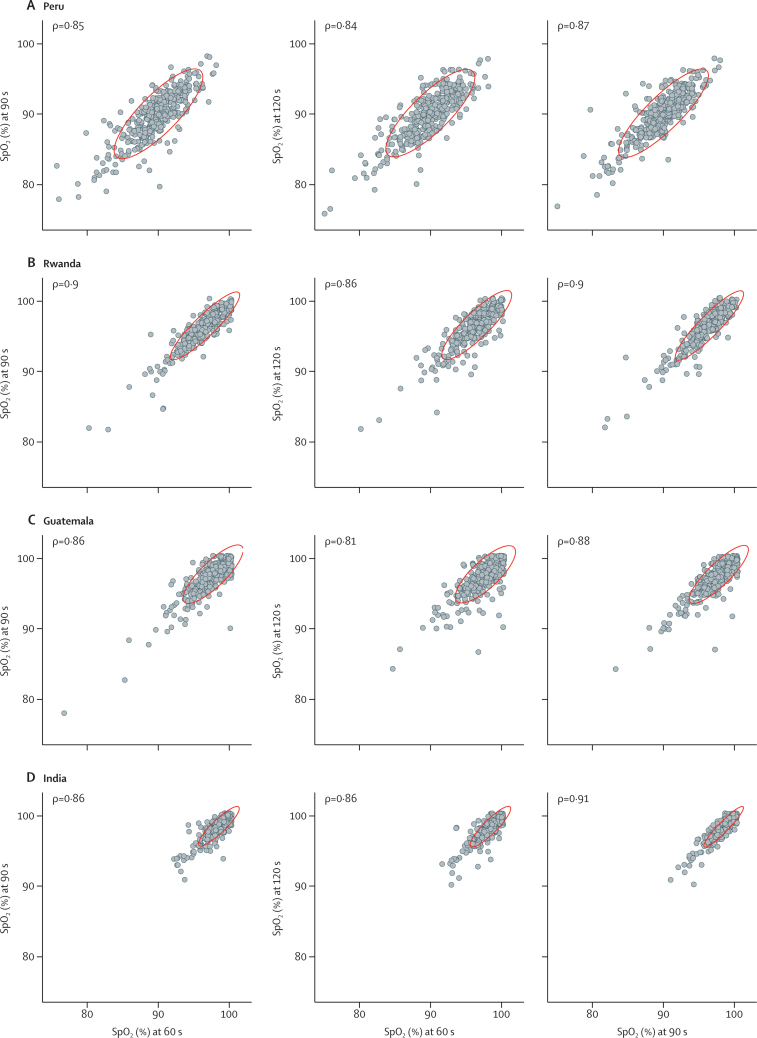
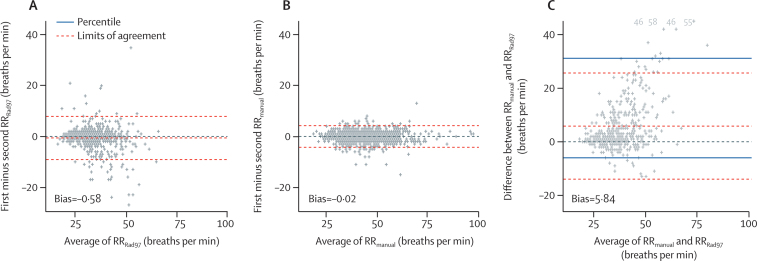
In this cross-sectional study, we enrolled healthy children aged 0-23 months who lived within the study areas in India, Guatemala, Rwanda, and Peru. Participants were excluded if they had been born prematurely (<37 weeks gestation); had a congenital heart defect; had history in the past 2 weeks of overnight admission to a health facility, diagnosis of pneumonia, antibiotic use, or respiratory or gastrointestinal signs; history in the past 24 h of difficulty breathing, fast breathing, runny nose, or nasal congestion; and current runny nose, nasal congestion, fever, chest indrawing, or cyanosis. We measured RR either automatically with the Masimo Rad-97, manually, or both, and measured SpO with the Rad-97. Trained staff measured RR in duplicate and SpO in triplicate in children who had no respiratory symptoms or signs in the past 2 weeks. We estimated smooth percentiles for RR and SpO that varied by age and site using generalised additive models for location, shape, and scale. We compared these data with WHO RR and SpO thresholds for tachypnoea and hypoxaemia to determine agreement.

FINDINGS

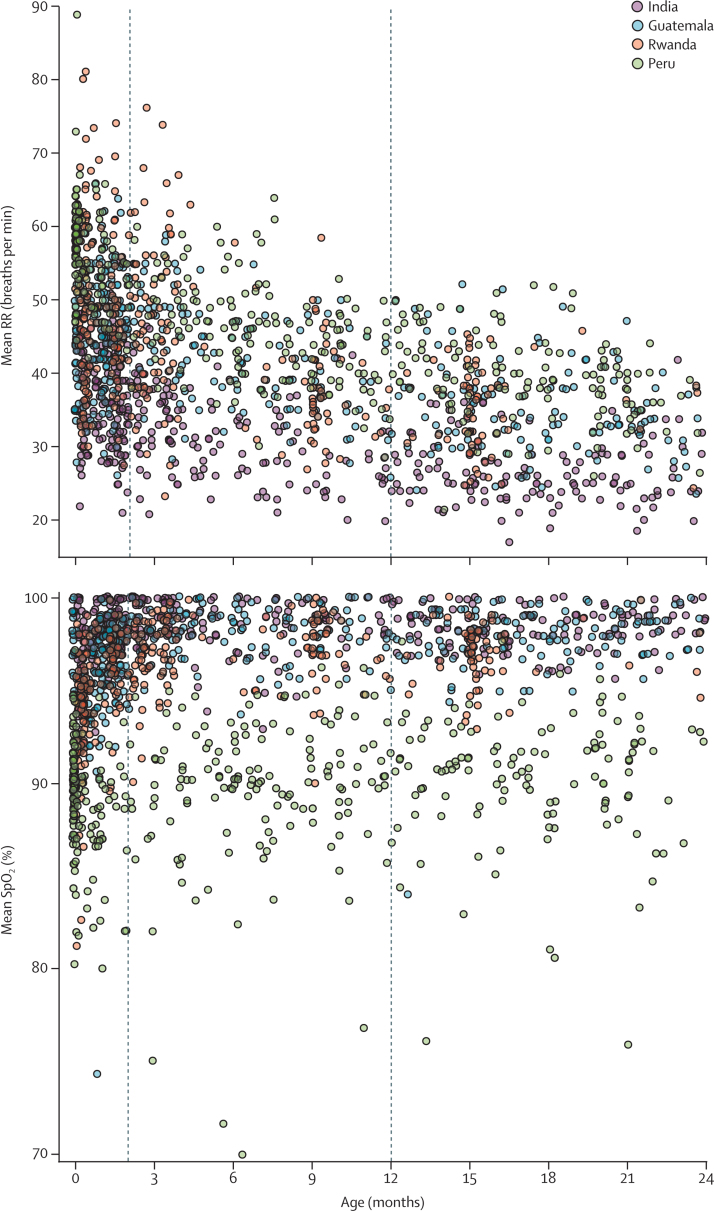
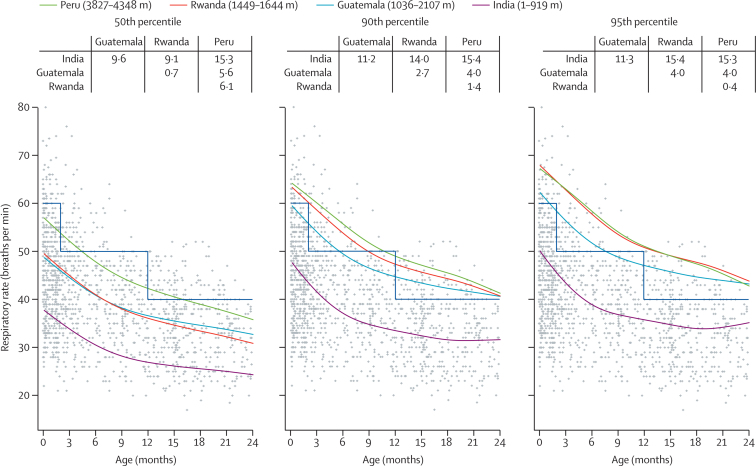
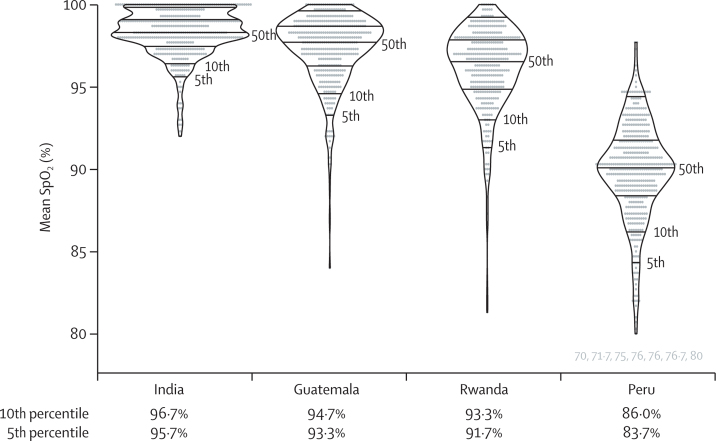
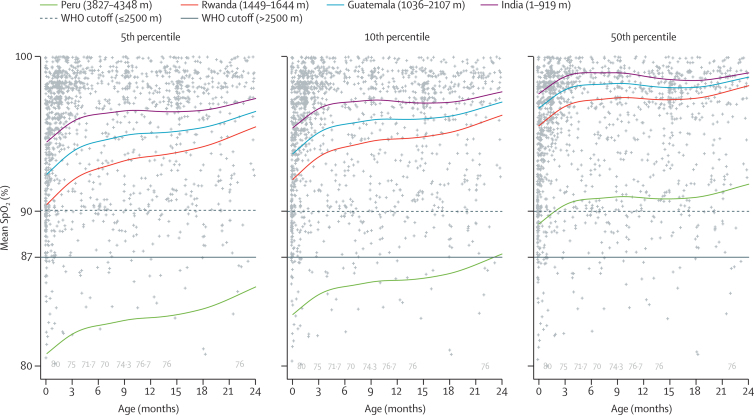
Between Nov 24, 2017, and Oct 10, 2018, we screened 2027 children for eligibility. 335 were ineligible, leaving 1692 eligible participants. 30 children were excluded because of missing values and 92 were excluded because of measurement or data entry errors, leaving 1570 children in the final analysis. 404 participants were from India (altitude 1-919 m), 389 were from Guatemala (1036-2017 m), 341 from Rwanda (1449-1644 m), and 436 from Peru (3827-4348 m). Mean age was 7·2 months (SD 7·2) and 796 (50·7%) of 1570 participants were female. Although average age was mostly similar between settings, the average participant age in Rwanda was noticeably younger, at 5·5 months (5·9). In the 1570 children included in the analysis, mean RR was 31·9 breaths per min (SD 7·1) in India, 41·5 breaths per min in Guatemala (8·4), 44·0 breaths per min in Rwanda (10·8), and 48·0 breaths per min in Peru (9·4). Mean SpO was 98·3% in India (SD 1·5), 97·3% in Guatemala (2·4), 96·2% in Rwanda (2·6), and 89·7% in Peru (3·5). Compared to India, mean RR was 9·6 breaths per min higher in Guatemala, 12·1 breaths per min higher in Rwanda, and 16·1 breaths per min higher in Peru (likelihood ratio test p<0·0001). Smooth percentiles for RR and SpO varied by site and age. When we compared age-specific and site-specific 95th percentiles for RR and 5th percentiles for SpO against the WHO cutoffs, we found that the proportion of false positives for tachypnoea increased with altitude: 0% in India (95% CI 0-0), 7·3% in Guatemala (4·1-10·4), 16·8% in Rwanda (12·9-21·1), and 28·9% in Peru (23·7-33·0). We also found a high proportion of false positives for hypoxaemia in Peru (11·6%, 95% CI 7·0-14·7).

INTERPRETATION

WHO cutoffs for fast breathing and hypoxaemia overlap with RR and SpO values that are normal for children in different altitudes. Use of WHO definitions for fast breathing could result in misclassification of pneumonia in many children who live at moderate to high altitudes and show acute respiratory signs. The 5th percentile for SpO was in reasonable agreement with the WHO definition of hypoxaemia in all regions except for Peru (the highest altitude site). Misclassifications could result in inappropriate management of paediatric respiratory illness and misdirection of potentially scarce resources such as antibiotics and supplemental oxygen. Future studies at various altitudes are needed to validate our findings and recommend a revision to current guidelines. Substantiating research in sick children is still needed.

FUNDING

US National Institutes of Health, Bill & Melinda Gates Foundation.

摘要

背景

在资源有限的情况下,肺炎的诊断和管理基于世界卫生组织(WHO)推荐的呼吸频率(RR)和血氧饱和度(SpO)阈值。然而,随着海拔的升高,RR 增加,SpO 降低,这些阈值可能并不适用于所有海拔高度。我们旨在确定四个地点(海拔范围从海平面到 4348 米)按年龄和海拔划分的 RR 上限和 SpO 下限。

方法

在这项横断面研究中,我们招募了居住在印度、危地马拉、卢旺达和秘鲁研究区域内 0-23 个月龄的健康儿童。如果儿童有以下情况则被排除在外:早产(<37 周妊娠);先天性心脏病;过去 2 周内有过夜间住院、肺炎诊断、抗生素使用或呼吸或胃肠道症状的病史;过去 24 小时内有呼吸困难、呼吸急促、流鼻涕或鼻塞的病史;目前有流鼻涕、鼻塞、发热、胸部凹陷或发绀。我们使用 Masimo Rad-97 自动或手动测量 RR,并用 Rad-97 测量 SpO。在过去 2 周内没有出现呼吸道症状或体征的儿童中,由经过培训的工作人员重复测量 RR,用三重测量 SpO。使用位置、形状和比例的广义加性模型来估计 RR 和 SpO 的平滑百分位数,这些百分位数随年龄和地点而变化。我们将这些数据与 WHO 用于确定呼吸急促和低氧血症的 RR 和 SpO 阈值进行比较,以确定一致性。

发现

在 2017 年 11 月 24 日至 2018 年 10 月 10 日期间,我们对 2027 名儿童进行了筛选,以确定其是否符合纳入标准。其中 335 名儿童不符合条件,其余 1692 名儿童符合条件。有 30 名儿童因数据缺失被排除,92 名儿童因测量或数据输入错误被排除,最终有 1570 名儿童纳入分析。其中 404 名儿童来自印度(海拔 1-919 米),389 名儿童来自危地马拉(海拔 1036-2017 米),341 名儿童来自卢旺达(海拔 1449-1644 米),436 名儿童来自秘鲁(海拔 3827-4348 米)。平均年龄为 7.2 个月(SD 7.2),1570 名参与者中 796 名(50.7%)为女性。虽然各地区的平均年龄大致相似,但卢旺达的平均参与者年龄明显较小,为 5.5 个月(5.9)。在纳入分析的 1570 名儿童中,RR 的平均值在印度为 31.9 次/分钟(SD 7.1),在危地马拉为 41.5 次/分钟(8.4),在卢旺达为 44.0 次/分钟(10.8),在秘鲁为 48.0 次/分钟(9.4)。SpO 的平均值在印度为 98.3%(SD 1.5),在危地马拉为 97.3%(2.4),在卢旺达为 96.2%(2.6),在秘鲁为 89.7%(3.5)。与印度相比,危地马拉 RR 平均高 9.6 次/分钟,卢旺达 RR 平均高 12.1 次/分钟,秘鲁 RR 平均高 16.1 次/分钟(似然比检验 p<0.0001)。RR 和 SpO 的平滑百分位数随地点和年龄而变化。当我们比较 RR 的年龄特异性和地点特异性 95%百分位数和 SpO 的 5%百分位数与 WHO 截止值时,我们发现随着海拔的升高,呼吸急促的假阳性比例增加:印度为 0%(95%CI 0-0),危地马拉为 7.3%(4.1-10.4),卢旺达为 16.8%(12.9-21.1),秘鲁为 28.9%(23.7-33.0)。我们还发现秘鲁低氧血症的假阳性比例很高(11.6%,95%CI 7.0-14.7)。

解释

WHO 用于呼吸急促和低氧血症的截止值与不同海拔高度儿童的正常 RR 和 SpO 值重叠。在许多居住在中高度海拔地区并出现急性呼吸道症状的儿童中,使用 WHO 定义的快速呼吸可能会导致肺炎的误诊。SpO 的第 5 百分位与所有地区(除了海拔最高的秘鲁地区)的 WHO 低氧血症定义大致一致。除了秘鲁(海拔最高的地点)之外,在所有地区,SpO 的第 5 百分位与 WHO 定义的低氧血症在分类上具有良好的一致性。在秘鲁,SpO 的第 5 百分位与 WHO 定义的低氧血症之间存在差异,可能是因为海拔较高的地区,SpO 降低,但仍在第 5 百分位范围内。分类错误可能导致对儿科呼吸道疾病的不适当管理,以及对潜在稀缺资源(如抗生素和补充氧气)的错误分配。需要在不同海拔高度进行进一步的研究,以验证我们的发现并建议修订当前的指南。在患病儿童中进行的研究仍然是必要的。

资金

美国国立卫生研究院,比尔和梅琳达·盖茨基金会。

https://cdn.ncbi.nlm.nih.gov/pmc/blobs/824c/7034060/0cbefcfafca4/gr6.jpg
https://cdn.ncbi.nlm.nih.gov/pmc/blobs/824c/7034060/18ffa09d6041/gr1.jpg
https://cdn.ncbi.nlm.nih.gov/pmc/blobs/824c/7034060/d38cb76ef1af/gr2.jpg
https://cdn.ncbi.nlm.nih.gov/pmc/blobs/824c/7034060/5e435d7d7e71/gr3.jpg
https://cdn.ncbi.nlm.nih.gov/pmc/blobs/824c/7034060/4e84e8568898/gr4.jpg
https://cdn.ncbi.nlm.nih.gov/pmc/blobs/824c/7034060/fdc40c925ce9/gr5.jpg
https://cdn.ncbi.nlm.nih.gov/pmc/blobs/824c/7034060/0cbefcfafca4/gr6.jpg
https://cdn.ncbi.nlm.nih.gov/pmc/blobs/824c/7034060/18ffa09d6041/gr1.jpg
https://cdn.ncbi.nlm.nih.gov/pmc/blobs/824c/7034060/d38cb76ef1af/gr2.jpg
https://cdn.ncbi.nlm.nih.gov/pmc/blobs/824c/7034060/5e435d7d7e71/gr3.jpg
https://cdn.ncbi.nlm.nih.gov/pmc/blobs/824c/7034060/4e84e8568898/gr4.jpg
https://cdn.ncbi.nlm.nih.gov/pmc/blobs/824c/7034060/fdc40c925ce9/gr5.jpg
https://cdn.ncbi.nlm.nih.gov/pmc/blobs/824c/7034060/0cbefcfafca4/gr6.jpg

相似文献

1
Effects of high altitude on respiratory rate and oxygen saturation reference values in healthy infants and children younger than 2 years in four countries: a cross-sectional study.高海拔地区对四个国家 2 岁以下健康婴儿和儿童呼吸频率及血氧饱和度参考值的影响:一项横断面研究。
Lancet Glob Health. 2020 Mar;8(3):e362-e373. doi: 10.1016/S2214-109X(19)30543-1.
2
Defining hypoxaemia from pulse oximeter measurements of oxygen saturation in well children at low altitude in Bangladesh: an observational study.在孟加拉国低海拔地区,对健康儿童的脉搏血氧仪氧饱和度测量值定义低氧血症:一项观察性研究。
BMJ Open Respir Res. 2021 Nov;8(1). doi: 10.1136/bmjresp-2021-001023.
3
Folic acid supplementation and malaria susceptibility and severity among people taking antifolate antimalarial drugs in endemic areas.在流行地区,服用抗叶酸抗疟药物的人群中,叶酸补充剂与疟疾易感性和严重程度的关系。
Cochrane Database Syst Rev. 2022 Feb 1;2(2022):CD014217. doi: 10.1002/14651858.CD014217.
4
Risk and accuracy of outpatient-identified hypoxaemia for death among suspected child pneumonia cases in rural Bangladesh: a multifacility prospective cohort study.孟加拉国农村疑似小儿肺炎病例中门诊识别低氧血症与死亡的风险和准确性:一项多机构前瞻性队列研究。
Lancet Respir Med. 2023 Sep;11(9):769-781. doi: 10.1016/S2213-2600(23)00098-X. Epub 2023 Apr 7.
5
Reference values for oxygen saturation from sea level to the highest human habitation in the Andes in acclimatised persons.在适应高原环境的人群中,从海平面到安第斯山脉最高人类居住地的血氧饱和度参考值。
Thorax. 2018 Aug;73(8):776-778. doi: 10.1136/thoraxjnl-2017-210598. Epub 2017 Oct 20.
6
When should oxygen be given to children at high altitude? A systematic review to define altitude-specific hypoxaemia.何时应给高海拔地区的儿童吸氧?一项旨在定义特定海拔低氧血症的系统评价。
Arch Dis Child. 2009 Jan;94(1):6-10. doi: 10.1136/adc.2008.138362. Epub 2008 Oct 1.
7
Revised threshold values for neonatal oxygen saturation at mild and moderate altitudes.轻度和中度海拔地区新生儿血氧饱和度的修订阈值
Acta Paediatr. 2020 Feb;109(2):321-326. doi: 10.1111/apa.14962. Epub 2019 Sep 10.
8
Oxygen saturation reference ranges and factors affecting SpO among children living at altitude.居住在高原地区儿童的血氧饱和度参考范围及影响经皮血氧饱和度(SpO)的因素。
Arch Dis Child. 2021 Dec;106(12):1160-1164. doi: 10.1136/archdischild-2020-321545. Epub 2021 May 24.
9
Oxygen Saturation Ranges for Healthy Newborns within 2 h at Altitudes between 847 and 4,360 m: A Prospective Cohort Study.海拔 847 至 4360 米地区健康新生儿生后 2 h 内的血氧饱和度范围:一项前瞻性队列研究。
Neonatology. 2023;120(1):111-117. doi: 10.1159/000527266. Epub 2022 Dec 2.
10
[Standard technical specifications for methacholine chloride (Methacholine) bronchial challenge test (2023)].[氯化乙酰甲胆碱支气管激发试验标准技术规范(2023年)]
Zhonghua Jie He He Hu Xi Za Zhi. 2024 Feb 12;47(2):101-119. doi: 10.3760/cma.j.cn112147-20231019-00247.

引用本文的文献

1
Newborn brain development comparison of plateau and plain regions: insights from quantitative EEG.高原地区与平原地区新生儿脑发育比较:基于定量脑电图的见解
Pediatr Res. 2025 Aug 1. doi: 10.1038/s41390-025-04220-9.
2
Normative pulse oximetry values in healthy children: A cross-sectional study from Jeddah, Saudi Arabia.沙特阿拉伯吉达市健康儿童的脉搏血氧饱和度标准值:一项横断面研究
Saudi Med J. 2025 Apr;46(4):358-363. doi: 10.15537/smj.2025.46.4.20241051.
3
Sepsis in Critically Ill Children in Bolivia: Multicenter Retrospective Evaluation of the Phoenix Criteria for Sepsis in a 2023 Cohort.

本文引用的文献

1
Challenges in the diagnosis of paediatric pneumonia in intervention field trials: recommendations from a pneumonia field trial working group.介入性临床试验中儿童肺炎诊断面临的挑战:肺炎临床试验工作组的建议。
Lancet Respir Med. 2019 Dec;7(12):1068-1083. doi: 10.1016/S2213-2600(19)30249-8. Epub 2019 Oct 4.
2
Global, regional, and national estimates of pneumonia morbidity and mortality in children younger than 5 years between 2000 and 2015: a systematic analysis.全球、区域和国家层面 2000 至 2015 年 5 岁以下儿童肺炎发病率和死亡率的系统分析。
Lancet Glob Health. 2019 Jan;7(1):e47-e57. doi: 10.1016/S2214-109X(18)30408-X. Epub 2018 Nov 26.
3
玻利维亚危重症儿童的脓毒症:2023年队列中脓毒症凤凰标准的多中心回顾性评估
Pediatr Crit Care Med. 2025 May 1;26(5):e699-e707. doi: 10.1097/PCC.0000000000003714. Epub 2025 Feb 20.
4
High-altitude cerebral oxygen saturation detection using wireless wearable cerebral oximeter.使用无线可穿戴式脑血氧仪进行高海拔地区脑氧饱和度检测。
Front Neurol. 2024 Sep 30;15:1445563. doi: 10.3389/fneur.2024.1445563. eCollection 2024.
5
Respiratory rates among rural Gambian children: a community-based cohort study.冈比亚农村儿童的呼吸频率:一项基于社区的队列研究。
Sci Rep. 2024 Sep 2;14(1):20354. doi: 10.1038/s41598-024-70796-7.
6
Preoperative Atelectasis in Patients with Obesity Undergoing Bariatric Surgery: A Cross-Sectional Study.肥胖症患者接受减肥手术时的术前肺不张:一项横断面研究。
Anesth Analg. 2024 Aug 23;140(6):1450-60. doi: 10.1213/ANE.0000000000007166.
7
[Cerebral oxygen metabolism and brain electrical activity of healthy full-term neonates in high-altitude areas: a multicenter clinical research protocol].[高原地区健康足月儿脑氧代谢与脑电活动:一项多中心临床研究方案]
Zhongguo Dang Dai Er Ke Za Zhi. 2024 Apr 15;26(4):403-409. doi: 10.7499/j.issn.1008-8830.2310102.
8
Liquefied Petroleum Gas or Biomass Cooking and Severe Infant Pneumonia.液化石油气或生物质炊事与严重婴儿肺炎。
N Engl J Med. 2024 Jan 4;390(1):32-43. doi: 10.1056/NEJMoa2305681.
9
Vital sign predictors of severe influenza among children in an emergent care setting.急症护理环境中儿童严重流感的生命体征预测指标。
PLoS One. 2022 Aug 12;17(8):e0272029. doi: 10.1371/journal.pone.0272029. eCollection 2022.
10
Facing the Realities of Pragmatic Design Choices in Environmental Health Studies: Experiences from the Household Air Pollution Intervention Network Trial.直面环境健康研究中实用设计选择的现实:来自家庭空气污染干预网络试验的经验。
Int J Environ Res Public Health. 2022 Mar 23;19(7):3790. doi: 10.3390/ijerph19073790.
Reference values for oxygen saturation from sea level to the highest human habitation in the Andes in acclimatised persons.
在适应高原环境的人群中,从海平面到安第斯山脉最高人类居住地的血氧饱和度参考值。
Thorax. 2018 Aug;73(8):776-778. doi: 10.1136/thoraxjnl-2017-210598. Epub 2017 Oct 20.
4
Estimates of the global, regional, and national morbidity, mortality, and aetiologies of lower respiratory tract infections in 195 countries: a systematic analysis for the Global Burden of Disease Study 2015.195个国家下呼吸道感染的全球、区域和国家发病率、死亡率及病因估计:全球疾病负担研究2015的系统分析
Lancet Infect Dis. 2017 Nov;17(11):1133-1161. doi: 10.1016/S1473-3099(17)30396-1. Epub 2017 Aug 23.
5
Hypoxaemia as a Mortality Risk Factor in Acute Lower Respiratory Infections in Children in Low and Middle-Income Countries: Systematic Review and Meta-Analysis.低氧血症作为低收入和中等收入国家儿童急性下呼吸道感染的死亡风险因素:系统评价与荟萃分析
PLoS One. 2015 Sep 15;10(9):e0136166. doi: 10.1371/journal.pone.0136166. eCollection 2015.
6
Predictors of treatment failure for non-severe childhood pneumonia in developing countries--systematic literature review and expert survey--the first step towards a community focused mHealth risk-assessment tool?发展中国家非重症儿童肺炎治疗失败的预测因素——系统文献综述与专家调查——迈向以社区为重点的移动健康风险评估工具的第一步?
BMC Pediatr. 2015 Jul 9;15:74. doi: 10.1186/s12887-015-0392-x.
7
Pulse oximetry: understanding its basic principles facilitates appreciation of its limitations.脉氧仪:了解其基本原理有助于认识其局限性。
Respir Med. 2013 Jun;107(6):789-99. doi: 10.1016/j.rmed.2013.02.004. Epub 2013 Mar 13.
8
High incidence of childhood pneumonia at high altitudes in Pakistan: a longitudinal cohort study.巴基斯坦高海拔地区儿童肺炎的高发病率:一项纵向队列研究。
Bull World Health Organ. 2009 Mar;87(3):193-9. doi: 10.2471/blt.07.048264.
9
Child health and living at high altitude.儿童健康与高海拔地区生活
Arch Dis Child. 2009 Oct;94(10):806-11. doi: 10.1136/adc.2008.141838. Epub 2008 Dec 9.
10
Development of a WHO growth reference for school-aged children and adolescents.世界卫生组织学龄儿童和青少年生长标准的制定。
Bull World Health Organ. 2007 Sep;85(9):660-7. doi: 10.2471/blt.07.043497.