Division of Violence Prevention, National Center for Injury Prevention and Control, Centers for Disease Control and Prevention, Atlanta, GA, USA.
Division of Unintentional Injury Prevention, National Center for Injury Prevention and Control, Centers for Disease Control and Prevention, Atlanta, GA, USA.
Prev Med. 2020 May;134:106034. doi: 10.1016/j.ypmed.2020.106034. Epub 2020 Feb 20.
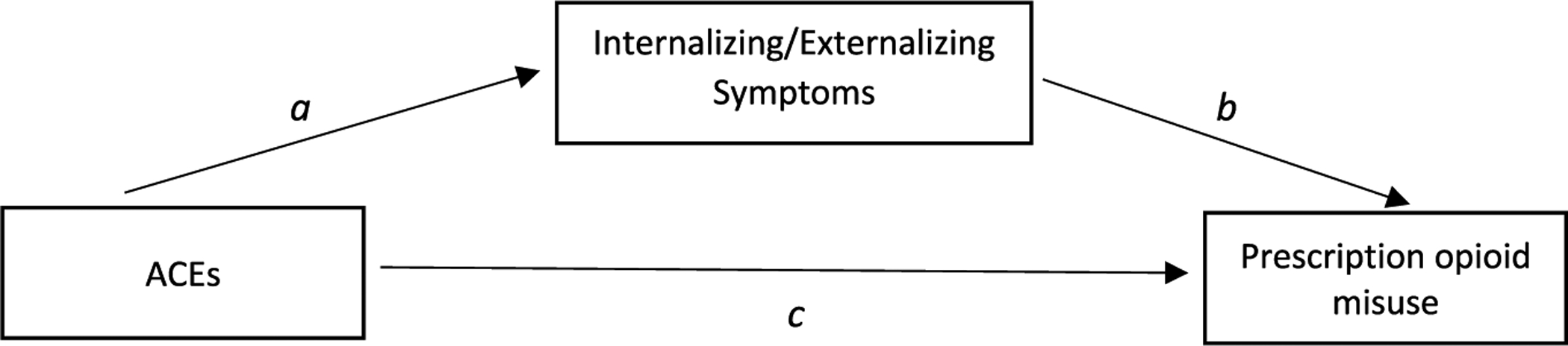
Adverse childhood experiences (ACEs) are associated with mental health and substance use problems, but lesser known is how they interconnect. The objective of this study was to examine how internalizing and externalizing symptoms mediate the association of ACEs with prescription opioid misuse in order to understand how ACEs interconnect with mental health and substance use problems. Adults aged 18 or older from the National Epidemiological Survey on Alcohol and Related Conditions Wave 3 (NESARC-III) conducted in 2012-2013 were included (N = 36,309). The prescription opioid misuse outcomes examined include prescription opioid misuse status, early-onset status of prescription opioid misuse, frequency of past-year prescription opioid misuse, and opioid use disorder. A natural effect model and regression analyses were used to conduct the mediation analyses. We found that respondents with higher ACE scores had greater odds of reporting past-year and lifetime prescription opioid misuse and DSM-V-diagnosed opioid use disorder as well as early onset of prescription opioid misuse (AORs range from 1.06 to 1.12). These associations are partially mediated by internalizing and externalizing symptoms. The findings suggest that internalizing and externalizing symptoms may be potential pathways through which ACEs are associated with prescription opioid misuse. Our results underscore the importance of preventing ACEs and reducing risk for internalizing and externalizing symptoms after exposure, which may reduce later prescription opioid misuse.
不良的童年经历(ACEs)与心理健康和物质使用问题有关,但鲜为人知的是它们是如何相互关联的。本研究的目的是检验内化和外化症状如何在 ACEs 与处方类阿片药物滥用之间的关联中起中介作用,以了解 ACEs 如何与心理健康和物质使用问题相互关联。该研究纳入了 2012-2013 年进行的全国酒精相关情况和条件调查第三波(NESARC-III)中年龄在 18 岁或以上的成年人(N=36309)。研究中检验的处方类阿片药物滥用结果包括处方类阿片药物滥用状况、处方类阿片药物滥用的早期发病状况、过去一年中滥用处方类阿片药物的频率以及阿片类药物使用障碍。采用自然效应模型和回归分析进行中介分析。我们发现,ACE 评分较高的受访者报告过去一年和终身滥用处方类阿片药物以及 DSM-V 诊断的阿片类药物使用障碍以及处方类阿片药物早期发病的几率更高(比值比范围从 1.06 到 1.12)。这些关联部分通过内化和外化症状来介导。这些发现表明,内化和外化症状可能是 ACEs 与处方类阿片药物滥用相关的潜在途径。我们的研究结果强调了预防 ACEs 以及在暴露后降低内化和外化症状风险的重要性,这可能会减少日后的处方类阿片药物滥用。