Unit of Pharmacogenomics, Department of Genetics, Institut Curie, Paris, France.
Laboratory of Preclinical Investigation, Department of Translational Research, Institut Curie Research Center, Paris, France.
J Hematol Oncol. 2020 Feb 22;13(1):13. doi: 10.1186/s13045-020-0846-y.
Metaplastic breast cancer (MBC) is a rare form of breast cancer characterized by an aggressive clinical presentation, with a poor response to standard chemotherapy. MBCs are typically triple-negative breast cancers (TNBCs), frequently with alterations to genes of the PI3K-AKT-mTOR and RTK-MAPK signaling pathways. The objective of this study was to determine the response to PI3K and MAPK pathway inhibitors in patient-derived xenografts (PDXs) of MBCs with targetable alterations.
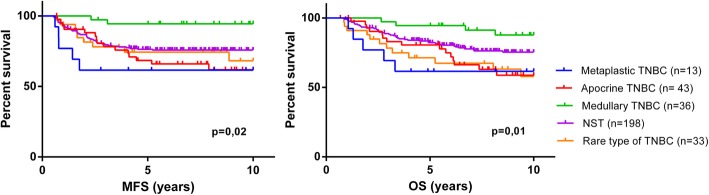
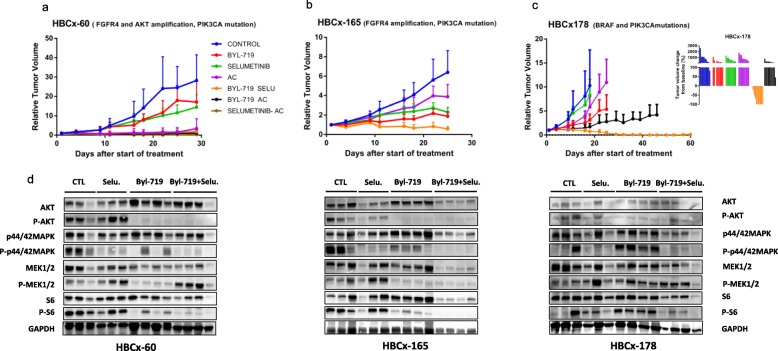
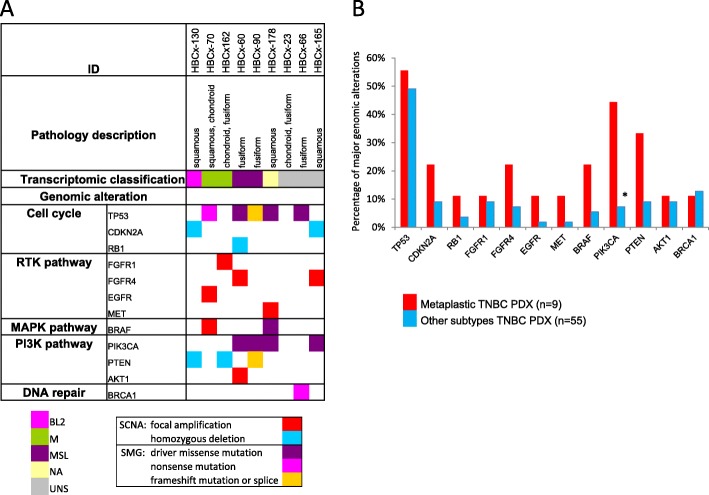
We compared survival between triple-negative MBCs and other histological subtypes, in a clinical cohort of 323 TNBC patients. PDX models were established from primary breast tumors classified as MBC. PI3K-AKT-mTOR and RTK-MAPK pathway alterations were detected by targeted next-generation sequencing (NGS) and analyses of copy number alterations. Activation of the PI3K-AKT-mTOR and RTK-MAPK signaling pathways was analyzed with reverse-phase protein arrays (RPPA). PDXs carrying an activating mutation of PIK3CA and genomic changes to the RTK-MAPK signaling pathways were treated with a combination consisting of a PI3K inhibitor and a MEK inhibitor.
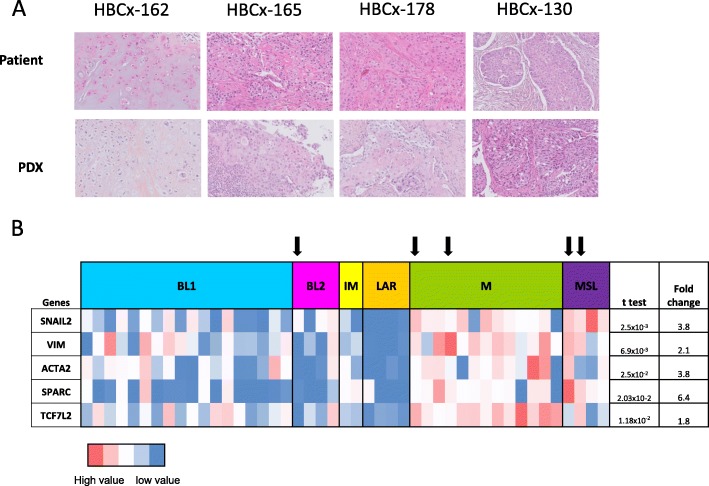
In our clinical cohort, the patients with MBC had a worse prognosis than those with other histological subtypes. We established nine metaplastic TNBC PDXs. Three had a pathogenic mutation of PIK3CA and additional alterations to genes associated with RTK-MAPK signaling. The MBC PDXs expressed typical EMT and stem cell genes and were of the mesenchymal or mesenchymal stem-like TNBC subtypes. On histological analysis, MBC PDXs presented squamous or chondroid differentiation. RPPA analysis showed activation of the PI3K-AKT-mTOR and RTK-MAPK signaling pathways. In vivo, the combination of PI3K and MAPK inhibitors displayed marked antitumor activity in PDXs carrying genomic alterations of PIK3CA, AKT1, BRAF, and FGFR4.
The treatment of metaplastic breast cancer PDXs by activation of the PI3K-AKT-mTOR and RTK-MAPK pathways at the genomic and protein levels with a combination of PI3K and MEK inhibitors resulted in tumor regression in mutated models and may therefore be of interest for therapeutic purposes.
化生性乳腺癌(MBC)是一种罕见的乳腺癌形式,其临床表现具有侵袭性,对标准化疗反应不佳。MBC 通常是三阴性乳腺癌(TNBC),常伴有 PI3K-AKT-mTOR 和 RTK-MAPK 信号通路基因的改变。本研究的目的是确定针对具有靶向改变的 MBC 患者来源异种移植(PDX)中 PI3K 和 MAPK 通路抑制剂的反应。
我们比较了 323 例 TNBC 患者的临床队列中三阴性 MBC 与其他组织学亚型之间的生存情况。从原发性乳腺癌肿瘤中建立了 MBC 分类的 PDX 模型。通过靶向下一代测序(NGS)和拷贝数改变分析检测 PI3K-AKT-mTOR 和 RTK-MAPK 通路改变。使用反相蛋白阵列(RPPA)分析 PI3K-AKT-mTOR 和 RTK-MAPK 信号通路的激活。携带 PIK3CA 激活突变和 RTK-MAPK 信号通路基因组改变的 PDX 用由 PI3K 抑制剂和 MEK 抑制剂组成的组合进行治疗。
在我们的临床队列中,MBC 患者的预后比其他组织学亚型差。我们建立了 9 个化生性 TNBC PDX。其中 3 个有 PIK3CA 致病性突变和与 RTK-MAPK 信号相关的基因的额外改变。MBC PDX 表达典型的 EMT 和干细胞基因,属于间充质或间充质干细胞样 TNBC 亚型。组织学分析显示,MBC PDX 呈鳞状或软骨样分化。RPPA 分析显示 PI3K-AKT-mTOR 和 RTK-MAPK 信号通路的激活。在体内,PI3K 和 MAPK 抑制剂的组合在携带 PIK3CA、AKT1、BRAF 和 FGFR4 基因组改变的 PDX 中显示出明显的抗肿瘤活性。
通过在基因组和蛋白质水平上激活 PI3K-AKT-mTOR 和 RTK-MAPK 通路,并使用 PI3K 和 MEK 抑制剂的组合治疗化生性乳腺癌 PDX,导致突变模型中的肿瘤消退,因此可能对治疗目的有意义。