Schratz Kristen E, DeZern Amy E
Division of Pediatric Oncology, Johns Hopkins University School of Medicine, Bloomberg 11379, 1800 Orleans Street, Baltimore, MD 21287, USA; Sidney Kimmel Comprehensive Cancer Center, Johns Hopkins University School of Medicine, 1650 Orleans Street, Baltimore, MD 21287, USA.
Sidney Kimmel Comprehensive Cancer Center, Johns Hopkins University School of Medicine, 1650 Orleans Street, Baltimore, MD 21287, USA; Division of Hematologic Malignancies, Johns Hopkins University School of Medicine, CRBI Room 3M87, 1650 Orleans Street, Baltimore, MD 21287-0013, USA.
Hematol Oncol Clin North Am. 2020 Apr;34(2):333-356. doi: 10.1016/j.hoc.2019.10.002. Epub 2020 Jan 6.
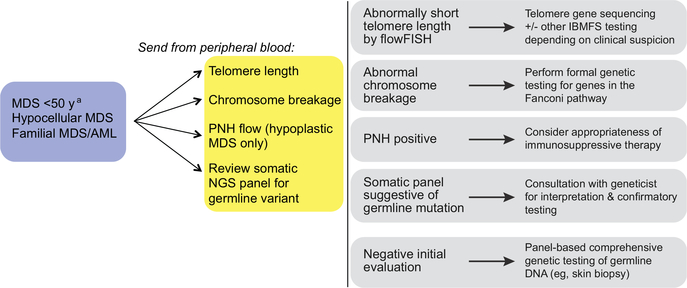
Myelodysplastic syndromes (MDSs) are a heterogeneous group of marrow failure disorders that primarily affect older persons but also occur at a lower frequency in children and young adults. There is increasing recognition of an inherited predisposition to MDS as well as other myeloid malignancies for patients of all ages. Germline predisposition to MDS can occur as part of a syndrome or sporadic disease. The timely diagnosis of an underlying genetic predisposition in the setting of MDS is important. This article delineates germline genetic causes of MDS and provides a scaffold for the diagnosis and management of patients in this context.
骨髓增生异常综合征(MDS)是一组异质性的骨髓衰竭性疾病,主要影响老年人,但在儿童和年轻人中也有较低的发病率。所有年龄段的患者对MDS以及其他髓系恶性肿瘤的遗传易感性认识都在不断增加。MDS的种系易感性可作为综合征的一部分或散发性疾病出现。在MDS背景下及时诊断潜在的遗传易感性很重要。本文阐述了MDS的种系遗传原因,并为在这种情况下患者的诊断和管理提供了一个框架。