Department of Microbiology and Parasitology, Faculty of Medicine, University of Rijeka, Rijeka, Croatia.
Biomed Res Int. 2020 Jan 20;2020:6826983. doi: 10.1155/2020/6826983. eCollection 2020.
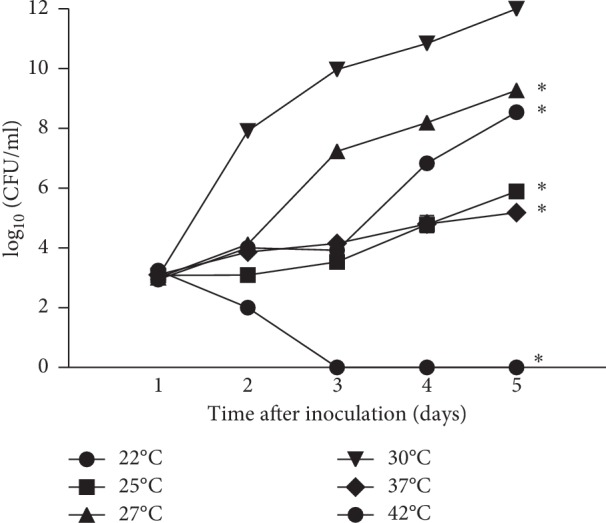
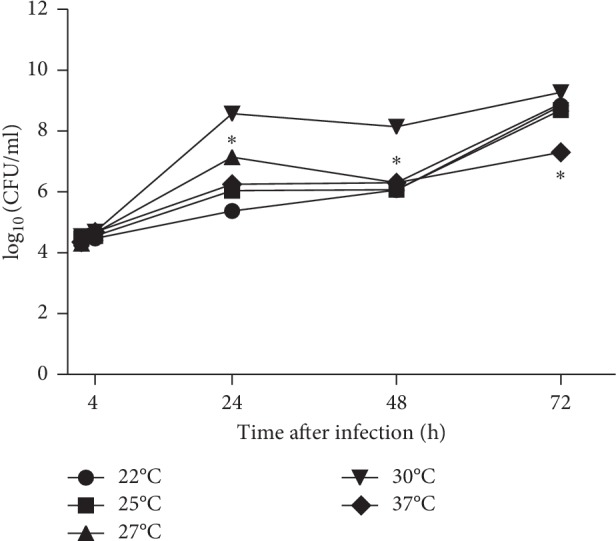
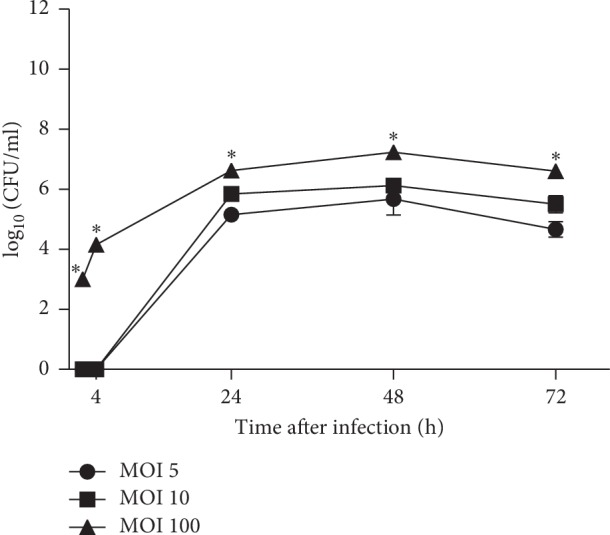
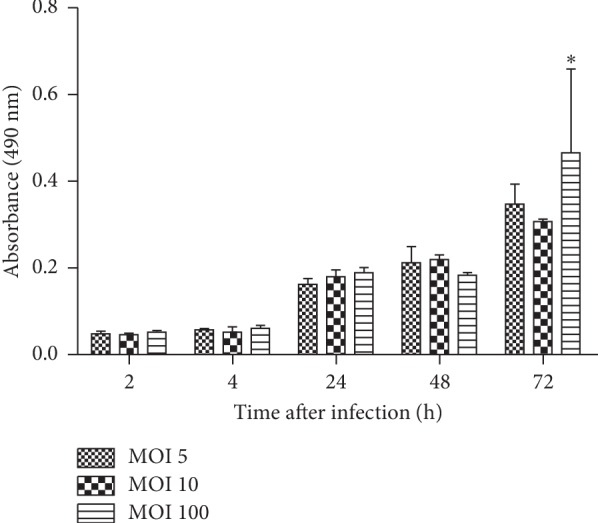
The amoeba has been used as a model organism to study host-pathogen interaction in many intracellular bacteria. is a Gram-negative, highly infectious bacterium that causes the zoonotic disease tularemia. The bacterium is able to replicate in different phagocytic and nonphagocytic cells including mammalian, amoebae, and arthropod cells. The aim of this study was to determine the optimal temperature and infection dose in the interaction of with in order to establish a model of infection in the social amoeba. The amoeba cells were infected with a different multiplicity of infection (5, 10, and 100) and incubated at different temperatures (22, 25, 27, 30, and 37°C). The number of intracellular bacteria within , as well as cytotoxicity, was determined at 2, 4, 24, 48, and 72 hours after infection. Our results showed that the optimal temperature for intracellular replication within amoeba is 30°C with the MOI of 10. We can conclude that this MOI and temperature induced the optimal growth of bacteria in with low cytotoxicity.
变形虫一直被用作研究许多胞内细菌的宿主-病原体相互作用的模式生物。土拉弗朗西斯菌是一种革兰氏阴性、高度传染性的细菌,可引起人畜共患的土拉菌病。该细菌能够在不同的吞噬细胞和非吞噬细胞中复制,包括哺乳动物、变形虫和节肢动物细胞。本研究的目的是确定 与 相互作用的最佳温度和感染剂量,以便在社会变形虫中建立 感染模型。用不同的感染复数(5、10 和 100)感染变形虫细胞,并在不同温度(22、25、27、30 和 37°C)下孵育。在感染后 2、4、24、48 和 72 小时,测定 内的细菌数量以及细胞毒性。结果表明,在 MOI 为 10 时, 内复制的最佳温度为 30°C。我们可以得出结论,这种 MOI 和温度诱导了细菌在 中的最佳生长,同时细胞毒性较低。