Imaging Platform, Broad Institute of MIT and Harvard, Cambridge, Massachusetts.
Northern Institute for Cancer Research, Newcastle University, UK.
Cytometry A. 2020 Apr;97(4):407-414. doi: 10.1002/cyto.a.23987. Epub 2020 Feb 24.
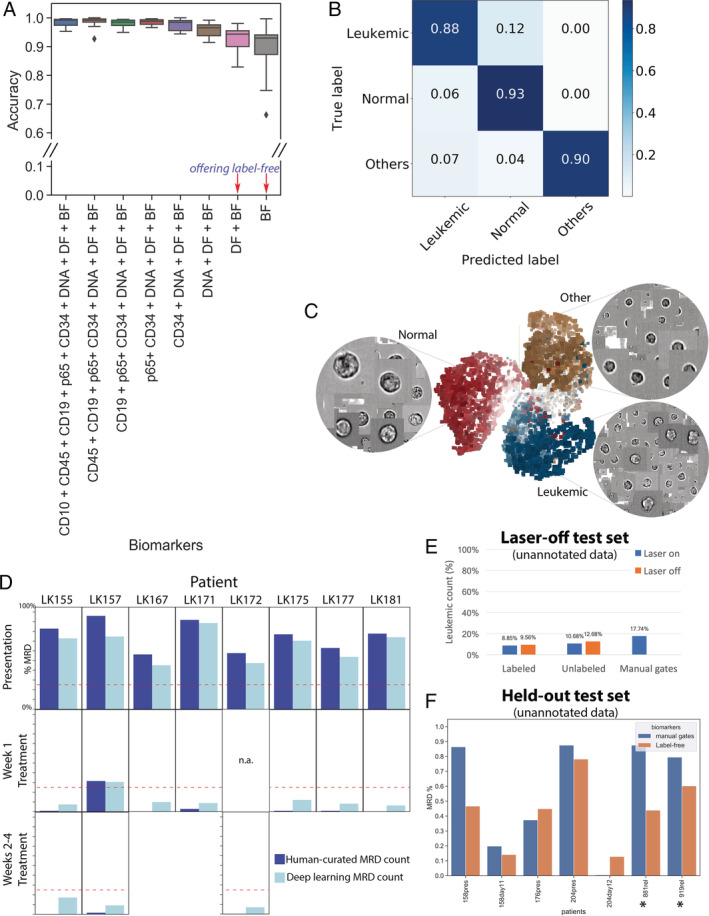
Acute lymphoblastic leukemia (ALL) is the most common childhood cancer. While there are a number of well-recognized prognostic biomarkers at diagnosis, the most powerful independent prognostic factor is the response of the leukemia to induction chemotherapy (Campana and Pui: Blood 129 (2017) 1913-1918). Given the potential for machine learning to improve precision medicine, we tested its capacity to monitor disease in children undergoing ALL treatment. Diagnostic and on-treatment bone marrow samples were labeled with an ALL-discriminating antibody combination and analyzed by imaging flow cytometry. Ignoring the fluorescent markers and using only features extracted from bright-field and dark-field cell images, a deep learning model was able to identify ALL cells at an accuracy of >88%. This antibody-free, single cell method is cheap, quick, and could be adapted to a simple, laser-free cytometer to allow automated, point-of-care testing to detect slow early responders. Adaptation to other types of leukemia is feasible, which would revolutionize residual disease monitoring. © 2020 The Authors. Cytometry Part A published by Wiley Periodicals, Inc. on behalf of International Society for Advancement of Cytometry.
急性淋巴细胞白血病 (ALL) 是最常见的儿童癌症。虽然在诊断时存在许多公认的预后生物标志物,但最强大的独立预后因素是白血病对诱导化疗的反应(Campana 和 Pui:Blood 129(2017)1913-1918)。鉴于机器学习有可能提高精准医学的水平,我们测试了它监测接受 ALL 治疗的儿童疾病的能力。通过成像流式细胞术对诊断和治疗中的骨髓样本进行标记,并用识别 ALL 的抗体组合进行分析。忽略荧光标记物,仅使用明场和暗场细胞图像中提取的特征,深度学习模型能够以 >88%的准确率识别 ALL 细胞。这种无抗体、单细胞方法便宜、快速,并且可以适用于简单的无激光细胞仪,从而实现自动化、即时检测,以检测反应缓慢的早期患者。适用于其他类型的白血病是可行的,这将彻底改变残留疾病监测。 2020 年作者。细胞仪 A 部分由 Wiley 期刊出版,代表国际细胞分析促进协会。