Emerg Infect Dis. 2020 Mar;26(3):491-503. doi: 10.3201/eid2603.190573.
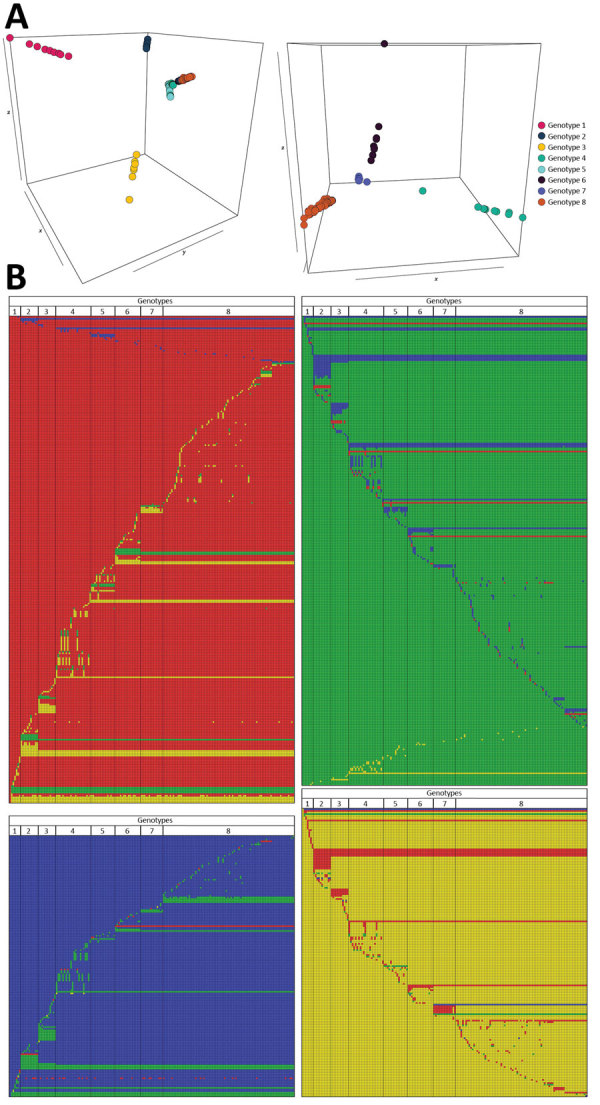
Mycobacterium ulcerans is the causative agent of Buruli ulcer, a neglected tropical disease found in rural areas of West and Central Africa. Despite the ongoing efforts to tackle Buruli ulcer epidemics, the environmental reservoir of its pathogen remains elusive, underscoring the need for new approaches to improving disease prevention and management. In our study, we implemented a local-scale spatial clustering model and deciphered the genetic diversity of the bacteria in a small area of Benin where Buruli ulcer is endemic. Using 179 strain samples from West Africa, we conducted a phylogeographic analysis combining whole-genome sequencing with spatial scan statistics. The 8 distinct genotypes we identified were by no means randomly spread over the studied area. Instead, they were divided into 3 different geographic clusters, associated with landscape characteristics. Our results highlight the ability of M. ulcerans to evolve independently and differentially depending on location in a specific ecologic reservoir.
溃疡分枝杆菌是造成布吕利溃疡的病原体,这是一种在西非和中非农村地区流行的被忽视的热带病。尽管人们一直在努力应对布吕利溃疡的流行,但该病原体的环境储库仍然难以捉摸,这凸显了需要采取新方法来改善疾病预防和管理。在我们的研究中,我们在布基纳法索的一个布吕利溃疡流行的小区域实施了局部尺度空间聚类模型,并对细菌的遗传多样性进行了解码。我们使用来自西非的 179 株菌株样本,通过全基因组测序和空间扫描统计数据结合进行了系统地理学分析。我们确定的 8 种不同基因型并非随机分布在研究区域内。相反,它们分为 3 个不同的地理群,与景观特征有关。我们的研究结果强调了溃疡分枝杆菌能够在特定的生态储库中根据位置独立和差异进化的能力。