OMNI Research Group, Ottawa Hospital Research Institute, Ottawa, Ontario, Canada.
Department of Obstetrics and Gynecology, University of Ottawa Faculty of Medicine, Ottawa, Ontario, Canada.
JAMA Pediatr. 2020 May 1;174(5):446-454. doi: 10.1001/jamapediatrics.2019.6096.
The extent to which assisted reproductive technology is associated with increased risk of congenital heart defects independent of its known association with twinning remains uncertain.
To assess the extent to which assisted pregnancy is associated with increased risk of congenital heart defects independent of its known association with twinning.
DESIGN, SETTING, AND PARTICIPANTS: This retrospective cohort study linked records of congenital heart defect diagnoses with assisted reproductive technology cycles in 507 390 singleton or twin pregnancies (10 149 assisted pregnancies and 497 241 nonassisted pregnancies), including singleton and twin early pregnancy losses, stillbirths, and live births (follow-up to 1 year of age) in Ontario, Canada, between April 1, 2012, and October 31, 2015. Statistical analysis was performed from January 1, 2017, to September 9, 2019.
Assisted reproductive technology and its 2 subtypes: intracytoplasmic sperm injection and in vitro fertilization without intracytoplasmic sperm injection.
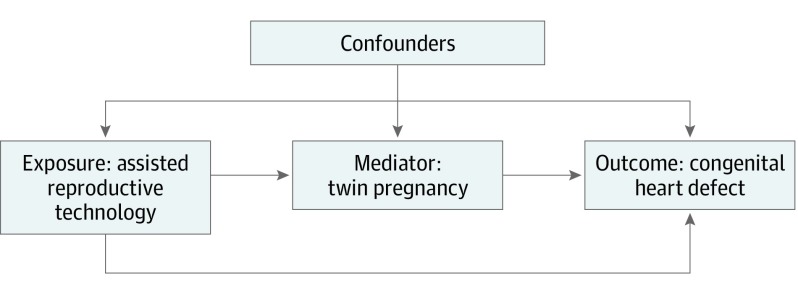
The main outcome was congenital heart defects (prevalence and relative risk measured as odds ratios [ORs]). Mediation analysis was performed to assess the extent to which the association between assisted reproductive technology and congenital heart defects was mediated by twinning.
Of 507 390 mother-infant pairs with singleton or twin pregnancies evaluated, the prevalence of congenital heart defects in assisted pregnancies (223 [2.2%]) was higher than that in nonassisted pregnancies (6057 [1.2%]; crude OR, 1.82; 95% CI, 1.59-2.09). The strength of the association between assisted pregnancy and congenital heart defects decreased after adjusting for several risk factors simultaneously (adjusted OR, 1.70; 95% CI, 1.48-1.95). Further mediation analysis indicated that most of the association between assisted pregnancy and congenital heart defects was mediated by twinning (adjusted OR, 1.68; 95% CI, 1.44-1.92), and the natural direct association of assisted pregnancy with congenital heart defects among singleton pregnancies was 1.09 (95% CI, 0.93-1.25). Mediation of twinning accounted for 87.3% of the association.
Our study results suggest that the association between assisted reproductive technology and congenital heart defects may be mediated by twinning.
辅助生殖技术与先天性心脏病风险增加之间的关联程度,独立于其与双胞胎的已知关联,仍不确定。
评估辅助妊娠与先天性心脏病风险增加之间的关联程度,独立于其与双胞胎的已知关联。
设计、环境和参与者:这项回顾性队列研究将先天性心脏病诊断的记录与 507390 例单胎或双胞胎妊娠(10149 例辅助妊娠和 497241 例非辅助妊娠)中的辅助生殖技术周期相关联,包括单胎和双胞胎早期妊娠丢失、死产和活产(随访至 1 岁),该研究在加拿大安大略省进行,时间为 2012 年 4 月 1 日至 2015 年 10 月 31 日。统计分析于 2017 年 1 月 1 日至 2019 年 9 月 9 日进行。
辅助生殖技术及其 2 个亚型:胞浆内精子注射和体外受精而不进行胞浆内精子注射。
主要结局是先天性心脏病(患病率和相对风险以比值比[OR]衡量)。进行中介分析以评估辅助生殖技术与先天性心脏病之间的关联在多大程度上受双胞胎的影响。
在评估的 507390 例单胎或双胞胎妊娠的母婴对中,辅助妊娠(223 例[2.2%])的先天性心脏病患病率高于非辅助妊娠(6057 例[1.2%])(粗 OR,1.82;95%CI,1.59-2.09)。在同时调整多个危险因素后,辅助妊娠与先天性心脏病之间的关联强度减弱(调整后的 OR,1.70;95%CI,1.48-1.95)。进一步的中介分析表明,辅助妊娠与先天性心脏病之间的大部分关联是由双胞胎介导的(调整后的 OR,1.68;95%CI,1.44-1.92),而在单胎妊娠中,辅助妊娠与先天性心脏病之间的自然直接关联为 1.09(95%CI,0.93-1.25)。双胞胎的中介作用占关联的 87.3%。
我们的研究结果表明,辅助生殖技术与先天性心脏病之间的关联可能是由双胞胎介导的。