Department of Population Health, London School of Hygiene & Tropical Medicine, London, England, United Kingdom.
Department of Public Health and Primary Care, University of Cambridge, Cambridge, England, United Kingdom.
PLoS One. 2020 Feb 24;15(2):e0229438. doi: 10.1371/journal.pone.0229438. eCollection 2020.
In India, the prevalence of overweight and obesity has increased rapidly in recent decades. Given the association between overweight and obesity with many non-communicable diseases, forecasts of the future prevalence of overweight and obesity can help inform policy in a country where around one sixth of the world's population resides.
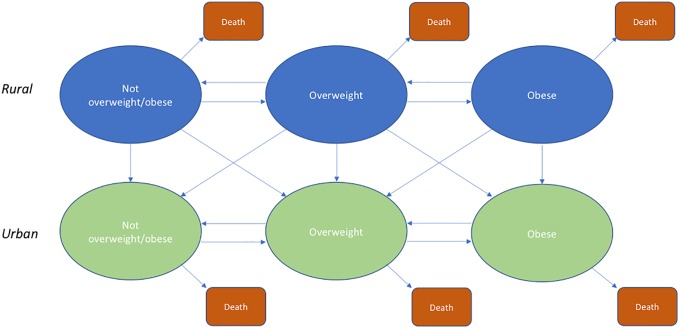
We used a system of multi-state life tables to forecast overweight and obesity prevalence among Indians aged 20-69 years by age, sex and urban/rural residence to 2040. We estimated the incidence and initial prevalence of overweight using nationally representative data from the National Family Health Surveys 3 and 4, and the Study on global AGEing and adult health, waves 0 and 1. We forecasted future mortality, using the Lee-Carter model fitted life tables reported by the Sample Registration System, and adjusted the mortality rates for Body Mass Index using relative risks from the literature.
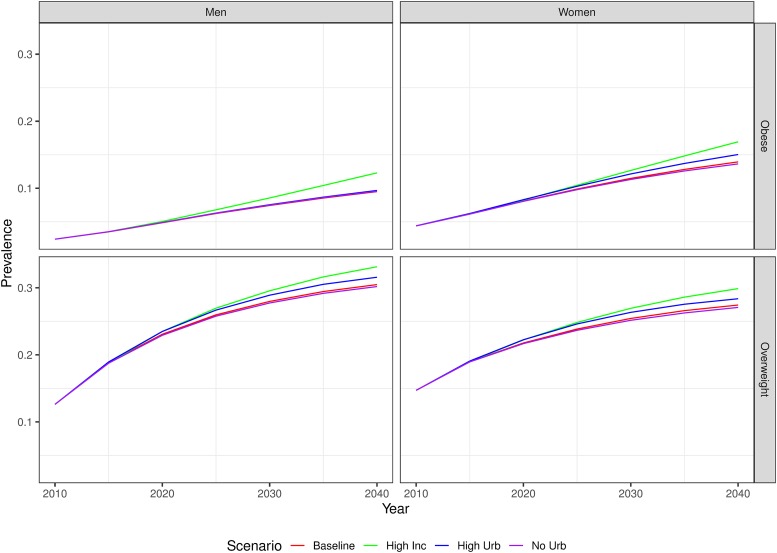
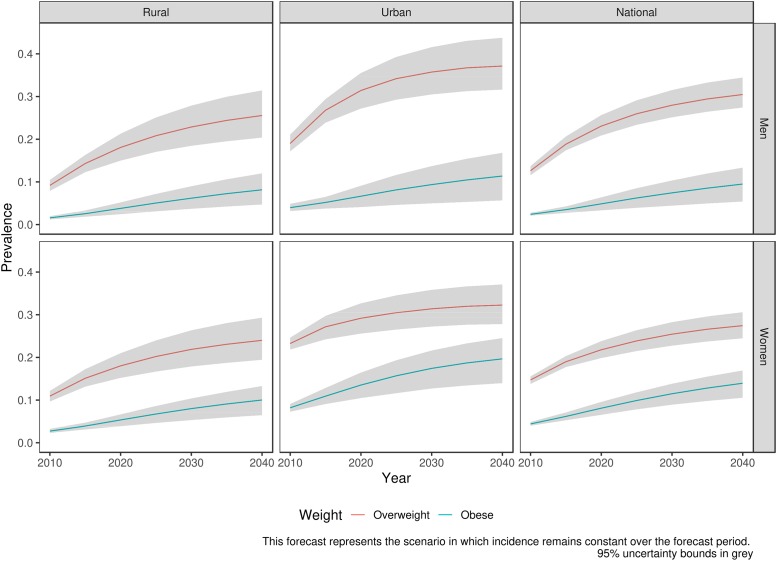
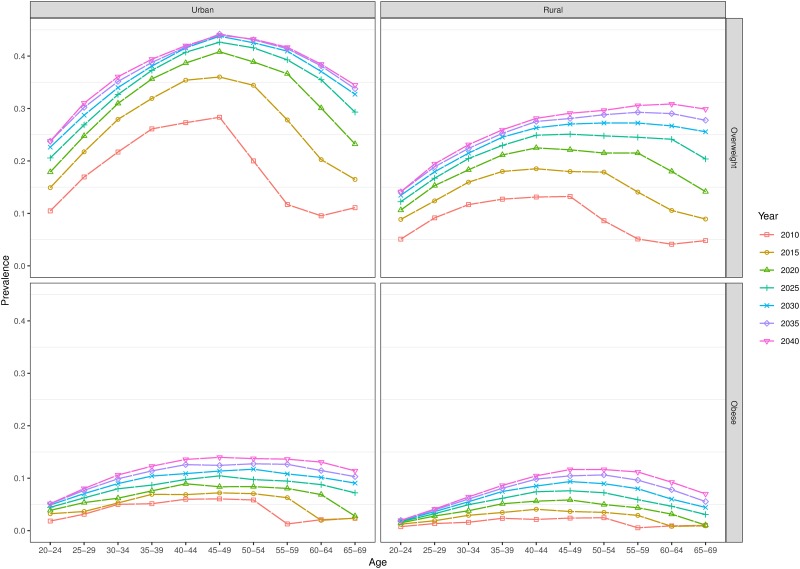
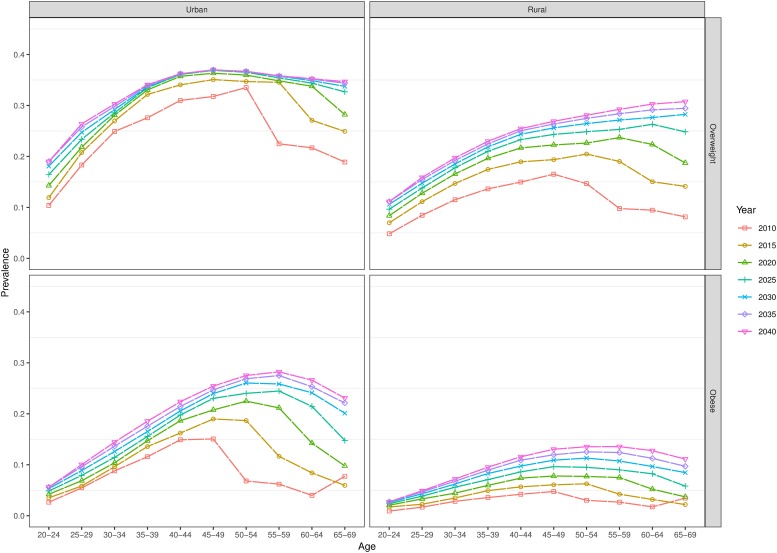
The prevalence of overweight will more than double among Indian adults aged 20-69 years between 2010 and 2040, while the prevalence of obesity will triple. Specifically, the prevalence of overweight and obesity will reach 30.5% (27.4%-34.4%) and 9.5% (5.4%-13.3%) among men, and 27.4% (24.5%-30.6%) and 13.9% (10.1%-16.9%) among women, respectively, by 2040. The largest increases in the prevalence of overweight and obesity between 2010 and 2040 is expected to be in older ages, and we found a larger relative increase in overweight and obesity in rural areas compared to urban areas. The largest relative increase in overweight and obesity prevalence was forecast to occur at older age groups.
The overall prevalence of overweight and obesity is expected to increase considerably in India by 2040, with substantial increases particularly among rural residents and older Indians. Detailed predictions of excess weight are crucial in estimating future non-communicable disease burdens and their economic impact.
在印度,超重和肥胖的患病率在最近几十年迅速上升。鉴于超重和肥胖与许多非传染性疾病有关,对超重和肥胖未来患病率的预测可以为这个拥有世界六分之一人口的国家的政策制定提供信息。
我们使用多状态生命表系统,根据年龄、性别和城乡居住情况,预测 20-69 岁印度人超重和肥胖的患病率,预测时间至 2040 年。我们利用全国代表性数据,即国家家庭健康调查 3 期和 4 期和全球老龄化与成人健康研究(wave 0 和 1)的数据,估算超重的发生率和初始患病率。我们使用样本登记系统报告的 Lee-Carter 模型拟合生命表来预测未来的死亡率,并根据文献中的相对风险调整 BMI 的死亡率。
2010 年至 2040 年期间,20-69 岁印度成年人的超重患病率将增加一倍以上,而肥胖的患病率将增加两倍以上。具体来说,到 2040 年,男性超重和肥胖的患病率将分别达到 30.5%(27.4%-34.4%)和 9.5%(5.4%-13.3%),女性分别达到 27.4%(24.5%-30.6%)和 13.9%(10.1%-16.9%)。2010 年至 2040 年期间,超重和肥胖患病率预计将在年龄较大的人群中大幅增加,我们发现农村地区的超重和肥胖患病率相对增加幅度大于城市地区。超重和肥胖患病率的相对增加预计将在年龄较大的年龄组中最大。
到 2040 年,印度超重和肥胖的总体患病率预计将大幅上升,尤其是在农村居民和年龄较大的印度人中。对超重和肥胖的详细预测对于估计未来非传染性疾病负担及其经济影响至关重要。