Ye Zhujia, Sangireddy Sasikiran Reddy, Yu Chih-Li, Hui Dafeng, Howe Kevin, Fish Tara, Thannhauser Theodore W, Zhou Suping
Department of Agricultural and Environmental Sciences, College of Agriculture, Tennessee State University, 3500 John Merritt Blvd, Nashville, TN 37209, USA.
Department of Biological Sciences, Tennessee State University, 3500 John Merritt Blvd, Nashville, TN 37209, USA.
Proteomes. 2020 Feb 19;8(1):3. doi: 10.3390/proteomes8010003.
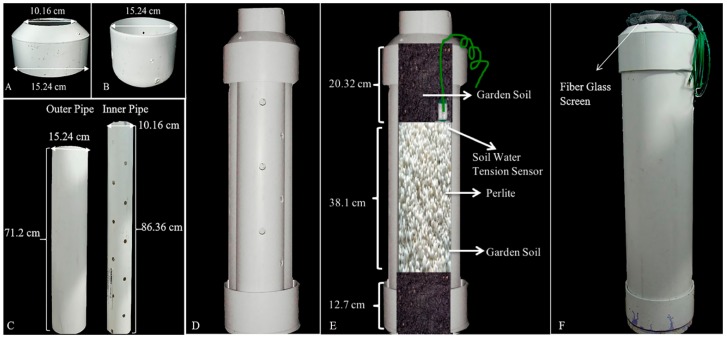
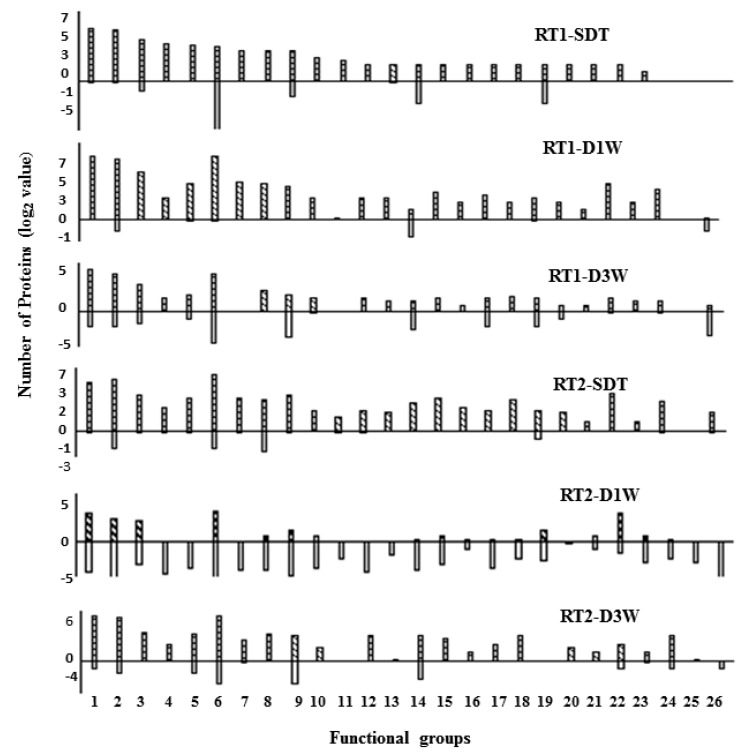
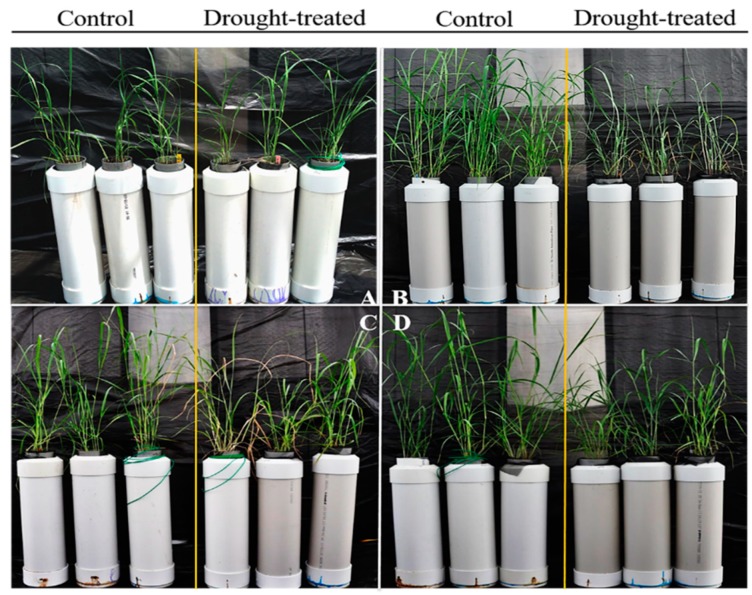
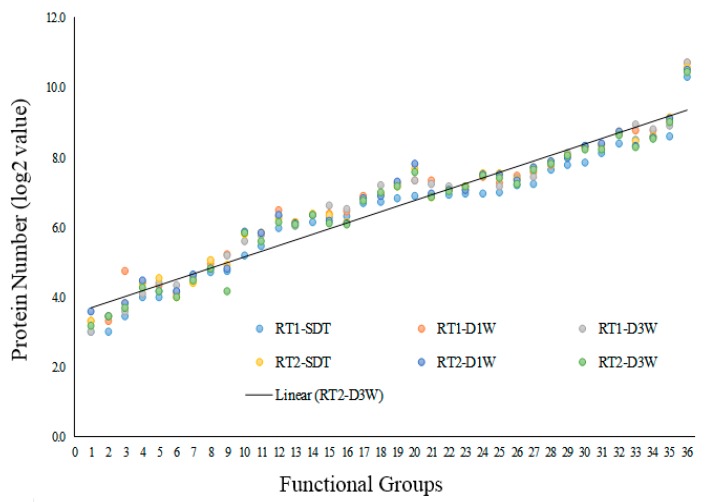
Switchgrass plants were grown in a Sandwich tube system to induce gradual drought stress by withholding watering. After 29 days, the leaf photosynthetic rate decreased significantly, compared to the control plants which were watered regularly. The drought-treated plants recovered to the same leaf water content after three days of re-watering. The root tip (1cm basal fragment, designated as RT1 hereafter) and the elongation/maturation zone (the next upper 1 cm tissue, designated as RT2 hereafter) tissues were collected at the 29th day of drought stress treatment, (named SDT for severe drought treated), after one (D1W) and three days (D3W) of re-watering. The tandem mass tags mass spectrometry-based quantitative proteomics analysis was performed to identify the proteomes, and drought-induced differentially accumulated proteins (DAPs). From RT1 tissues, 6156, 7687, and 7699 proteins were quantified, and 296, 535, and 384 DAPs were identified in the SDT, D1W, and D3W samples, respectively. From RT2 tissues, 7382, 7255, and 6883 proteins were quantified, and 393, 587, and 321 proteins DAPs were identified in the SDT, D1W, and D3W samples. Between RT1 and RT2 tissues, very few DAPs overlapped at SDT, but the number of such proteins increased during the recovery phase. A large number of hydrophilic proteins and stress-responsive proteins were induced during SDT and remained at a higher level during the recovery stages. A large number of DAPs in RT1 tissues maintained the same expression pattern throughout drought treatment and the recovery phases. The DAPs in RT1 tissues were classified in cell proliferation, mitotic cell division, and chromatin modification, and those in RT2 were placed in cell wall remodeling and cell expansion processes. This study provided information pertaining to root zone-specific proteome changes during drought and recover phases, which will allow us to select proteins (genes) as better defined targets for developing drought tolerant plants. The mass spectrometry proteomics data are available via ProteomeXchange with identifier PXD017441.
柳枝稷植株种植于三明治管系统中,通过停止浇水诱导逐渐干旱胁迫。29天后,与正常浇水的对照植株相比,叶片光合速率显著下降。干旱处理的植株在重新浇水三天后恢复到相同的叶片含水量。在干旱胁迫处理的第29天(称为严重干旱处理,SDT)、重新浇水一天(D1W)和三天(D3W)后,收集根尖(基部1厘米片段,以下称为RT1)和伸长/成熟区(接下来上方1厘米组织,以下称为RT2)组织。进行基于串联质量标签质谱的定量蛋白质组学分析,以鉴定蛋白质组和干旱诱导的差异积累蛋白(DAPs)。从RT1组织中,分别定量了6156、7687和7699种蛋白质,并在SDT、D1W和D3W样品中分别鉴定出296、535和384种DAPs。从RT2组织中,分别定量了7382、7255和6883种蛋白质,并在SDT、D1W和D3W样品中分别鉴定出393、587和321种DAPs。在RT1和RT2组织之间,在SDT时很少有DAPs重叠,但在恢复阶段此类蛋白质的数量增加。在SDT期间诱导了大量亲水性蛋白质和胁迫响应蛋白,并在恢复阶段保持在较高水平。RT1组织中的大量DAPs在整个干旱处理和恢复阶段保持相同的表达模式。RT1组织中的DAPs分类为细胞增殖、有丝分裂细胞分裂和染色质修饰,而RT2组织中的DAPs则归类于细胞壁重塑和细胞扩张过程。本研究提供了干旱和恢复阶段根区特异性蛋白质组变化的信息,这将使我们能够选择蛋白质(基因)作为培育耐旱植物更明确的目标。质谱蛋白质组学数据可通过ProteomeXchange获得,标识符为PXD017441。