Winiarski Juliusz, Niciejewska Anna, Ryl Jacek, Darowicki Kazimierz, Baśladyńska Sylwia, Winiarska Katarzyna, Szczygieł Bogdan
Department of Advanced Material Technologies, Faculty of Chemistry, Wrocław University of Science and Technology, 50-370 Wrocław, Poland.
Department of Electrochemistry, Corrosion and Materials Engineering, Faculty of Chemistry, Gdansk University of Technology, 80-233 Gdańsk, Poland.
Materials (Basel). 2020 Feb 19;13(4):924. doi: 10.3390/ma13040924.
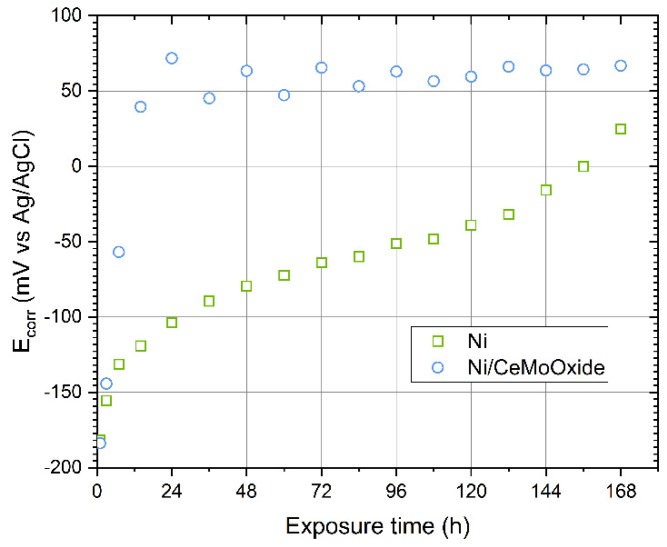
Cerium molybdenum oxide hydrate microflakes are codeposited with nickel from a deep eutectic solvent-based bath. During seven days of exposure in 0.05 M NaCl solution, the corrosion resistance of composite coating (Ni/CeMoOxide) is slightly reduced, due to the existence of some microcracks caused by large microflakes. Multielemental analysis of the solution, in which coatings are exposed and the qualitative changes in the surface chemistry (XPS) show selective etching molybdenum from microflakes. The amount of various molybdenum species within the surface of coating nearly completely disappear, due to the corrosion process. Significant amounts of Ce compounds are removed, however the corrosion process is less selective towards the cerium, and the overall cerium chemistry remains unchanged. Initially, blank Ni coatings are covered by NiO and Ni(OH) in an atomic ratio of 1:2. After exposure, the amount of Ni(OH) increases in relation to NiO (ratio 1:3). For the composite coating, the atomic ratios of both forms of nickel vary from 1:0.8 to 1:1.3. Despite achieving lower corrosion resistance of the composite coating, the applied concept of using micro-flakes, whose skeleton is a system of Ce(III) species and active form are molybdate ions, may be interesting for applications in materials with potential self-healing properties.
铈钼氧化物水合物微片与镍从基于深共熔溶剂的镀液中共沉积。在0.05 M NaCl溶液中暴露7天期间,复合涂层(Ni/CeMoOxide)的耐腐蚀性略有降低,这是由于大微片导致一些微裂纹的存在。对涂层所暴露的溶液进行多元素分析以及表面化学的定性变化(XPS)表明,微片中的钼被选择性蚀刻。由于腐蚀过程,涂层表面各种钼物种的量几乎完全消失。大量的铈化合物被去除,然而腐蚀过程对铈的选择性较小,整体铈化学性质保持不变。最初,空白镍涂层被原子比为1:2的NiO和Ni(OH)覆盖。暴露后,Ni(OH)的量相对于NiO增加(比例为1:3)。对于复合涂层,两种镍形式的原子比从1:0.8变化到1:1.3。尽管复合涂层的耐腐蚀性较低,但所应用的使用微片的概念可能在具有潜在自修复性能的材料应用中很有趣,这些微片的骨架是Ce(III)物种体系,活性形式是钼酸根离子。