Behavioral and Policy Sciences, RAND Corporation, 1776 Main Street, Santa Monica, CA, USA.
Economics, Sociology, Statistics, RAND Corporation, Santa Monica, CA, USA.
BMC Infect Dis. 2020 Feb 24;20(1):173. doi: 10.1186/s12879-020-4896-0.
Studies report serious adherence problems among youth (individuals age 15-24 years of age) in Uganda. Recent growth in mobile phone ownership has highlighted the potential of using text-based interventions to improve antiretroviral treatment (ART) adherence among Ugandan youth. We piloted a randomized controlled trial of a text-based intervention providing weekly real-time antiretroviral adherence feedback, based on information from a smart pill box, to HIV-positive Ugandan youth. In this paper, we report the acceptability, feasibility, and preliminary impact of the intervention.
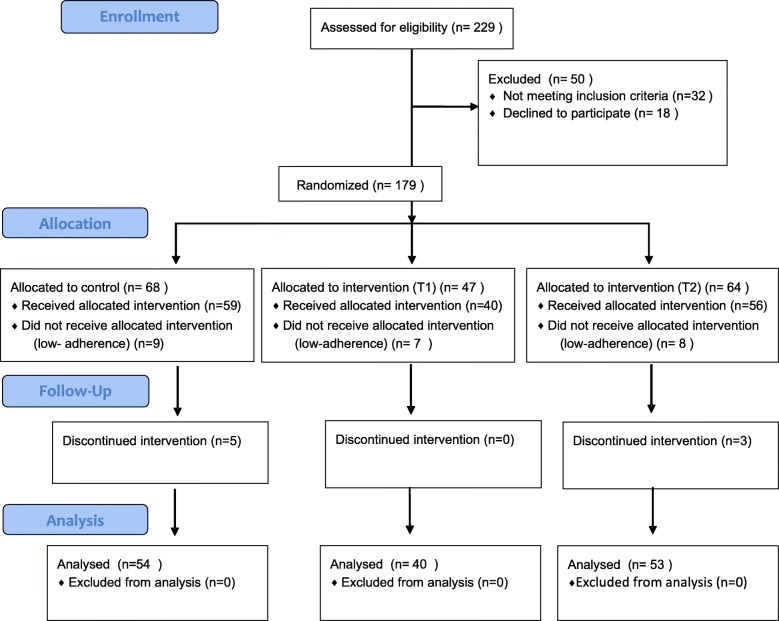
We randomized participants to a control group, or to receive messages with information on either their own adherence levels (Treatment 1 - T1), or their own adherence and peer adherence levels (Treatment 2 - T2). We conducted six focus groups from December 2016 to March 2017 with providers and youth ages 15-24, double coded 130 excerpts, and achieved a pooled Cohen's Kappa of 0.79 and 0.80 based on 34 randomly selected excerpts.
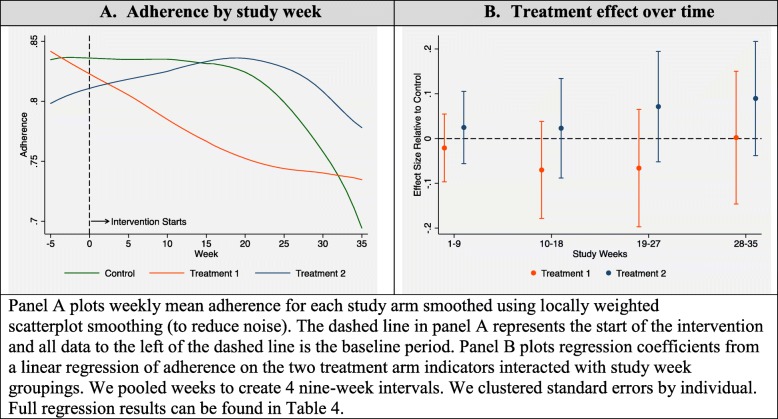
The quantitative and qualitative data show that the intervention was deemed acceptable and feasible. After controlling for baseline adherence, the T1 group had 3.8 percentage point lower adherence than the control group (95% CI -9.9, 2.3) and the T2 group had 2.4 percentage points higher adherence than the control group (95% CI -3.0, 7.9). However, there was an increasing treatment effect over time for the T2 group with the largest effect towards the end of the study; a 2.5 percentage point increase in the initial 9-weeks that grows steadily to 9.0 percentage points by the last 9-weeks of the study. We find negative treatment effects for T1 in 3 of the 4 9-week intervals. This pilot study was not designed to detect statistically significant differences.
Improving youth's adherence by supplementing information about their adherence with information about the adherence of peers is a promising new strategy that should be further evaluated in a fully-powered study. Providing one's own adherence information alone appears to have less potential.
NCT02514356 07/30/2015.
研究报告显示,乌干达的年轻人(年龄在 15-24 岁之间的个体)存在严重的服药依从性问题。最近,手机拥有量的增长突显了利用基于短信的干预措施来提高乌干达青年接受抗逆转录病毒治疗(ART)的依从性的潜力。我们对一项基于智能药盒提供每周实时抗逆转录病毒服药依从性反馈的基于短信的干预措施进行了一项随机对照试验,该试验针对的是 HIV 阳性的乌干达青年。在本文中,我们报告了该干预措施的可接受性、可行性和初步影响。
我们将参与者随机分配到对照组,或接受关于他们自己的服药依从性水平的信息(治疗 1 - T1),或接受关于他们自己的服药依从性和同伴服药依从性水平的信息(治疗 2 - T2)。我们于 2016 年 12 月至 2017 年 3 月期间与 15-24 岁的提供者和青年进行了六次焦点小组讨论,对 130 个摘录进行了双重编码,并根据 34 个随机选择的摘录实现了 0.79 和 0.80 的 pooled Cohen's Kappa。
定量和定性数据表明,该干预措施被认为是可接受和可行的。在控制基线依从性后,T1 组的依从性比对照组低 3.8 个百分点(95%CI-9.9,2.3),T2 组的依从性比对照组高 2.4 个百分点(95%CI-3.0,7.9)。然而,T2 组的治疗效果随着时间的推移而增加,在研究结束时效果最大;在最初的 9 周内增加了 2.5 个百分点,在研究的最后 9 周内稳步增加到 9.0 个百分点。我们发现 T1 在 4 个 9 周间隔中的 3 个中存在负的治疗效果。这项试点研究的设计目的不是为了检测具有统计学意义的差异。
通过在有关自身服药依从性的信息中补充有关同伴服药依从性的信息来改善年轻人的服药依从性,是一种很有前途的新策略,应该在一项全面的研究中进一步评估。仅提供自身的服药依从性信息似乎潜力不大。
NCT02514356 2015 年 7 月 30 日。