Centre for Human Movement Sciences, University of Groningen, University Medical Centre Groningen, Antonius Deusinglaan 1, 9713 AV, Groningen, the Netherlands.
Department of Motion Science, Institute of Sports Science, University of Münster, Horstmarer Landweg 62b, 48149, Münster, Germany.
J Neuroeng Rehabil. 2020 Feb 24;17(1):29. doi: 10.1186/s12984-020-00664-8.
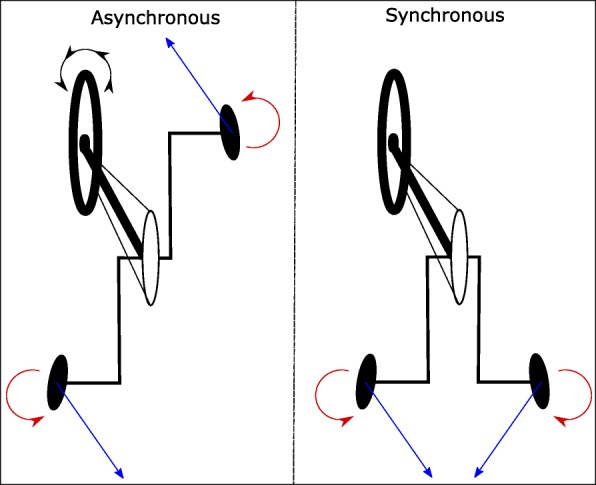
Originally, the cranks of a handcycle were mounted with a 180° phase shift (asynchronous). However, as handcycling became more popular, the crank mode switched to a parallel mounting (synchronous) over the years. Differences between both modes have been investigated, however, not into great detail for propulsion technique or practice effects. Our aim is to compare both crank modes from a biomechanical and physiological perspective, hence considering force and power production as a cause of physiological outcome measures. This is done within a practice protocol, as it is expected that motor learning takes place in the early stages of handcycling in novices.
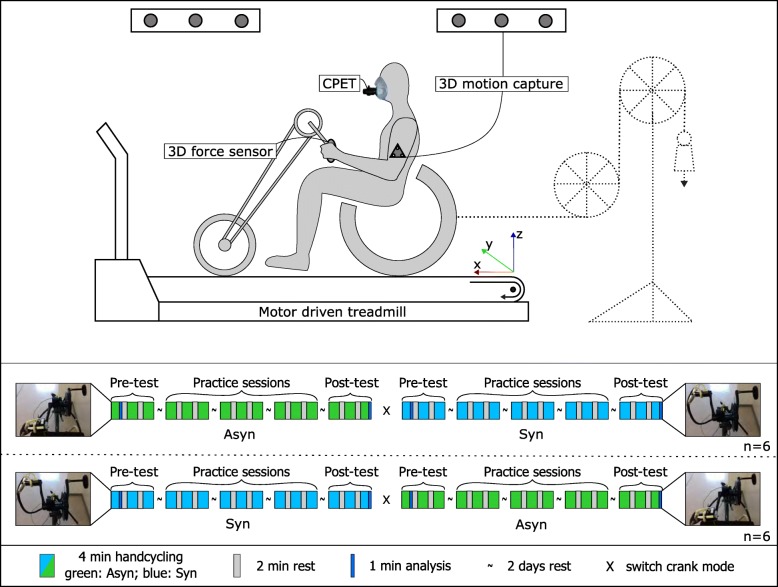
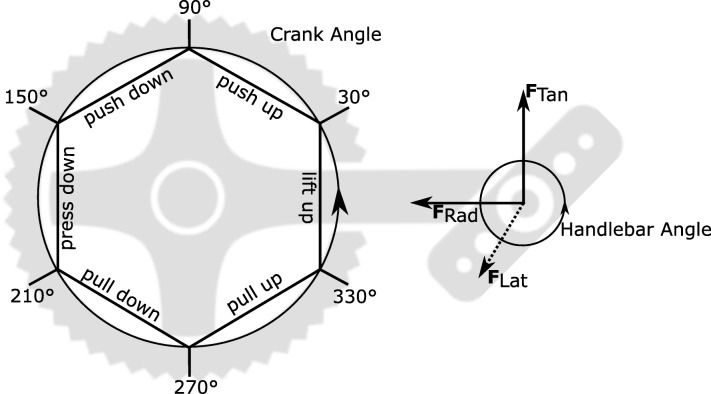
Twelve able-bodied male novices volunteered to take part. The experiment consisted of a pre-test, three practice sessions and a post-test, which was subsequently repeated for both crank modes in a counterbalanced manner. In each session the participants handcycled for 3 × 4 minutes on a leveled motorized treadmill at 1.94 m/s. Inbetween sessions were 2 days of rest. 3D forces, handlebar and crank angle were measured on the left hand side. Kinematic markers were placed on the handcycle to monitor the movement on the treadmill. Lastly, breath-by-breath spirometry combined with heart-rate were continuously measured. The effects of crank mode and practice-based learning were analyzed using a two way repeated measures ANOVA, with synchronous vs asynchronous and pre-test vs post-test as within-subject factors.
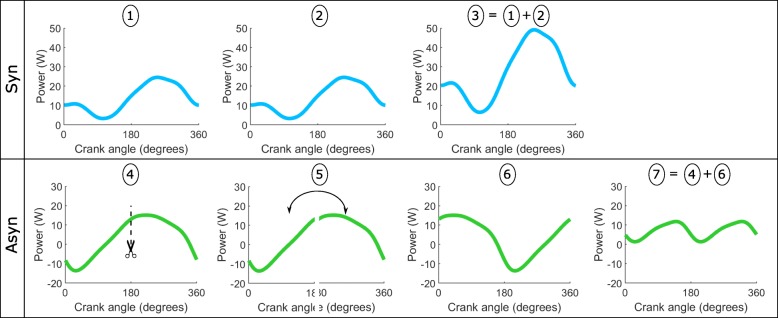
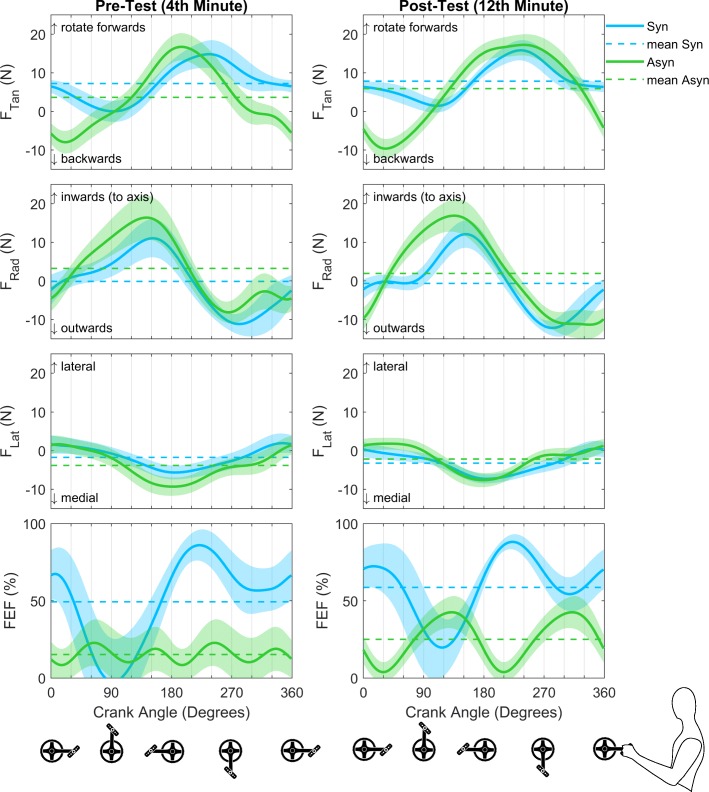
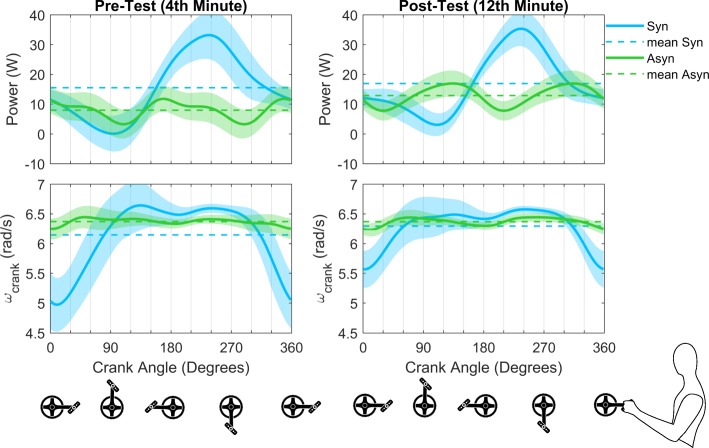
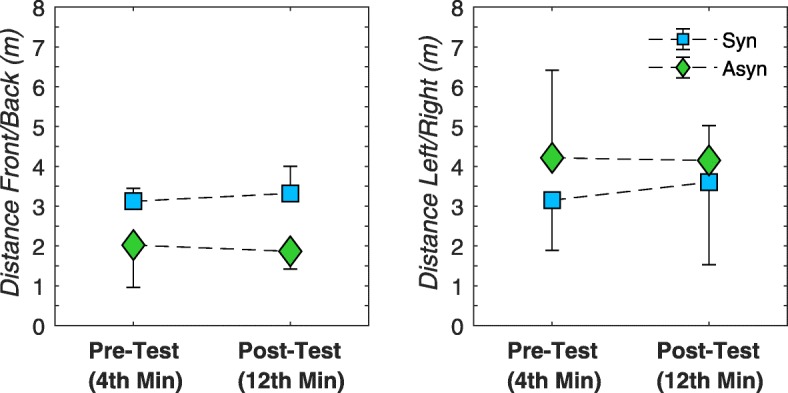
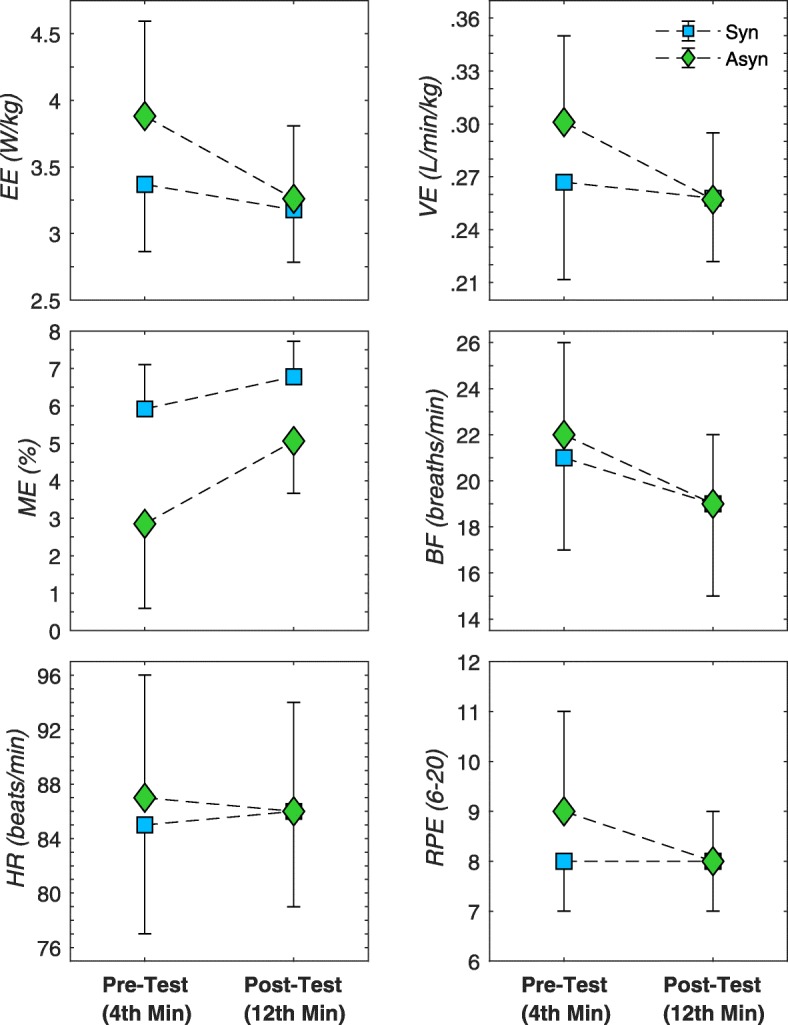
In the pre-test, asynchronous handcycling was less efficient than synchronous handcycling in terms of physiological strain, force production and timing. At the post-test, the metabolic costs were comparable for both modes. The force production was, also after practice, more efficient in the synchronous mode. External power production, crank rotation velocity and the distance travelled back and forwards on the treadmill suggest that asynchronous handcycling is more constant throughout the cycle.
As the metabolic costs were reduced in the asynchronous mode, we would advise to include a practice period, when comparing both modes in scientific experiments. For handcycle users, we would currently advise a synchronous set-up for daily use, as the force production is more effective in the synchronous mode, even after practice.
最初,手摇曲柄的曲柄安装有 180°的相位差(异步)。然而,随着手摇曲柄的普及,多年来曲柄模式已切换为平行安装(同步)。尽管已经研究了两种模式之间的差异,但尚未深入研究推进技术或实践效果。我们的目的是从生物力学和生理学的角度比较两种曲柄模式,因此将力和功率产生作为生理结果测量的原因。这是在实践方案内完成的,因为预计初学者在早期阶段会对手摇曲柄进行运动学习。
十二名健康男性新手自愿参加。实验包括预测试、三个练习阶段和后测试,随后以平衡方式在两种曲柄模式下重复后测试。在每个阶段,参与者以 1.94 m/s 的速度在水平电动跑步机上手摇动 3×4 分钟。在各阶段之间休息两天。在左侧测量 3D 力、把手和曲柄角度。运动标记放置在手摇曲柄上,以监测在跑步机上的运动。最后,连续测量呼吸对呼吸的肺活量测定法和心率。使用双因素重复测量方差分析分析曲柄模式和基于实践的学习效果,将同步与异步以及预测试与后测试作为组内因素。
在预测试中,异步手摇动在生理压力、力产生和计时方面不如同步手摇动有效。在后测试中,两种模式的代谢成本相当。在练习之后,同步模式的力产生也更有效。外部功率产生、曲柄旋转速度和在跑步机上前后行进的距离表明,异步手摇动在整个周期内更稳定。
由于异步模式下的代谢成本降低,我们建议在科学实验中比较两种模式时纳入练习期。对于手摇曲柄使用者,我们目前建议在日常使用中采用同步设置,因为即使在练习之后,同步模式的力产生也更有效。