Osborne Vicki, Davies Miranda, Roy Debabrata, Tescione Francesco, Shakir Saad A W
Drug Safety Research Unit, Southampton, UK
School of Pharmacy and Biomedical Sciences, University of Portsmouth, Portsmouth, UK.
BMJ Evid Based Med. 2020 Dec;25(6):199-205. doi: 10.1136/bmjebm-2019-111295. Epub 2020 Feb 24.
Prior to approval in the European Union, a systematic benefit-risk assessment was required to compare buprenorphine implant to sublingual buprenorphine as part of the license application to the European Medicines Agency.
The Benefit-Risk Action Team framework was used to describe the overall benefit-risk of buprenorphine implant in comparison to sublingual buprenorphine.
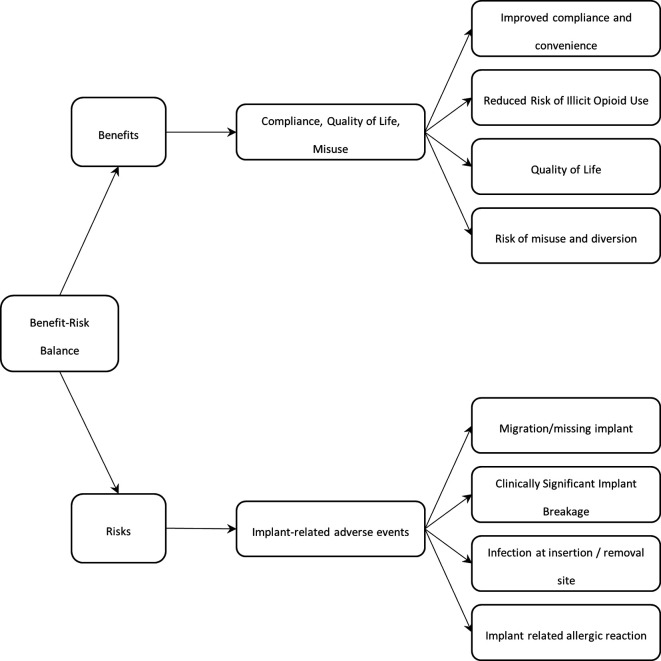
STUDY SELECTION/METHODS: A value tree of key benefits and risks related to the implant formulation of buprenorphine was constructed. Risk differences (RD) or reporting ORs (ROR) and corresponding 95% CIs were calculated for each outcome, along with the number needed to treat and number needed to harm. Swing weighting was assigned to outcomes and the weighted net clinical benefit (wNCB) was calculated.
Key benefits assessed: reduced risk of illicit opioid use (RD=0.09, 95% CI 0.01 to 0.17), reduced risk of misuse and diversion (ROR=0.13, 95% CI 0.02 to 0.94), improved compliance and convenience (RD=0.20) and quality of life measures (RD=0.03). Key risks assessed: clinically significant implant breakage (RD=0.01, 95% CI 0.00 to 0.01), migration/missing implant (RD=0.01, 95% CI 0.00 to 0.02), infection at insertion/removal site (RD=0.08, 95% CI 0.03 to 0.12) and implant-related allergic reaction (RD=0.07, 95% CI 0.03 to 0.11). The wNCB for buprenorphine implant was 4.96, which suggests a favourable benefit-risk profile.
The benefit-risk profile of buprenorphine implant is considered favourable in comparison to sublingual buprenorphine, based on this semiquantitative analysis using available data. Further data from real-world use on benefits and risks should be used for ongoing monitoring of the benefit-risk profile of buprenorphine implants in the postmarketing setting.
在欧盟批准之前,作为向欧洲药品管理局申请许可的一部分,需要进行系统的效益-风险评估,以比较丁丙诺啡植入剂与舌下丁丙诺啡。
使用效益-风险行动小组框架来描述丁丙诺啡植入剂相对于舌下丁丙诺啡的总体效益-风险。
研究选择/方法:构建了与丁丙诺啡植入剂配方相关的关键效益和风险的价值树。计算每个结局的风险差异(RD)或报告比值比(ROR)及相应的95%置信区间(CI),以及治疗所需人数和伤害所需人数。为结局分配摆动权重并计算加权净临床效益(wNCB)。
评估的关键效益:非法使用阿片类药物风险降低(RD = 0.09,95%CI 0.01至0.17),滥用和转移风险降低(ROR = 0.13,95%CI 0.02至0.94),依从性和便利性改善(RD = 0.20)以及生活质量指标改善(RD = 0.03)。评估的关键风险:具有临床意义的植入剂破损(RD = 0.01,95%CI 0.00至0.01),移位/植入剂丢失(RD = 0.01,95%CI 0.00至0.02),插入/取出部位感染(RD = 0.08,95%CI 0.03至0.12)以及与植入剂相关的过敏反应(RD = 0.07,95%CI 0.03至0.11)。丁丙诺啡植入剂的wNCB为4.96,这表明其效益-风险概况良好。
基于使用现有数据的这项半定量分析,与舌下丁丙诺啡相比,丁丙诺啡植入剂的效益-风险概况被认为是良好的。来自实际使用的关于效益和风险的进一步数据应用于在上市后环境中持续监测丁丙诺啡植入剂的效益-风险概况。