Gjerdrum Bjørn, Gundersen Kjell Gunnar, Lundmark Per Olof, Potvin Rick, Aakre Bente Monica
Department of Optometry, Radiography and Lighting Design, University of South-Eastern Norway, Kongsberg, Norway.
Ifocus Eye Clinic, Haugesund, Norway.
Clin Ophthalmol. 2020 Jan 28;14:269-279. doi: 10.2147/OPTH.S236749. eCollection 2020.
To compare the prevalence of dry eye disease (DED) as determined by signs and symptoms in patients with a history of laser vision correction (LVC) or implantable collamer lens (ICL) implantation 5-15 years ago with a matched control group with no history of refractive surgery.
This was a cross-sectional case-control study. The subject population included patients who had LVC or ICL 5 to 15 years ago. The control group was age matched. A test eye was randomly chosen. Subjects were required to have good ocular health. DED was evaluated using categorical cut-off criteria for tear film osmolarity (measured in both eyes), the subjective Ocular Surface Disease Index (OSDI), the dynamic Objective Scatter Index (OSI), non-invasive keratography tear break-up time (NIKBUT), meibography, and the Schirmer 1 test.
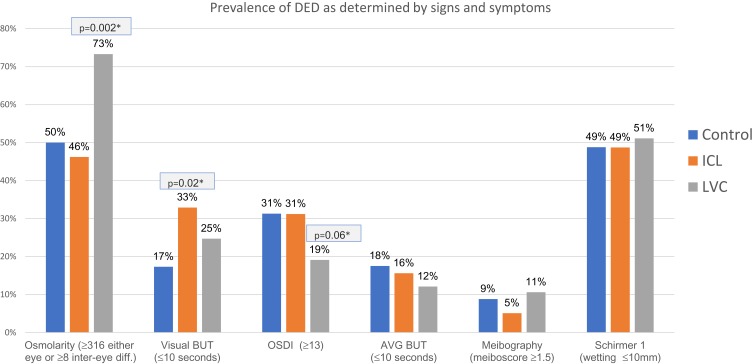
The study included 257 subjects (94 LVC, 80 ICL, 83 control). The frequency of hyperosmolarity was significantly higher in the LVC group vs the control (73% vs 50%, p = 0.002), In contrast, the frequency of subjective symptoms tended to be lower in the LVC group than in the control group (19% vs 31%; p = 0.06). These differences were not seen between the ICL and control group.
The results suggest that LVC may cause tear film instability as indicated by hyperosmolar tears up to 15 years after surgery, with few subjective symptoms of dry eye. This may have implications for IOL calculations for cataract or refractive lens exchange later in life.
比较5至15年前有激光视力矫正(LVC)或植入式角膜接触镜(ICL)植入史的患者与无屈光手术史的匹配对照组中,根据体征和症状确定的干眼症(DED)患病率。
这是一项横断面病例对照研究。研究对象包括5至15年前接受过LVC或ICL的患者。对照组年龄匹配。随机选择一只测试眼。受试者需有良好的眼部健康状况。使用泪膜渗透压(双眼测量)、主观眼表疾病指数(OSDI)、动态客观散射指数(OSI)、非侵入性角膜地形图泪膜破裂时间(NIKBUT)、睑板腺照相和Schirmer 1试验的分类截断标准评估干眼症。
该研究纳入了257名受试者(94名LVC患者、80名ICL患者、83名对照)。LVC组的高渗频率显著高于对照组(73%对50%,p = 0.002)。相比之下,LVC组的主观症状频率往往低于对照组(19%对31%;p = 0.06)。ICL组和对照组之间未观察到这些差异。
结果表明,LVC可能导致泪膜不稳定,如术后15年内高渗性眼泪所示,且干眼症主观症状较少。这可能对晚年白内障或屈光性晶状体置换的人工晶状体计算有影响。