Al-Masri Abeer A, Habib Syed Shahid, Hersi Ahmad, Al Zamil Hana
Department of Physiology, College of Medicine, King Khalid University Hospital, King Saud University, Riyadh, Saudi Arabia.
Department of Cardiac Sciences, College of Medicine, King Khalid University Hospital, King Saud University, Riyadh, Saudi Arabia.
Int J Vasc Med. 2020 Feb 11;2020:4981092. doi: 10.1155/2020/4981092. eCollection 2020.
Coagulation mechanisms and fibrinolytic assembly are important components role players of acute myocardial infarction (AMI) progression. Our study objective was to see the serial variations in the levels of Von Willebrand factor (VWF) and A Disintegrin and Metalloprotease with ThromboSpondin motif (ADAMTS13) over the course of AMI and to determine their relationship with the cardiovascular risk markers and the patient's clinical characteristics.
This project was done at the departments of Emergency Medicine, Physiology and Cardiac sciences of King Saud University Medical City. We studied ADAMTS13, VWF, fibrinogen, and CRP levels in 80 patients with AMI when patients were admitted; post AMI by 3-4 days and at follow-up of 3 months. We compared them with a control group consisting of 36 subjects.
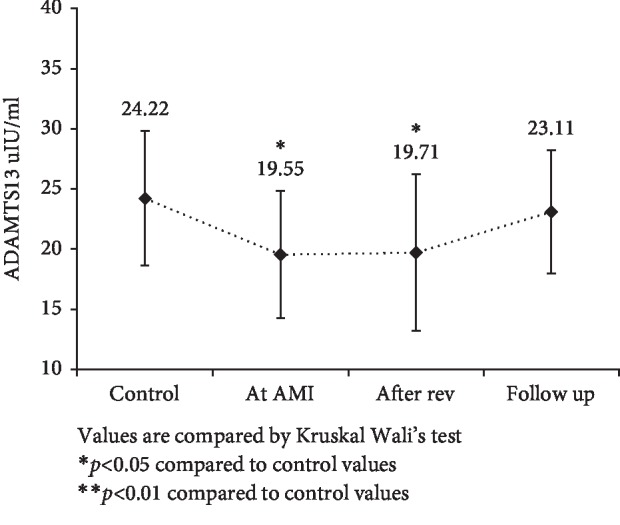
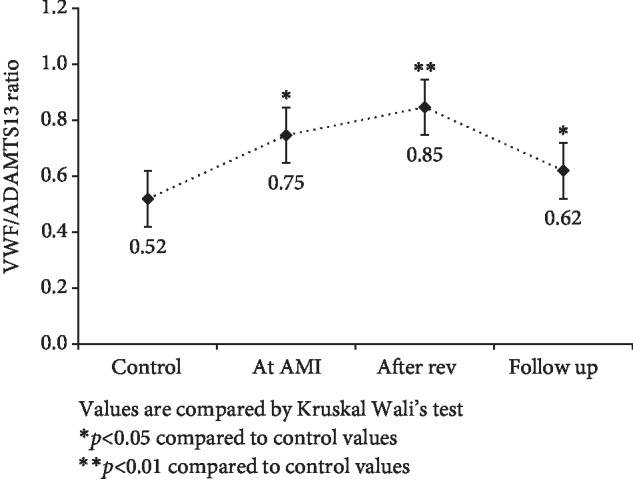
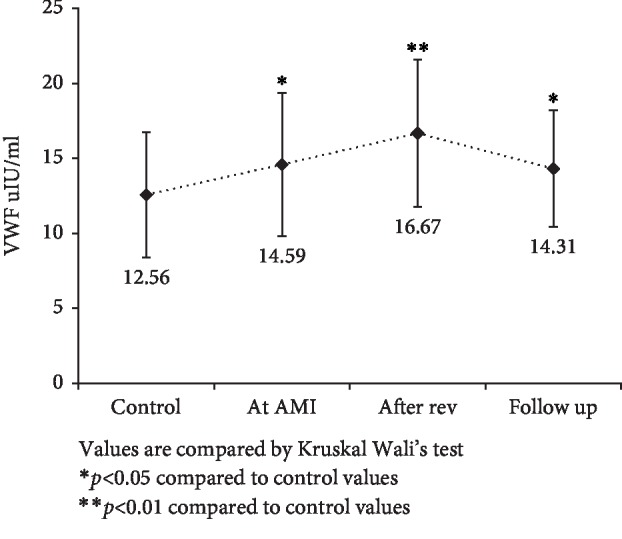
AMI had significantly lower levels of ADAMTS13 at AMI and after 3-4 days; at follow-up the difference in levels was nonsignificant, when compared with controls. Similarly, VWF levels were significantly higher in AMI and remained high even at follow-up compared to control subjects. VWF/ADAMTS13 ratio was also significantly higher at AMI and 3-4 days while at follow-up difference was nonsignificant compared to control subjects. Regression analysis between hsCRP and ADAMTS13 showed an inverse relationship ( = 0.376, < 0.01), while correlation with VWF was significantly positive ( = 0.376, < 0.01), while correlation with VWF was significantly positive (.
Increased levels of VWF and reduced levels of ADAMTS13 activity may contribute to the pathogenesis of acute myocardial infarction and might prove to be important mediators of AMI progression.
凝血机制和纤溶组装是急性心肌梗死(AMI)进展的重要组成部分和作用因素。我们的研究目的是观察急性心肌梗死病程中血管性血友病因子(VWF)和含血小板反应蛋白基序的解聚素和金属蛋白酶(ADAMTS13)水平的系列变化,并确定它们与心血管风险标志物及患者临床特征的关系。
本项目在沙特国王大学医学城的急诊医学、生理学和心脏科学系进行。我们研究了80例急性心肌梗死患者入院时、急性心肌梗死后3 - 4天以及3个月随访时的ADAMTS13、VWF、纤维蛋白原和CRP水平。我们将他们与由36名受试者组成的对照组进行比较。
与对照组相比,急性心肌梗死患者在急性心肌梗死时及3 - 4天后ADAMTS13水平显著降低;随访时水平差异无统计学意义。同样,急性心肌梗死患者的VWF水平显著高于对照组,甚至在随访时仍保持较高水平。急性心肌梗死时及3 - 4天时VWF/ADAMTS13比值也显著高于对照组,而随访时与对照组相比差异无统计学意义。hsCRP与ADAMTS13之间的回归分析显示呈负相关(= 0.376,< 0.01),而与VWF呈显著正相关(= 0.376,< 0.01),与VWF呈显著正相关(。
VWF水平升高和ADAMTS13活性降低可能有助于急性心肌梗死的发病机制,可能是急性心肌梗死进展的重要介质。