Appelt Ane L, Kerkhof Ellen M, Nyvang Lars, Harderwijk Ernst C, Abbott Natalie L, Teo Mark, Peters Femke P, Kronborg Camilla J S, Spindler Karen-Lise G, Sebag-Montefiore David, Marijnen Corrie A M
Leeds Institute of Medical Research at St James's, University of Leeds and Leeds Cancer Centre, St James's University Hospital, Leeds, UK.
Department of Radiotherapy, Leiden University Medical Center, Leiden, the Netherlands.
Tech Innov Patient Support Radiat Oncol. 2019 Oct 15;11:14-21. doi: 10.1016/j.tipsro.2019.09.001. eCollection 2019 Sep.
Organ preservation strategies are increasingly being explored for early rectal cancer. This requires revision of target volumes according to disease stage, as well as new guidelines for treatment planning. We conducted an international, multicentre dose planning study to develop robust planning objectives for modern radiotherapy of a novel mesorectal-only target volume, as implemented in the STAR-TReC trial (NCT02945566).
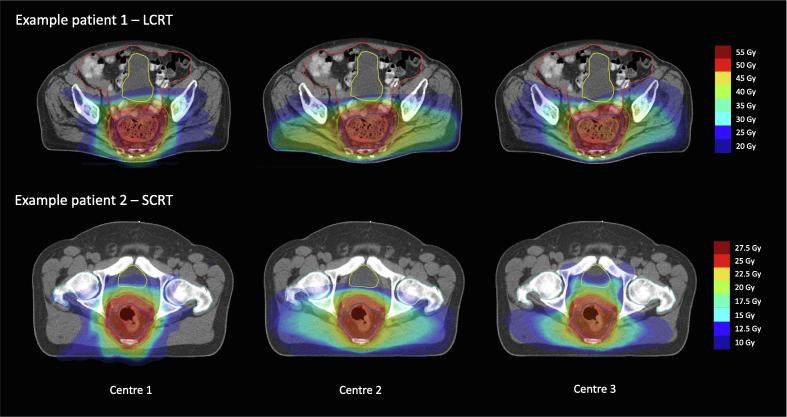
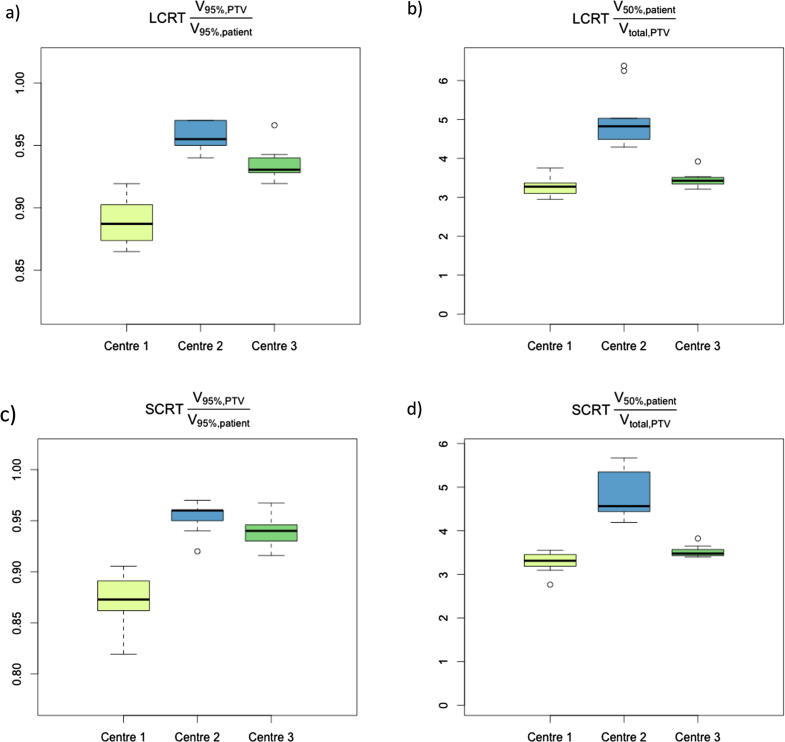
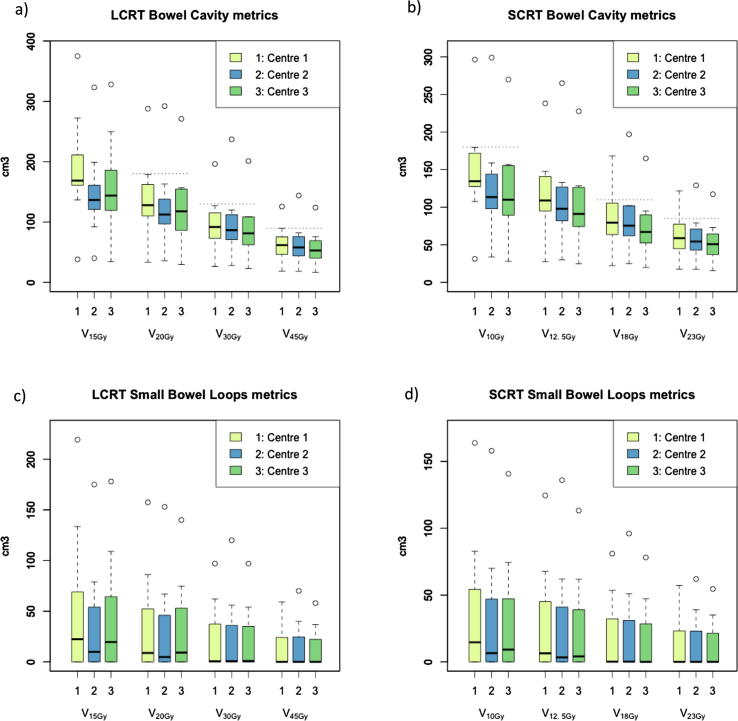
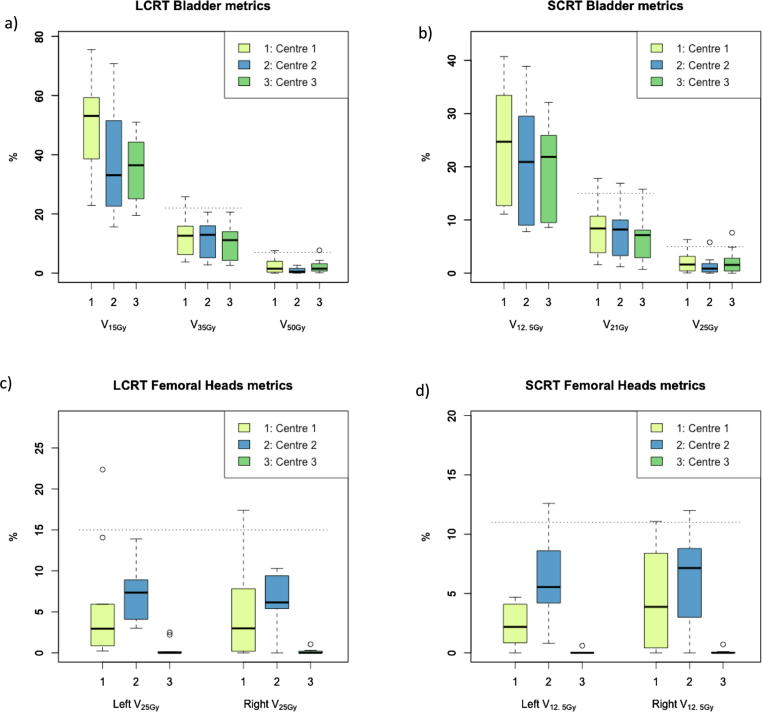
The published literature was used to establish relevant dose levels for organ at risk (OAR) plan optimisation. Ten representative patients with early rectal cancer were identified. Treatment scans had mesorectal target volumes as well as bowel cavity, bladder and femoral heads outlined, and were circulated amongst the three participating institutions. Each institution produced plans for short course (SCRT, 5 × 5 Gy) and long course (LCRT, 25 × 2 Gy) treatment, using volumetric modulated arc therapy on different dose planning systems. Optimisation objectives for OARs were established by determining dose metric objectives achievable for ≥90% of plans.
Sixty plans, all fulfilling target coverage criteria, were produced. The planning results and literature review suggested optimisation objectives for SCRT: < 180 cm, < 110 cm, < 85 cm for bowel cavity; < 15% and < 5% for bladder; and < 11% for femoral heads. Corresponding objectives for LCRT: < 180 cm, < 130 cm, < 90 cm for bowel cavity; < 22% and < 7% for bladder; and < 15% for femoral heads. Constraints were validated across all three institutions.
We utilized a multicentre planning study approach to develop robust planning objectives for mesorectal radiotherapy for early rectal cancer.
针对早期直肠癌,人们越来越多地探索器官保留策略。这需要根据疾病分期修订靶区体积,并制定新的治疗计划指南。我们开展了一项国际多中心剂量计划研究,旨在为在STAR-TReC试验(NCT02945566)中实施的仅针对新的直肠系膜靶区体积的现代放射治疗制定可靠的计划目标。
利用已发表的文献确定危及器官(OAR)计划优化的相关剂量水平。确定了10例早期直肠癌代表性患者。治疗扫描勾勒出直肠系膜靶区体积以及肠腔、膀胱和股骨头,扫描结果在三个参与机构之间传阅。每个机构使用不同的剂量计划系统,通过容积调强弧形放疗制定短程(SCRT,5×5 Gy)和长程(LCRT,25×2 Gy)治疗计划。通过确定≥90%的计划可实现的剂量指标目标,建立OAR的优化目标。
共制定了60个均满足靶区覆盖标准的计划。计划结果和文献综述表明,SCRT的优化目标为:肠腔V180<180 cm³,V110<110 cm³,V85<85 cm³;膀胱V15<15%且V5<5%;股骨头V11<11%。LCRT的相应目标为:肠腔V180<180 cm³,V130<130 cm³,V90<90 cm³;膀胱V22<22%且V7<7%;股骨头V15<15%。所有三个机构均验证了这些限制条件。
我们采用多中心计划研究方法,为早期直肠癌的直肠系膜放疗制定了可靠的计划目标。