Franssen Frits, Takumi Katsuhisa, van der Giessen Joke, Swart Arno
National Institute for Public Health and the Environment (RIVM), Bilthoven, The Netherlands.
Food Waterborne Parasitol. 2018 Apr 19;10:14-22. doi: 10.1016/j.fawpar.2018.04.003. eCollection 2018 Mar.
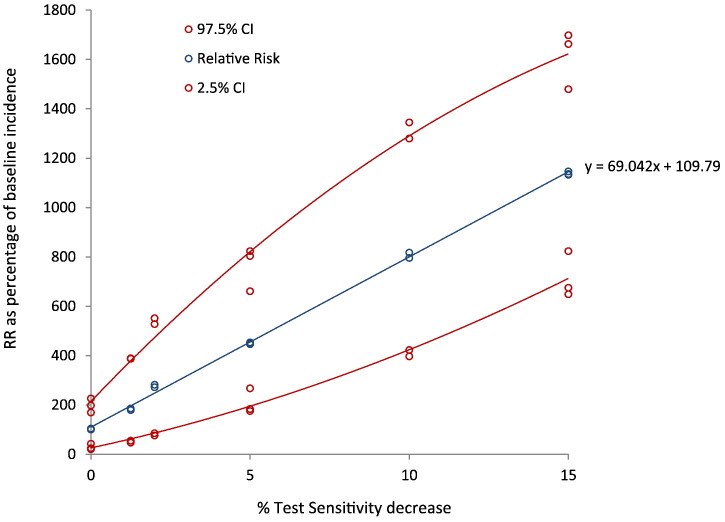
To support risk-based approach to prevent human trichinellosis, we estimated the human incidence for pigs originating from controlled and non-controlled housing, using a quantitative microbial risk assessment model for (QMRA-T). Moreover, the effect of test sensitivity on human trichinellosis incidence from pigs from non-controlled housing was quantified. The estimated annual risk from pigs from non-controlled housing was 59,443 human trichinellosis cases without testing at meat inspection and 832 (95%CI 346-1410) cases with testing, thus preventing 98.6% of trichinellosis cases per year by testing at meat inspection. Using the QMRA-T, a slight decrease in test sensitivity had a significant effect on the number of human trichinellosis cases from this housing type. The estimated annual risk for pigs from controlled housing was <0.002 (range 0.000-0.007) human cases with- and <0.010 (0.001-0.023) cases without testing at meat inspection, which does not differ significantly ( = 0.2075). In practice, this means no cases per year irrespective of testing. Thus controlled housing effectively prevents infection and testing does not contribute to food safety for this housing type. Not testing for requires evidence based full compliance with regulations for controlled housing.
为支持基于风险的方法来预防人类旋毛虫病,我们使用定量微生物风险评估模型(QMRA-T)估算了来自受控和非受控猪舍的猪的人类感染率。此外,还量化了检测灵敏度对来自非受控猪舍的猪导致人类旋毛虫病感染率的影响。来自非受控猪舍的猪的估计年度风险是,在肉类检验时不进行检测的情况下有59443例人类旋毛虫病病例,进行检测时有832例(95%置信区间346 - 1410)病例,因此通过肉类检验时的检测每年可预防98.6%的旋毛虫病病例。使用QMRA-T模型,检测灵敏度的轻微下降对这种猪舍类型导致的人类旋毛虫病病例数有显著影响。来自受控猪舍的猪的估计年度风险是,在肉类检验时进行检测的情况下人类病例数<0.002(范围0.000 - 0.007),不进行检测的情况下<0.010(0.001 - 0.023)例,两者无显著差异(P = 0.2075)。在实际中,这意味着无论是否进行检测每年都无病例。因此,受控猪舍能有效预防感染,并且对于这种猪舍类型,检测对食品安全没有贡献。不进行旋毛虫检测需要有基于证据的对受控猪舍法规的完全遵守。