Pietraszewska-Bogiel Anna, Joosen Linda, Chertkova Anna O, Goedhart Joachim
Section of Molecular Cytology and van Leeuwenhoek Centre for Advanced Microscopy, Swammerdam Institute for Life Sciences, University of Amsterdam, P.O. Box 94215, 1090 GE Amsterdam, The Netherlands.
ACS Omega. 2020 Feb 3;5(6):2648-2659. doi: 10.1021/acsomega.9b03146. eCollection 2020 Feb 18.
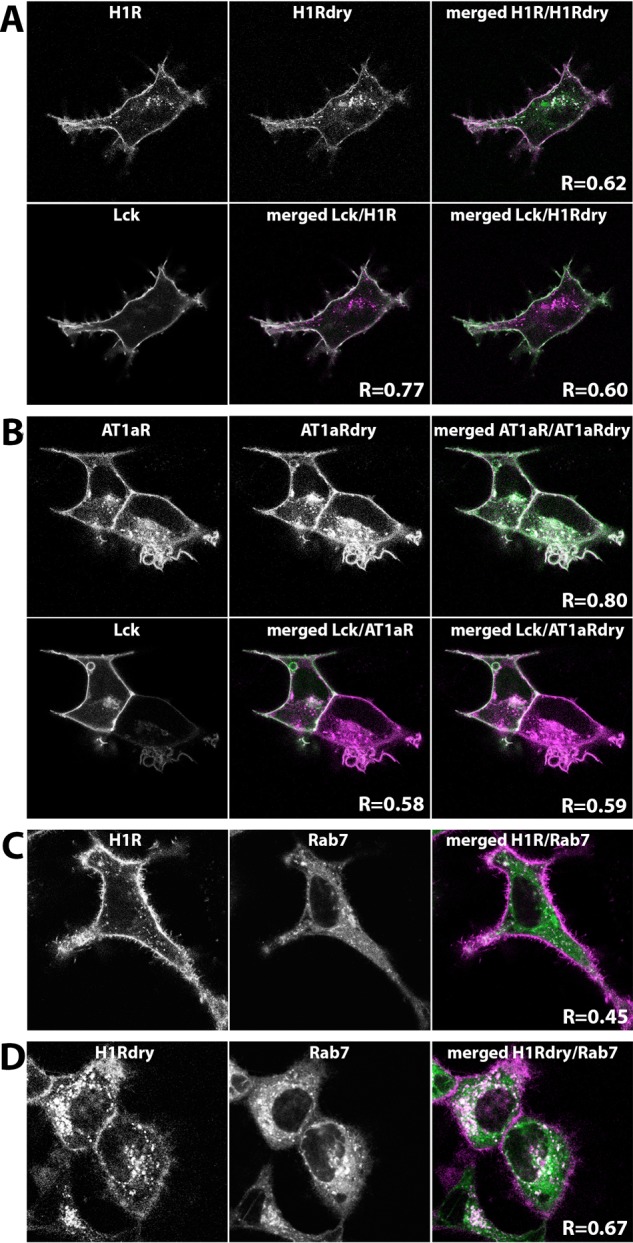
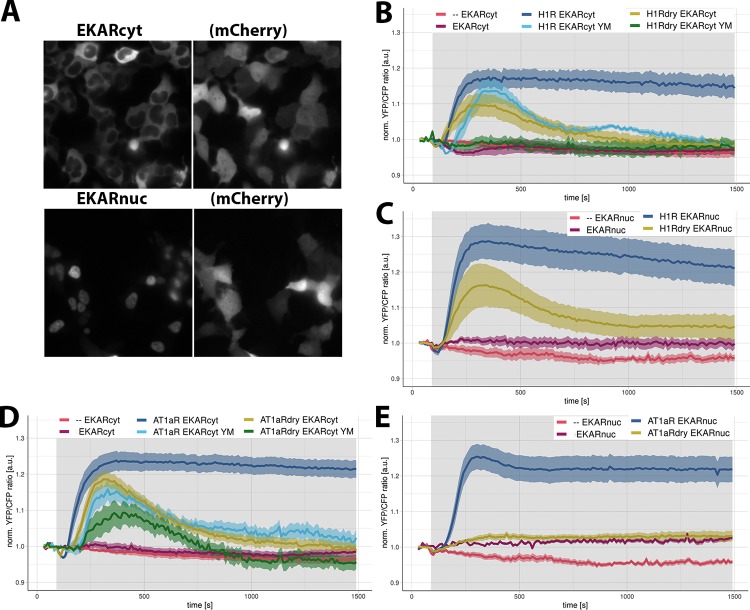
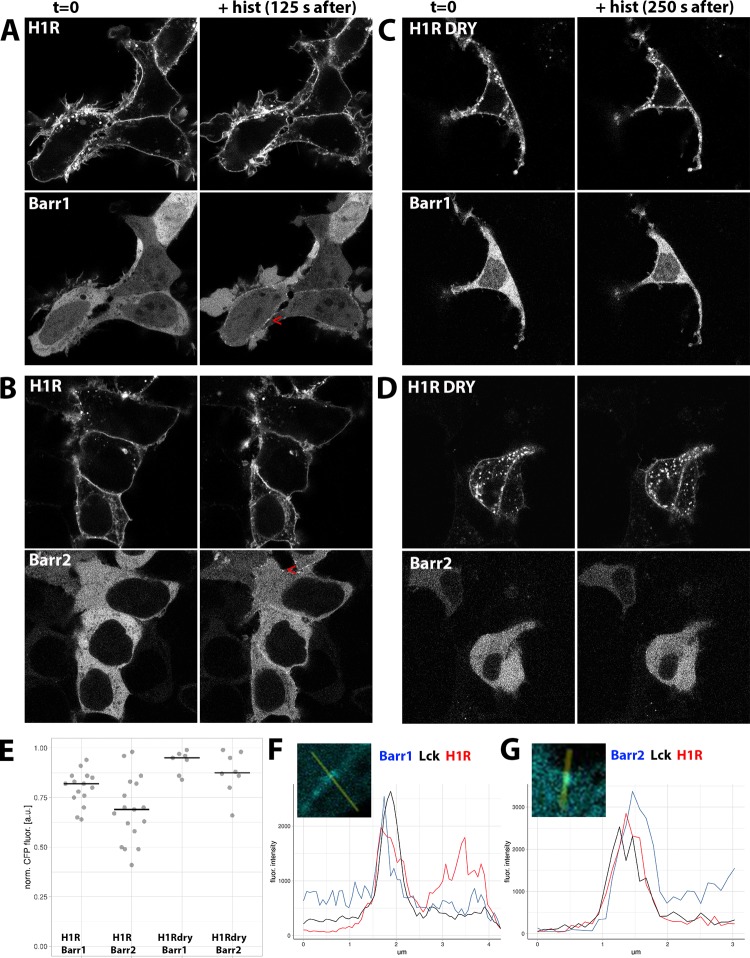
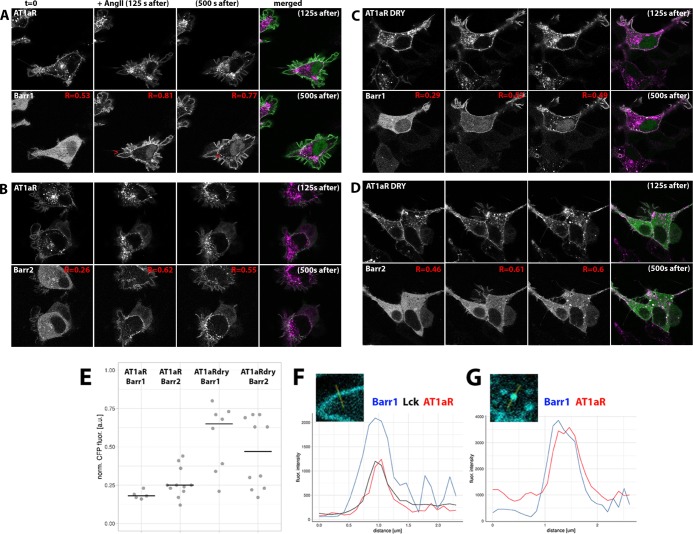
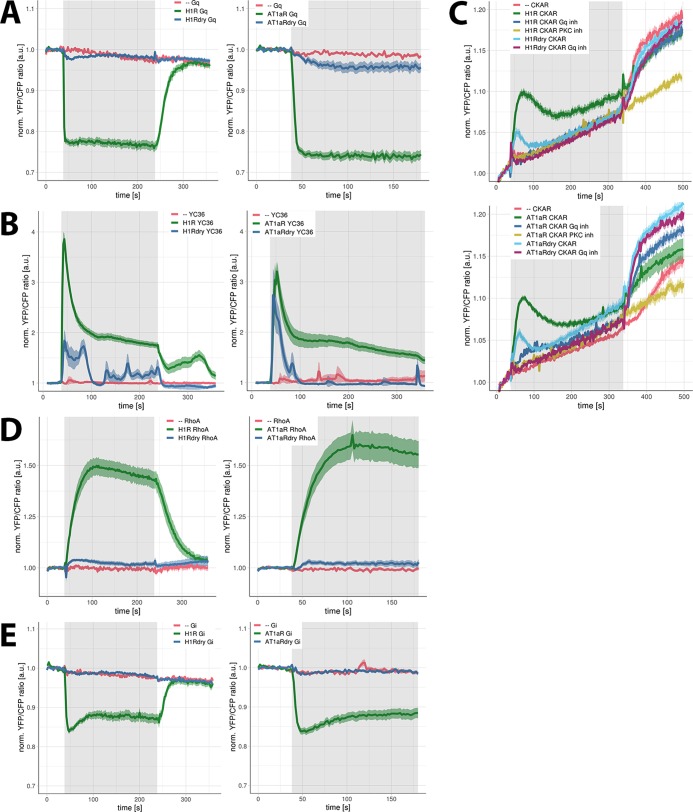
G-protein-coupled receptors (GPCRs) are seven transmembrane spanning receptors that regulate a wide array of intracellular signaling cascades in response to various stimuli. To do so, they couple to different heterotrimeric G proteins and adaptor proteins, including arrestins. Importantly, arrestins were shown to regulate GPCR signaling through G proteins, as well as promote G protein-independent signaling events. Several research groups have reported successful isolation of exclusively G protein-dependent and arrestin-dependent signaling downstream of GPCR activation using biased agonists or receptor mutants incapable of coupling to either arrestins or G proteins. In the latter category, the DRY mutant of the angiotensin II type 1 receptor was extensively used to characterize the functional selectivity downstream of AT1R. In an attempt to understand histamine 1 receptor signaling, we characterized the signaling capacity of the H1R DRY mutant in a panel of dynamic, live cell biosensor assays, including arrestin recruitment, heterotrimeric G protein activation, Ca signaling, protein kinase C activity, GTP binding of RhoA, and activation of ERK1/2. Here, we show that both H1R DRY mutant and the AT1R DRY mutant are capable of efficient activation of G protein-mediated signaling. Therefore, contrary to the common belief, they do not constitute suitable tools for the dissection of the arrestin-mediated, G protein-independent signaling downstream of these receptors.
G蛋白偶联受体(GPCRs)是具有七个跨膜结构域的受体,可响应各种刺激调节一系列细胞内信号级联反应。为此,它们与不同的异源三聚体G蛋白和衔接蛋白(包括抑制蛋白)偶联。重要的是,抑制蛋白已被证明可通过G蛋白调节GPCR信号传导,并促进不依赖G蛋白的信号传导事件。几个研究小组报告称,使用偏向性激动剂或无法与抑制蛋白或G蛋白偶联的受体突变体,成功分离出了GPCR激活下游仅依赖G蛋白和依赖抑制蛋白的信号传导。在后一类中,血管紧张素II 1型受体的DRY突变体被广泛用于表征AT1R下游的功能选择性。为了试图了解组胺1受体信号传导,我们在一组动态的活细胞生物传感器分析中,包括抑制蛋白募集、异源三聚体G蛋白激活、Ca信号传导、蛋白激酶C活性、RhoA的GTP结合以及ERK1/2的激活,对H1R DRY突变体的信号传导能力进行了表征。在此,我们表明H1R DRY突变体和AT1R DRY突变体都能够有效激活G蛋白介导的信号传导。因此,与普遍看法相反,它们并不是剖析这些受体下游抑制蛋白介导的、不依赖G蛋白的信号传导的合适工具。